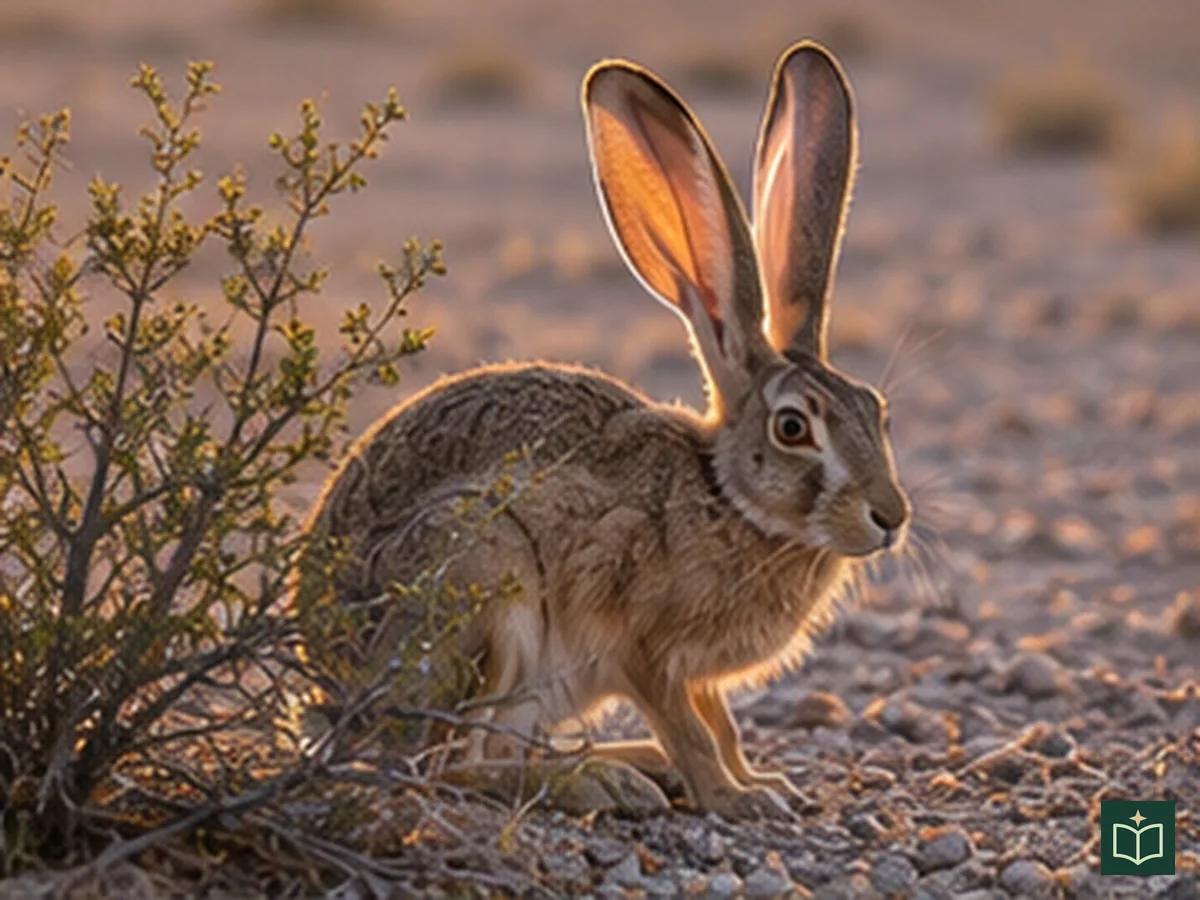
Close cousins, not the same animal
Rabbits and hares belong to the same family, the Leporidae, along with the cottontails of the Americas. They look alike at a glance: long ears, powerful back legs, a short tail and a habit of eating grass. Yet they are separate groups, and they cannot interbreed. True hares belong to the genus Lepus, which includes the European brown hare, the snowshoe hare and the jackrabbits of North America, whose name is misleading because they are hares. The European rabbit, ancestor of every domestic pet rabbit, belongs to a different genus. The clearest way to tell the two groups apart is not their size or colour but the state of their young at birth.
The decisive difference at birth
A newborn hare, called a leveret, arrives fully furred, with its eyes open and able to move within minutes. Biologists call this precocial. The mother gives birth in a shallow scrape on the open ground, called a form, and leaves the leverets alone for most of the day, returning briefly to feed them, often around dusk. A newborn rabbit, called a kit or kitten, is altricial: hairless, blind and deaf, and helpless for its first days. The mother rabbit gives birth in a burrow lined with grass and fur pulled from her own body. The kits' eyes open after about ten days, and they stay below ground until they can fend for themselves.
How the strategy shapes the body
Everything else follows from that choice. A hare has no burrow to escape into, so it must outrun predators across open country. It has longer hind legs, a leaner build and a larger heart for its size, and the European brown hare can reach about 70 km/h in short bursts. Its long ears help it hear danger early and, in hot places, shed body heat. A rabbit's defence is to bolt for the nearest hole. It is built for quick sprints and sharp turns over short distances rather than long chases. Its compact body, shorter ears and shorter legs suit tunnels, where a lanky frame would be a handicap.
Hares of the Arabian desert
The UAE has no native wild rabbits, but it does have hares. The Cape hare, sometimes described as the Arabian hare in the Gulf, lives in the gravel plains, dunes and wadis of the region. It shows the hare strategy in a harsh setting. It shelters in shallow scrapes beneath shrubs during the heat of the day and feeds at night, when the air is cooler. Its ears are large relative to its head, a feature common among desert hares, which helps it lose heat through the thin skin. Its young are born in the open, ready to crouch motionless and rely on camouflage before they are strong enough to run.
Solitary runners, social diggers
Their social lives differ as well. Most hares are largely solitary, gathering only loosely to feed or breed. The famous spring 'boxing' of brown hares was long thought to be rival males fighting, but it is usually a female fending off an overeager male. European rabbits, by contrast, often live in warrens, networks of burrows that can house many animals with a clear social order. That difference also explains domestication. Rabbits, used to crowding into tunnels, adapted to hutches and were kept by people for meat and fur for centuries. Hares, nervous and built to flee across open land, have never been truly domesticated.
Mix-ups and why they matter
Common names cause much of the confusion. The jackrabbit is a hare, while the Belgian hare is a breed of domestic rabbit. In folklore and children's stories the two are often used interchangeably, from the Easter hare of German tradition, later transformed into the Easter bunny, to the tortoise's rival in Aesop's fable. For conservation the distinction matters, because the two face different threats. Hares suffer when open farmland is ploughed or mown during the breeding season, because their exposed leverets cannot escape machinery. Rabbits are more vulnerable to diseases that spread quickly through crowded warrens. Knowing which animal is which helps explain why their populations rise and fall differently.
Sources & further reading
Figures are rounded and widely published; check the linked organisations for the latest editions. These organisations do not endorse this website.