Three families of ceramics
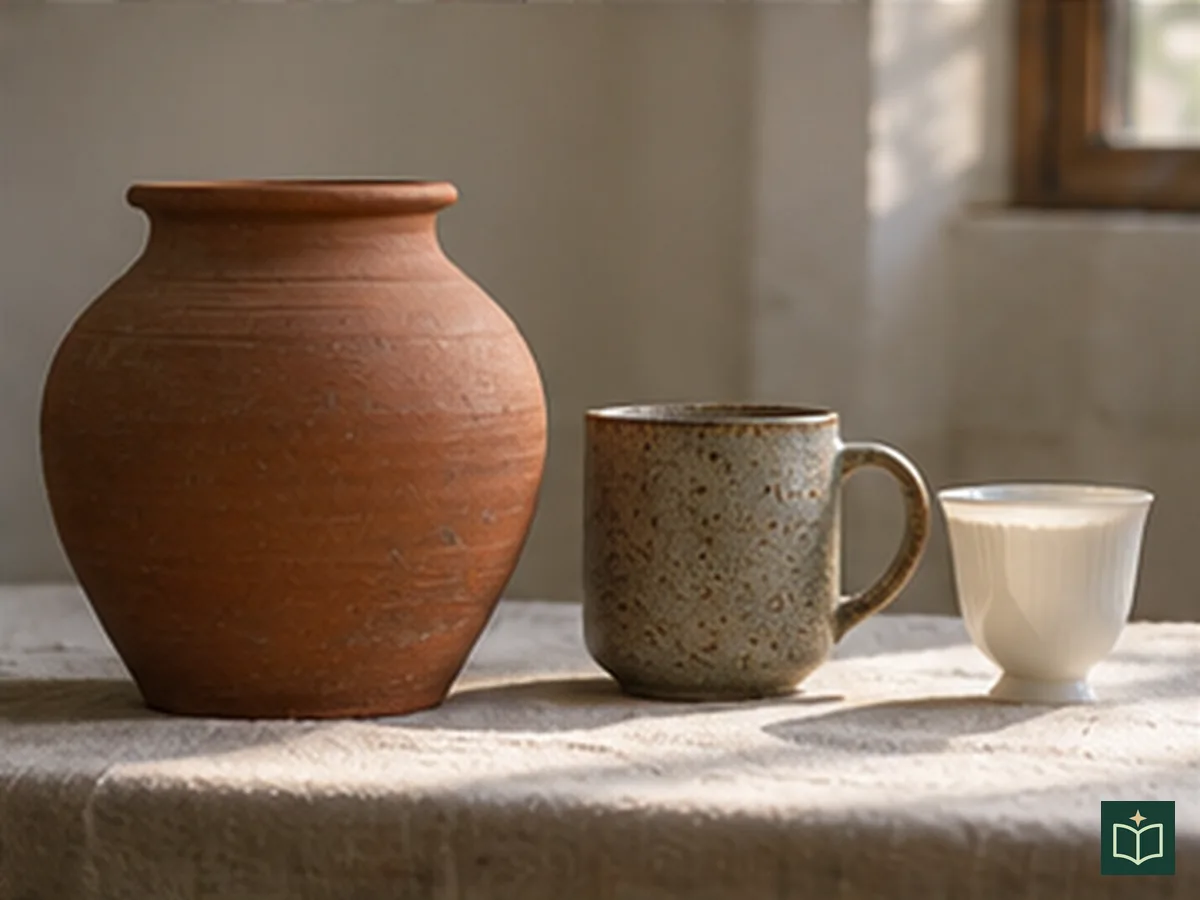
Almost every plate, mug, flowerpot and bathroom tile belongs to one of three families of fired clay. Earthenware is the oldest and most widespread: rustic, often reddish or buff, and slightly porous. Stoneware is denser, heavier and watertight, the material of many everyday mugs and oven dishes. Porcelain is the finest: white, hard, smooth and, when thin, translucent enough to let light glow through it. The differences come from two things. One is the type of clay and minerals used. The other is how hot the kiln gets. Together they decide how much of the clay melts and fuses during firing, a process known as vitrification.
What happens in the kiln
Raw clay is made of microscopic flat mineral particles mixed with water. When it is heated, the water is driven off, and above roughly 600°C the clay's structure changes permanently, so it can no longer be softened with water. As the temperature climbs further, minerals called fluxes begin to melt, forming glass that flows between the remaining particles and binds them. At lower temperatures only a little glass forms and tiny pores remain, so the body stays absorbent. At higher temperatures more glass fills the gaps until the body is dense and non-porous. Potters measure this by water absorption: earthenware may soak up several per cent of its weight, porcelain almost nothing.
Earthenware
Earthenware is fired at roughly 1,000 to 1,150°C, using common clays that often contain iron, which gives the familiar terracotta colour. Because it remains porous, unglazed earthenware lets water seep through slowly. That is a virtue in traditional water jars across the Middle East and South Asia, where evaporation through the walls keeps water cool, a principle long used in Gulf households before refrigeration. Glazed earthenware, such as decorative majolica or many patterned plates, is sealed on the surface. Its weaknesses are softness and fragility: it chips easily, and if the glaze cracks, water can enter the body. It is cheap to make, however, and easy to shape and decorate.
Stoneware
Stoneware is fired hotter, typically around 1,200 to 1,300°C, using clays that can withstand that heat without slumping. Much more of the body vitrifies, so stoneware is strong, chip-resistant and watertight even without glaze. Its colours range from grey and buff to brown, often speckled where iron in the clay reacts in the kiln. Stoneware has been made in China for well over two thousand years and was developed independently in Germany in the Middle Ages, where salt-glazed jugs became a major export. Today it is popular for everyday tableware and bakeware because it tolerates oven heat, dishwashers and daily knocks, though it is heavier and more opaque than porcelain.
Porcelain
Porcelain relies on kaolin, a pure white clay, mixed with minerals such as feldspar and quartz, fired at about 1,200 to 1,400°C. The result is a hard, dense, white body that rings when tapped and transmits light when thin. Chinese potters perfected it, and by the Tang and Song dynasties it was being traded far along maritime routes, including through Gulf ports; fragments of Chinese ceramics are found at archaeological sites in the UAE. European makers struggled for centuries to copy it, until the Meissen factory in Saxony succeeded around 1710. Bone china, developed in England, adds bone ash to produce a very white, strong and translucent variant.
Choosing and caring
For practical use, the categories overlap more than labels suggest, because manufacturers adjust recipes and temperatures. A few rules hold. Earthenware is best for decorative pieces, plant pots and gentle use, and unglazed pieces should not be soaked in detergent, which the pores absorb. Stoneware is the workhorse for daily cooking and serving. Porcelain combines strength with thinness, which is why it is used for fine tableware, laboratory crucibles and electrical insulators. Sudden temperature changes can crack any ceramic, so a cold dish should not go straight into a hot oven. When in doubt, the maker's markings for oven, microwave and dishwasher use are the best guide.
Sources & further reading
Figures are rounded and widely published; check the linked organisations for the latest editions. These organisations do not endorse this website.