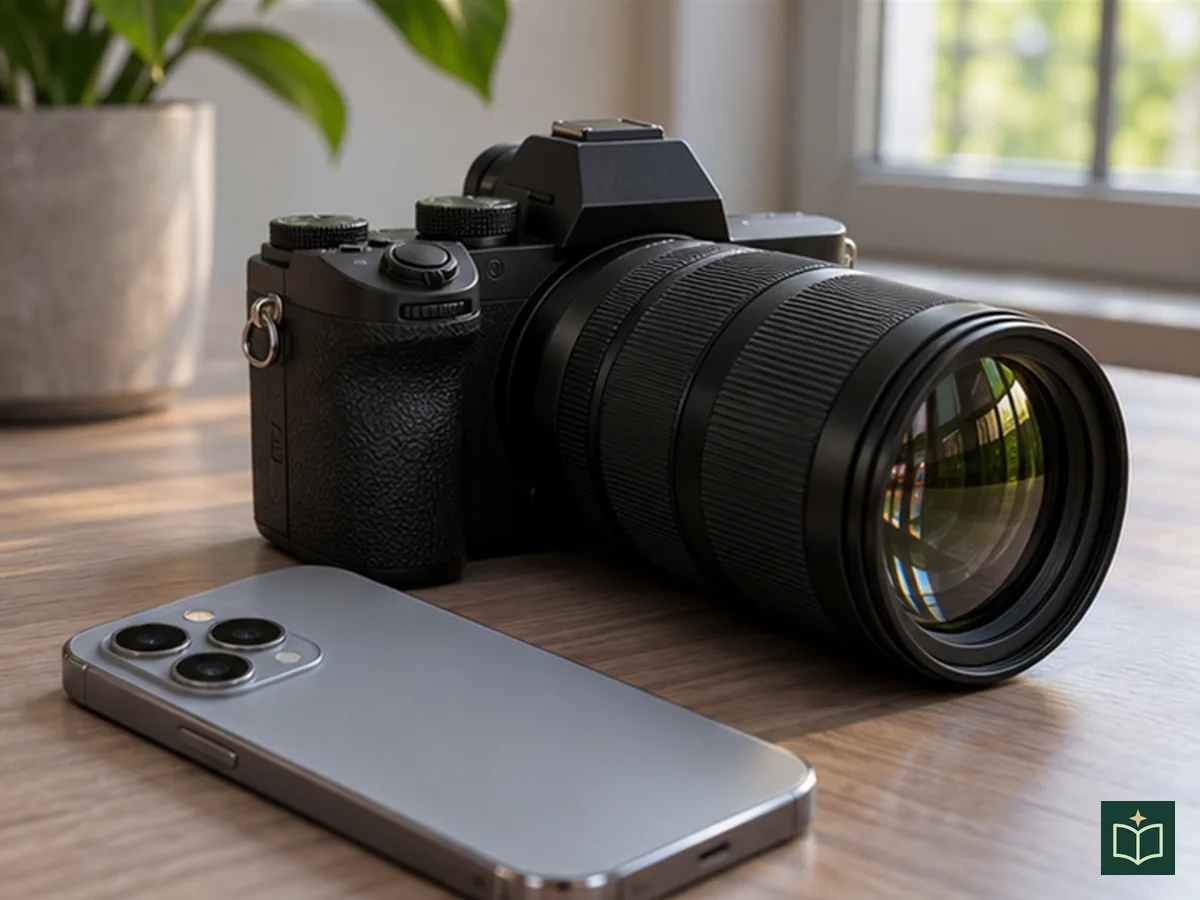
Two ways to get closer
Zooming makes a distant subject fill more of the frame, but there are two fundamentally different ways to do it. Optical zoom uses the lens. Glass elements inside move relative to each other, lengthening the focal length so that a narrower slice of the scene is projected across the whole sensor. Every pixel is still used, so the magnified image carries genuine extra detail. Digital zoom uses software. The camera takes the normal image, cuts out the central portion and enlarges it to fill the frame. No new information is captured; existing pixels are stretched and the gaps filled by calculation, which softens fine detail and magnifies noise.
Focal length and zoom ratios
Lenses are described by focal length, measured in millimetres. A short focal length gives a wide view; a long one gives a narrow, magnified view. A zoom lens covers a range, and its zoom ratio is simply the longest focal length divided by the shortest. A lens running from 24 millimetres to 240 millimetres is therefore a 10x zoom. Phone makers usually quote focal lengths as '35mm equivalents', comparing them with a traditional full-frame camera, because their tiny sensors make the true figures misleadingly small. When a phone advertises a 5x telephoto, it usually means five times the focal length of its main camera, not five times a fixed reference.
What cropping costs
The cost of digital zoom is easy to calculate. Zooming in by a factor of two halves both the width and height of the area used, leaving only a quarter of the original pixels. A 12-megapixel photo zoomed digitally to 2x is really a 3-megapixel image enlarged back to full size. At 4x, only one sixteenth of the pixels remain. That is why digital zoom shots often look smudgy, especially in low light, when noise is already high. Cropping a photo afterwards on a computer has exactly the same effect, which is why many photographers prefer to shoot at the widest setting and crop later, keeping their options open.
How phones changed the picture
Phones are too thin for a long sliding zoom lens, so manufacturers use several fixed lenses instead: typically an ultra-wide, a main camera and one or more telephotos. Switching between them gives true optical steps. Some phones fold the light path sideways with a prism, a periscope design, to fit a longer telephoto into a slim body. Between those steps, the phone uses digital zoom, but with tricks. Many main sensors now have 48 megapixels or more, so cropping the centre still leaves around 12 megapixels at 2x, close to optical quality. Software also merges several rapid frames to recover detail, a technique often marketed as hybrid or super-resolution zoom.
Limits of optical zoom
Optical zoom is not perfect either. Long focal lengths magnify camera shake along with the subject, so stabilisation becomes essential and blur appears faster in dim light. Telephoto lenses on phones usually have smaller apertures and smaller sensors than the main camera, so in a dark restaurant the phone may quietly switch back to the main lens and crop instead. Very long zooms also flatten perspective and are sensitive to heat haze, which can soften distant shots of skylines or desert landscapes on hot afternoons. In other words, the label on the button does not always describe which lens is actually being used to take the photograph.
Getting better results
For the sharpest pictures, use the native focal lengths of the camera, shown on many phones as 0.5x, 1x, 3x or 5x buttons, rather than pinching to an in-between value. Move closer to the subject on foot when possible; it is free and adds real detail. Steady the camera on a wall or rail for telephoto shots, and give it plenty of light. Treat very high zoom settings, such as 30x or 100x on some phones, as useful for reading a distant sign rather than for a print. Understanding the difference between optical and digital zoom turns marketing numbers into practical choices about which lens to use.
Sources & further reading
Figures are rounded and widely published; check the linked organisations for the latest editions. These organisations do not endorse this website.