How the list is drawn
Tunnels can be ranked in several ways, so this table sets clear limits. It includes railway and road tunnels now in service and measures each single bore from portal to portal. It leaves out metro lines, which can run underground for much longer distances but are built as chains of stations rather than single crossings. It also leaves out water-supply tunnels, such as the Delaware Aqueduct, which carries New York’s water through about 137 kilometres of rock. Tunnels still under construction, such as the Brenner Base Tunnel between Austria and Italy, are excluded until they open. Within those limits, rail tunnels dominate, because trains handle long dark journeys far better than drivers.
The Gotthard record
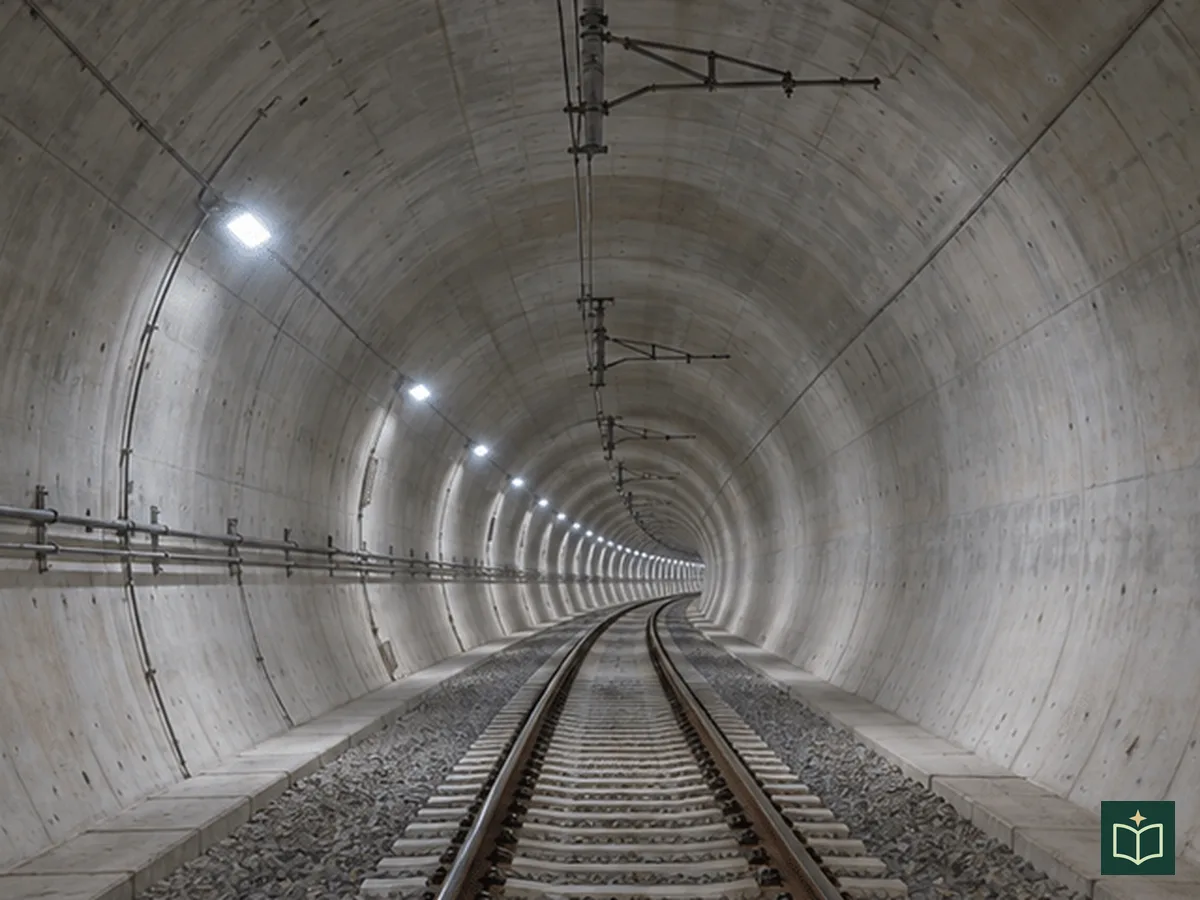
The Gotthard Base Tunnel runs about 57 kilometres beneath the Swiss Alps between Erstfeld and Bodio. It opened in 2016 after some seventeen years of construction and consists of two parallel single-track tubes linked by cross passages. Its purpose is to flatten the route: earlier lines climbed to about 1,100 metres through spiral tunnels, while the base tunnel stays below about 550 metres. That allows heavy freight trains to cross the Alps without extra locomotives and passenger trains to run at up to about 200 kilometres per hour. Combined with the shorter Ceneri Base Tunnel, it forms a flat rail route through the mountains between northern and southern Europe.
Under the sea
Second and third places are both undersea tunnels. Japan’s Seikan Tunnel, about 54 kilometres long, opened in 1988 and links the islands of Honshu and Hokkaido beneath the Tsugaru Strait; it was the world’s longest for nearly three decades. The Channel Tunnel, about 50 kilometres long, opened in 1994 and carries passenger and freight trains between Folkestone and Coquelles near Calais. About 38 kilometres of it lie beneath the sea, the longest undersea section of any tunnel. South Korea’s Yulhyeon Tunnel, a high-speed rail tunnel south of Seoul opened in 2016, is almost exactly the same length as the Channel Tunnel, and lists sometimes reverse the two.
Comparing the numbers
The gap between first and fifth is large. The Gotthard tunnel is about 22.5 kilometres longer than the Lötschberg Base Tunnel, its Swiss neighbour, which opened in 2007 at about 35 kilometres. Further down, lengths bunch together: Austria’s Koralm Tunnel and China’s New Guanjiao Tunnel are both about 33 kilometres, and the next three are all about 28 kilometres. China’s rapid expansion of high-speed and mountain railways has added dozens of tunnels longer than 20 kilometres since 2000, and more are under construction. The order in the lower places can therefore shift as new tunnels open, so the figures here are rounded to the nearest kilometre.
The longest road tunnel
No road tunnel makes the overall top ten. The longest is Norway’s Lærdal Tunnel, about 24.5 kilometres, which opened in 2000 on the main road between Oslo and Bergen. Driving through it takes about twenty minutes. To reduce fatigue and claustrophobia, its designers added three large caverns at intervals, lit in blue and yellow to suggest daylight and give drivers a sense of progress. Road tunnels face harder limits than rail tunnels because exhaust fumes must be removed, which requires powerful ventilation, and because fires involving vehicles are more difficult to manage. China is building several road tunnels of similar length through mountainous western regions.
Why tunnels keep growing
Modern tunnel-boring machines, which cut through rock with rotating heads and line the tunnel as they go, have made very long tunnels practical. Governments build them to shorten journeys, avoid steep gradients and protect mountain valleys from heavy traffic. Switzerland, for instance, built its base tunnels partly to move freight from roads to rail. The Gulf has no long mountain tunnels of this kind, though the Hajar Mountains in the UAE and Oman are crossed by shorter road tunnels, and metro and utility tunnels are expanding beneath Dubai, Riyadh and Doha. The next records in Europe are expected from the Brenner Base Tunnel, due in the 2030s.
Sources & further reading
Figures are rounded and widely published; check the linked organisations for the latest editions. These organisations do not endorse this website.