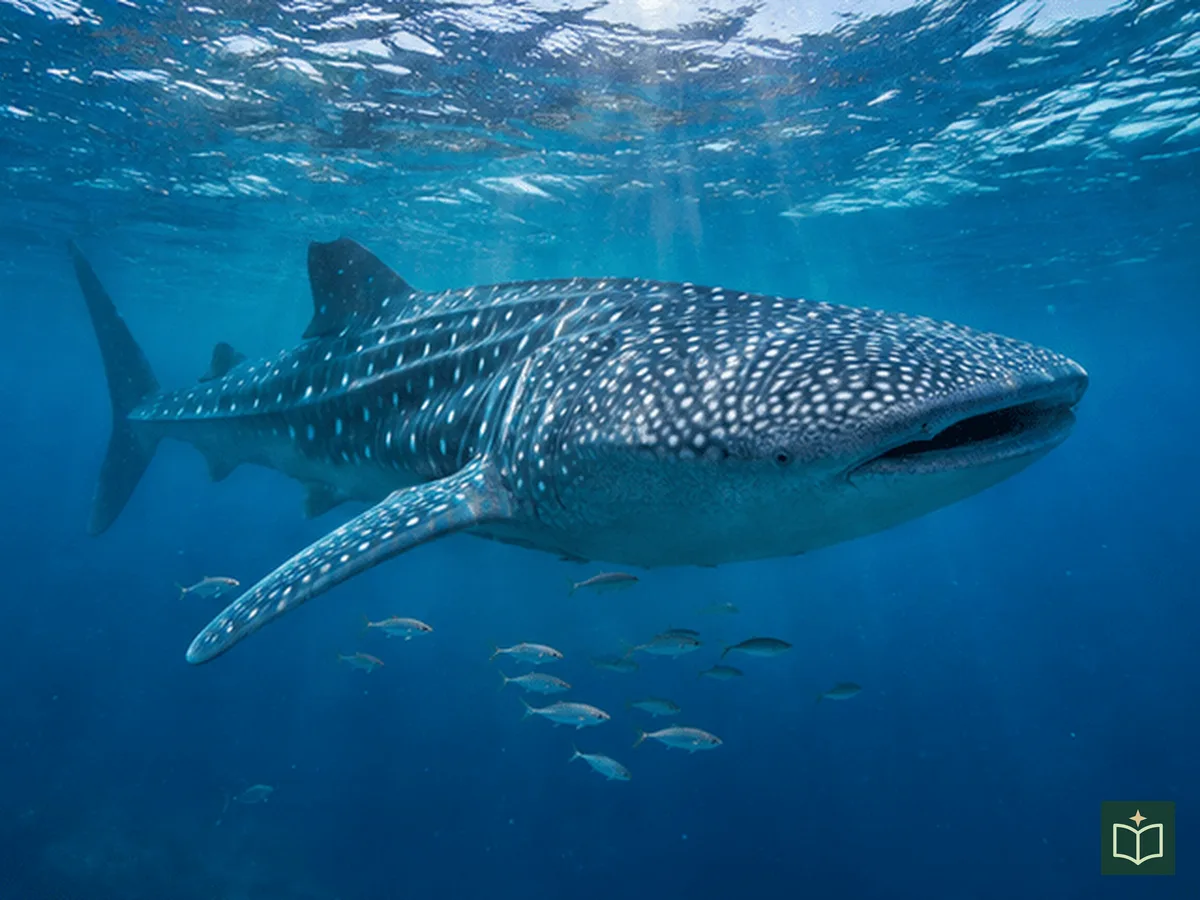
A shark, not a whale
The whale shark is a true fish, breathing through gills and carrying a skeleton of cartilage, despite a name that reflects its whale-like size. Typical adults reach 8 to 12 metres, and the largest credible measurements approach 18 metres, with weights estimated at well over 15 tonnes. It swims slowly with its broad mouth open, drawing in water and filtering out plankton, fish eggs and small schooling fish through spongy pads in its gills. Whale sharks live in warm tropical seas worldwide and travel thousands of kilometres between feeding areas. Each animal carries a unique pattern of pale spots on its back, which researchers photograph to identify individuals, much as fingerprints identify people.
How filter feeding allows size
The two largest fish, and several of the largest rays, all feed by filtering. This is not a coincidence. Plankton is abundant at the bottom of the food chain, so an animal that can harvest it directly has access to far more food energy than a predator chasing other fish. The basking shark, second in the table at about 12 metres, cruises near the surface of cooler seas with its mouth gaping, filtering hundreds of tonnes of water an hour. A similar pattern appears among mammals, where the filter-feeding blue whale dwarfs every hunter. Large size also helps such animals cover great distances efficiently in search of seasonal blooms.
Whale sharks in the Gulf
The Arabian Gulf and the Gulf of Oman host some of the region’s most notable whale shark gatherings. Researchers have recorded large seasonal aggregations near the Al Shaheen oil field off Qatar, where the sharks feed on the eggs of spawning tuna in the warm summer months. Sightings are also reported off the coasts of the UAE and Oman, especially around Musandam and the Daymaniyat Islands. Divers and boat operators in the region are encouraged to keep their distance and avoid touching the animals. Because whale sharks spend much of their time near the surface, they are vulnerable to ship strikes, a risk in some of the world’s busiest shipping lanes.
The longest bony fish
Most fish are bony fish, with skeletons of true bone, and they rarely reach the size of the largest sharks. The giant oarfish is the exception for length: a ribbon-like deep-sea fish with a red crest, reliably measured at around 8 metres and reported in older accounts at more than 11 metres. The beluga sturgeon of the Caspian and Black Sea basins once grew to about 7 metres, although such giants are now extremely rare after heavy fishing for caviar. Sharks fill most of the remaining places, including the Greenland shark of the cold North Atlantic, the great white, the great hammerhead and the long-tailed thresher, whose tail can make up half its length.
Wide and heavy instead
Length is not the only way to be large. The giant oceanic manta ray can measure about 7 metres from wingtip to wingtip, making it the widest fish, though its body is short. The ocean sunfish and its close relatives are the heaviest bony fish: a flattened, almost tailless shape packs great bulk into a body a few metres long, and the heaviest specimens recorded have exceeded two tonnes. Because these fish are measured by width or weight, they sit uneasily in a length table and are left out here. Measurements of all large fish are also hard to verify, since big individuals are seldom weighed whole and early reports often exaggerated.
Why size brings risk
Being large and slow to mature makes these fish vulnerable. Whale sharks and basking sharks take many years to reach breeding age and produce few young, so populations recover slowly after losses. Both have been hunted for their fins, meat and oil, and both are now listed as endangered by the International Union for Conservation of Nature. The great hammerhead and several other large sharks face similar pressure from fishing nets and longlines. International trade in many of these species is controlled under the CITES convention. Protecting feeding hotspots, including those in Gulf waters, and reducing accidental catch are seen as the most effective ways to help the giants survive.
Sources & further reading
Figures are rounded and widely published; check the linked organisations for the latest editions. These organisations do not endorse this website.