Why a speck matters
The transistors on a modern chip have features measured in tens of nanometres, thousands of times thinner than a human hair, which is around 70 micrometres across. A single particle of dust, skin or smoke landing on a wafer during patterning can block light, bridge two wires or leave a gap, killing the chip beneath it. A wafer passes through hundreds of steps over several weeks, so even rare contamination adds up to many lost chips. Yield, the share of chips on a wafer that work, decides whether a factory makes money. That is why chipmakers spend heavily on keeping their production floors cleaner than almost any other place people work.
Air that only goes down
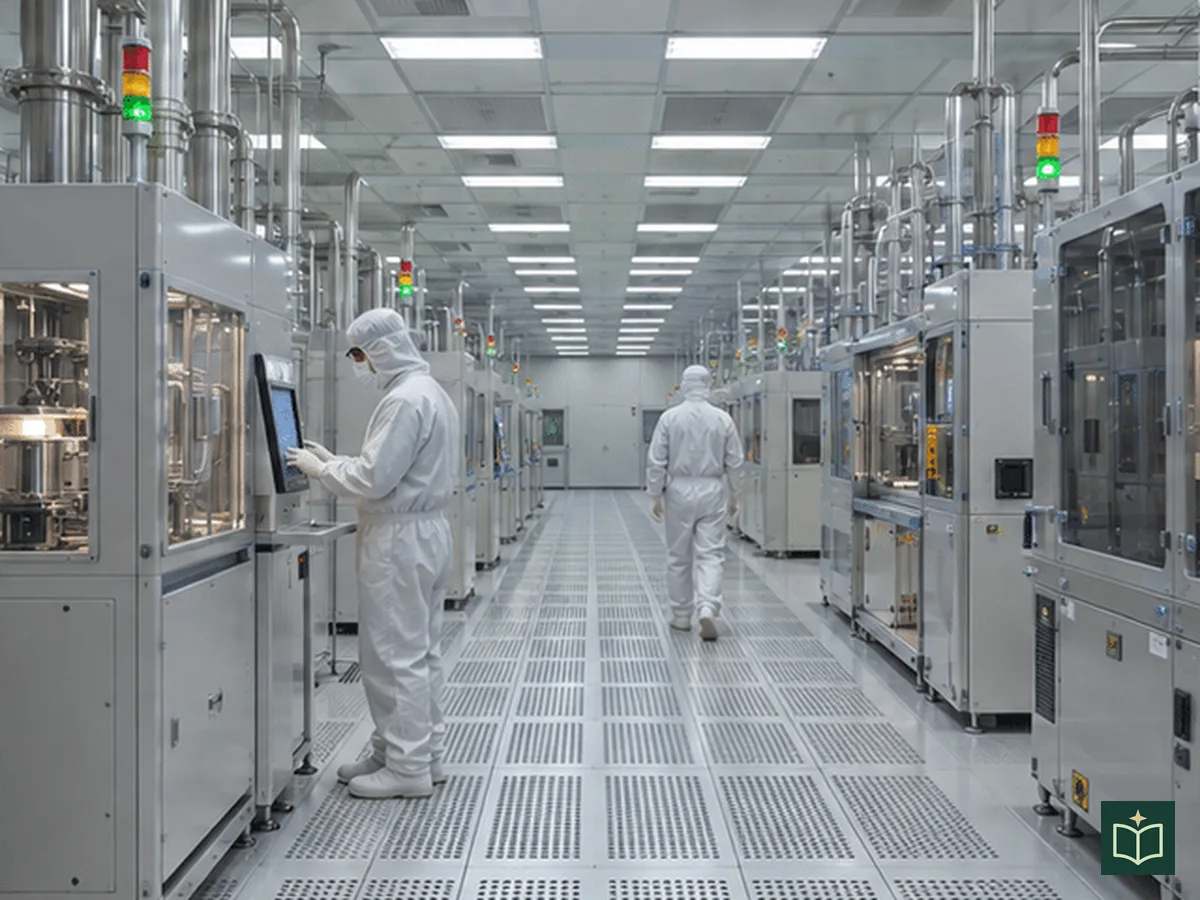
The core of a cleanroom is its airflow. Fans push air through high-efficiency filters covering much of the ceiling, which trap almost all particles down to a fraction of a micrometre. The clean air then flows straight down in smooth, parallel streams, sweeping anything shed by people or machines away from the work surface and out through perforated raised floors. From there it is recirculated and filtered again, so the air in the most critical zones can be replaced hundreds of times an hour. The room is also kept at slightly higher pressure than its surroundings, so when a door opens, air rushes out rather than dust drifting in.
Counting the dust
Cleanliness is measured by counting particles. The international standard ISO 14644-1 sets classes from 1, the cleanest, to 9. Each step allows roughly ten times more particles than the one below. For particles of half a micrometre or larger, an ISO 5 room may contain about 3,520 per cubic metre, while ISO 7, a level typical of many hospital clean areas, allows about 352,000, a hundred times more. Chip fabs keep the most sensitive zones at ISO 3 or cleaner, permitting around 35 such particles per cubic metre, ten thousand times fewer than ISO 7. Ordinary city air holds millions. Inside sealed wafer pods, conditions are cleaner still.
Dressed for the job
People are the biggest source of contamination. A person sitting still sheds huge numbers of skin flakes, hairs and fibres every minute, and walking multiplies that. So workers put on full-body suits, nicknamed bunny suits, made of fabrics that do not shed, plus hoods, masks, boots, gloves and often safety glasses. Gowning follows a set sequence, from head down, in a dedicated room, and staff usually pass through an air shower that blasts loose particles away. Cosmetics, perfume and ordinary paper are typically banned. Increasingly, though, wafers are rarely exposed to people at all: they travel in sealed pods carried by robots on overhead rails.
Beyond dust
Particles are not the only threat. Lithography tools align patterns to within a few nanometres, so the buildings sit on massive, stiff foundations and the machines on isolated platforms that damp vibrations from traffic, footsteps and air handlers. Temperature is held within a fraction of a degree, because metal and silicon expand when warm. Humidity is fixed to prevent static and corrosion. Lithography areas glow yellow, because the light-sensitive coatings on wafers react to blue and ultraviolet light. Factories also use vast amounts of ultrapure water to rinse wafers, purified so thoroughly that it contains almost nothing but water molecules, together with chemicals and gases of exceptional purity.
An invention from 1960
The modern cleanroom traces back to Willis Whitfield, a physicist at Sandia National Laboratories in the United States. Around 1960 he developed the laminar-flow design, in which filtered air moves smoothly in one direction instead of swirling around a room, and it cut particle counts dramatically. The idea spread quickly to electronics, aerospace and later pharmaceuticals and hospitals. Today the most advanced chip plants cost many billions of dollars, and a large share of that goes into the building itself: air handling, filtration, vibration control and water treatment. Those demands are one reason new fabs take years to build and why only a few companies operate at the leading edge.
Sources & further reading
Figures are rounded and widely published; check the linked organisations for the latest editions. These organisations do not endorse this website.