Too far for deliveries
Everything aboard the International Space Station has to be launched from Earth at great expense, and supply ships arrive only every few weeks or months. Water is heavy, and people need a lot of it. NASA estimates that each crew member uses roughly a gallon, about 3.8 litres, a day for drinking, food preparation and hygiene. Oxygen must be supplied continuously, and the carbon dioxide people breathe out must be removed before it builds up to harmful levels. Simply carrying all of this up would be costly and leave the crew vulnerable to delays. So the station recycles as much as it can, a skill that longer missions to the Moon and Mars will need even more.
Oxygen from water
Most of the station's oxygen comes from electrolysis. In both the American Oxygen Generation System and the Russian Elektron unit, electric current from the solar arrays passes through water and splits each molecule into hydrogen and oxygen. The oxygen is released into the cabin. The hydrogen was originally vented overboard, but since 2010 the US segment has used some of it in a Sabatier reactor, which combines hydrogen with captured carbon dioxide to make water and methane. The water returns to the system, while the methane is vented to space. Tanks of stored oxygen and chemical oxygen generators, which release oxygen when ignited, serve as backups if the main machines fail.
Scrubbing the air
Each astronaut exhales around a kilogram of carbon dioxide a day, and in a sealed cabin the gas would soon cause headaches and worse. The station removes it with systems such as the US Carbon Dioxide Removal Assembly and the Russian Vozdukh. They pass cabin air through beds of zeolite, a porous mineral-like material that traps carbon dioxide molecules. When a bed is full, it is heated and exposed to the vacuum of space to release the gas, then reused. Other filters catch dust, microbes and trace chemicals given off by equipment and people. Without gravity, air does not circulate by itself, so fans keep it moving to prevent pockets of stale gas forming around sleeping crew.
Yesterday's water, purified
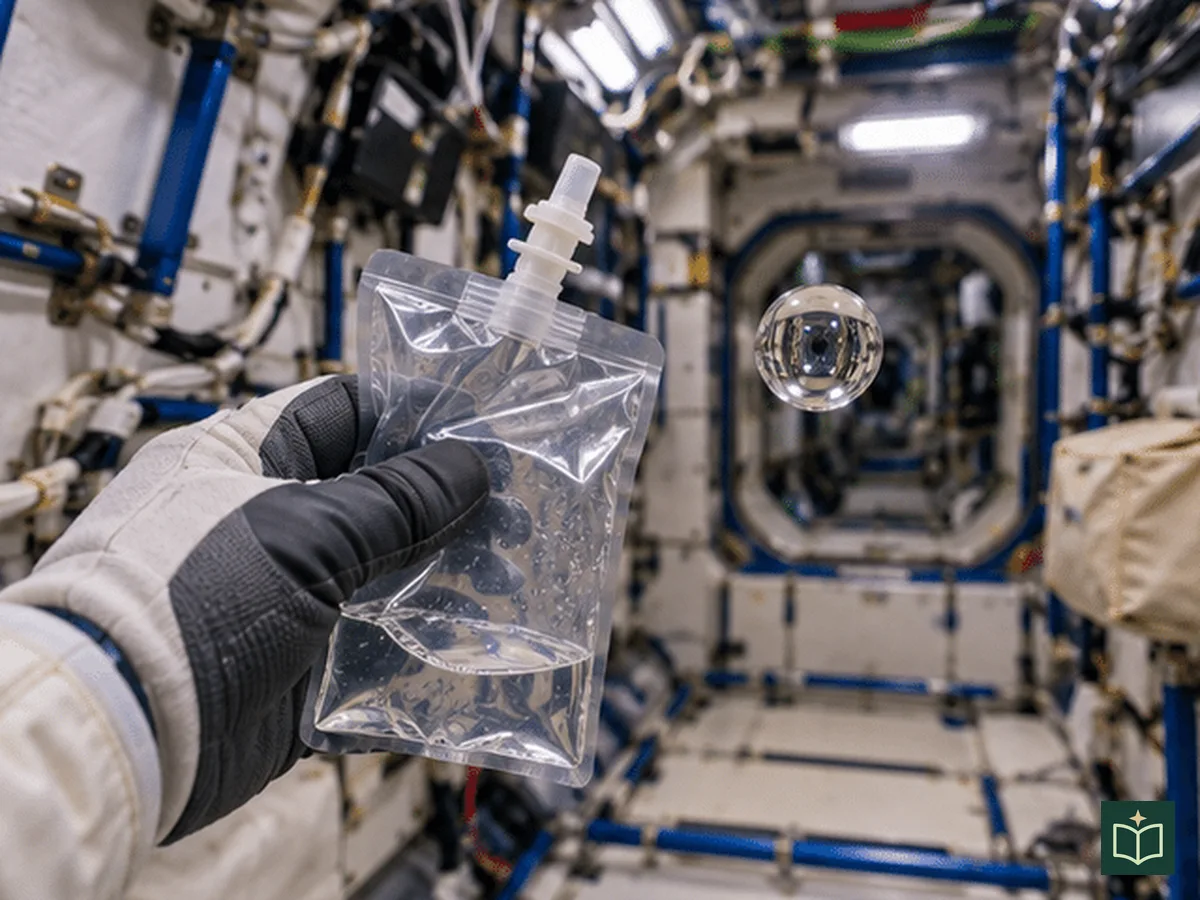
The Water Recovery System, installed in 2008, collects humidity condensed from the cabin air, which includes breath and sweat, and urine from the toilets. Urine is first distilled in a spinning drum at low pressure, since in weightlessness a rotating drum is needed to separate liquid from vapour. The resulting water joins the condensate in a processor that uses filters and a high-temperature catalytic reactor to break down remaining contaminants, and its quality is checked continuously. For years about 93 to 94 per cent of water was recovered, because some was left behind in concentrated brine. A brine processor tested from 2021 squeezed out most of the rest, raising recovery to about 98 per cent.
What 98 per cent means
Recycling at this level changes the supply problem. Consider a crew of seven, each using about 3.8 litres a day, over 30 days. That is about 800 litres of water passing through daily life in a month. With 98 per cent recovered, only about 16 litres has to be made up from fresh supplies, against roughly 50 to 55 litres at the older recovery rate of 93 to 94 per cent. The figures are approximate, because real consumption varies and some water is also split for oxygen. But the principle is clear: each extra percentage point of recovery saves cargo space on every resupply flight, and on a voyage to Mars that difference could decide what a ship must carry.
Not quite a closed loop
The station's system is impressive, but it is not fully self-sustaining. Food still comes from Earth, and so does some water and nitrogen to replace gas lost through airlocks and leaks. Carbon dioxide is only partly recycled, since the Sabatier reaction throws away carbon in the form of methane. The machines also need regular maintenance, spare parts and astronaut time, and they have broken down on occasion, which is why redundancy matters. Engineers are studying ways to close the loop further, including recovering more oxygen from carbon dioxide and growing crops, which researchers have already tested on the station. The lessons will shape habitats planned for the Moon and, one day, Mars.
Sources & further reading
Figures are rounded and widely published; check the linked organisations for the latest editions. These organisations do not endorse this website.