A race against time
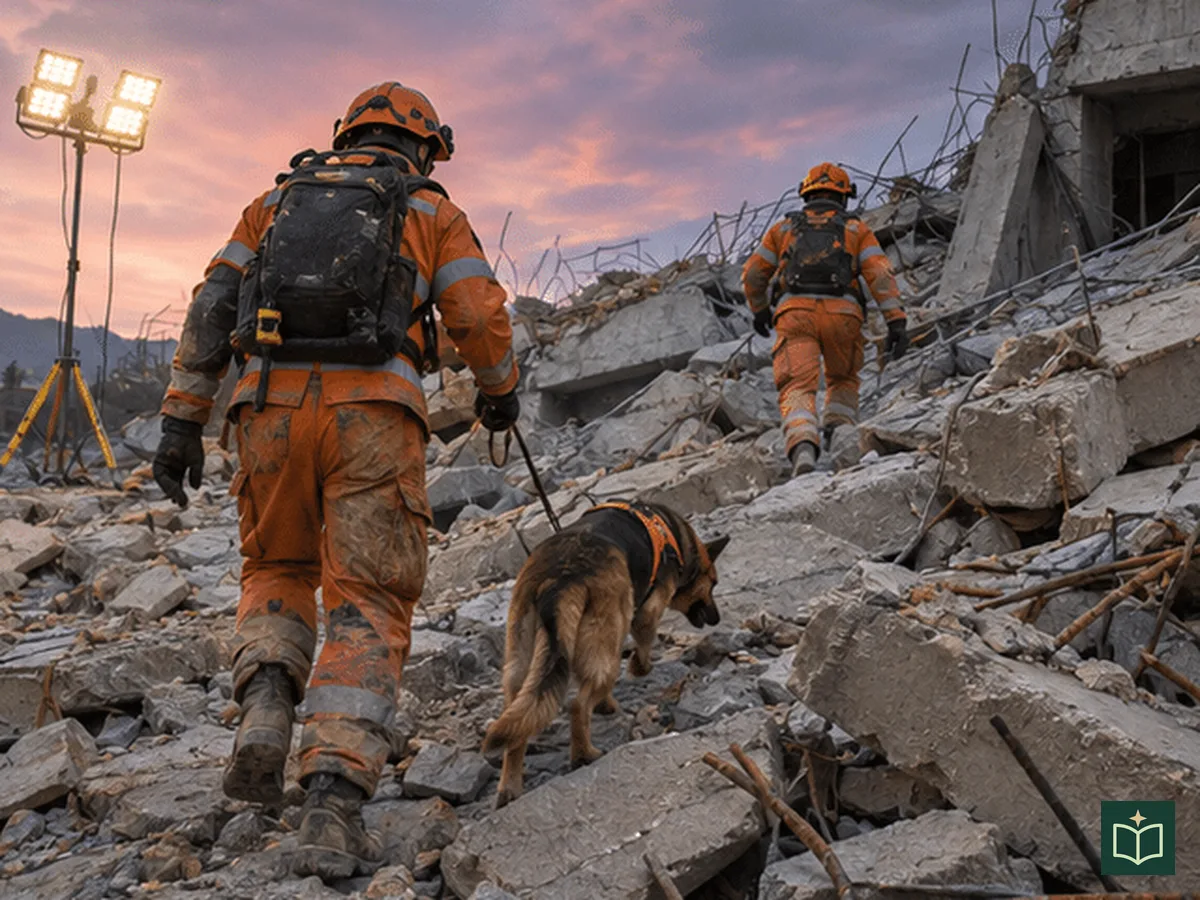
When an earthquake brings down buildings, people can survive for days in voids beneath the rubble, but chances of rescue fall as time passes. Local residents and national emergency services carry out most rescues in the first hours, often with their bare hands. International teams add specialist skills: locating people with search dogs, listening devices and cameras, cutting through reinforced concrete, shoring up unstable structures and providing medical care in confined spaces. These are urban search-and-rescue, or USAR, teams. Because many countries may offer help at once, the international community has developed shared rules so that teams arrive quickly, work safely and do not get in each other's way.
The rulebook
The International Search and Rescue Advisory Group, INSARAG, was created in 1991 after experience in major earthquakes in Mexico City in 1985 and Armenia in 1988 exposed problems with uncoordinated international help. It is a network of governments and response organisations, with a secretariat in the UN Office for the Coordination of Humanitarian Affairs. Its guidelines, endorsed by the UN General Assembly in 2002, set out how teams should be organised, equipped and coordinated. They also include a common marking system that rescuers paint on buildings to show which structures have been searched, whether hazards are present and whether any victims remain inside, so that no area is searched twice or missed.
Light, medium and heavy
Teams can apply for external classification, a peer-reviewed test in which experienced assessors watch them carry out a realistic exercise lasting many hours. Medium teams must be able to work at one structural collapse site around the clock. Heavy teams must be able to run two separate worksites at the same time, with enough specialists, equipment and supplies to stay self-sufficient for up to ten days without draining local food, water or fuel. A light classification has also been introduced for smaller teams. Teams must be reclassified every five years. Dozens of teams worldwide hold classification, including teams from the Gulf, Europe, Asia and the Americas.
Request, arrival and coordination
International teams deploy only when the affected government requests or accepts them. Alerts and updates are shared on the Virtual On-Site Operations Coordination Centre, an online platform where teams post their readiness and capabilities. On arrival, often at an airport, a reception and departure centre registers each team. A USAR coordination cell, set up by early-arriving teams or a UN assessment team and working with the national emergency authority, divides the affected area into sectors and assigns teams according to their skills. Teams report every rescue and every building cleared. After the February 2023 earthquakes in Türkiye and Syria, dozens of international teams, including from Gulf states, worked under this system alongside national responders.
Common misconceptions
It is often assumed that international teams save most victims. In reality, the vast majority of people rescued alive are pulled out by neighbours and local services before international teams arrive, which is why INSARAG also invests in training national and community responders. Another misconception is that more teams always help. Unrequested or unclassified teams can clog airports, roads and fuel supplies, and may lack the self-sufficiency to avoid becoming a burden. Teams are also expected to know when to stop. As the chance of finding survivors falls, the coordination cell and the host government decide when to move from rescue to recovery and humanitarian relief.
Why it matters
The USAR system shows how humanitarian coordination works when every hour counts. Shared standards mean a host country knows what a classified heavy team can do before it lands, and teams from different continents can share sectors, equipment and information. The approach is being extended to other areas, for example the deployment of emergency medical teams under WHO standards. For countries in earthquake zones, the lessons are practical: invest in building codes, train local responders, and plan in advance how to receive international help. When those pieces are in place, specialist teams can focus on what only they can do: reaching people trapped deep in the rubble.
Sources & further reading
Figures are rounded and widely published; check the linked organisations for the latest editions. These organisations do not endorse this website.