Light we cannot see
Every object warmer than absolute zero gives off electromagnetic radiation, and the wavelength depends on temperature. Very hot things, such as a stove element or the Sun, glow visibly. Objects at everyday temperatures, including people, walls and cars, glow too, but in infrared light, at wavelengths too long for our eyes. The astronomer William Herschel discovered this invisible radiation in 1800 when a thermometer placed just beyond the red end of a spectrum warmed up. A thermal camera is built to see that glow. Unlike night-vision devices, which amplify faint visible light, it needs no light at all and works the same in total darkness.
Where the human glow peaks
Physics predicts where an object's emission is strongest. Wien's law says the peak wavelength equals about 2,898 divided by the temperature in kelvin, giving micrometres. Human skin, at around 310 kelvin or 37 degrees Celsius, peaks at about 9.3 micrometres. The Sun's surface, near 5,800 kelvin, peaks at about 0.5 micrometres, in visible light. That is why most thermal cameras are tuned to the long-wave infrared band, from about 8 to 14 micrometres, where the glow of everyday objects is strongest. Conveniently, the atmosphere is also fairly transparent in this range, so a camera can see heat across considerable distances.
Inside the camera
Ordinary glass blocks long-wave infrared, so thermal lenses are made from materials such as germanium, which looks like dark metal yet is transparent to these wavelengths. The sensor in most modern cameras is a microbolometer array: a grid of tiny suspended plates, each one a pixel, that warm slightly when infrared falls on them, changing their electrical resistance. Electronics read those changes thousands of times a second and convert them to temperatures. Software then assigns a shade or a colour to each value, often white or yellow for warm and purple or black for cool. Early thermal imagers needed cooling with liquid nitrogen; uncooled microbolometers made the technology small and affordable.
Uses from buildings to rescue
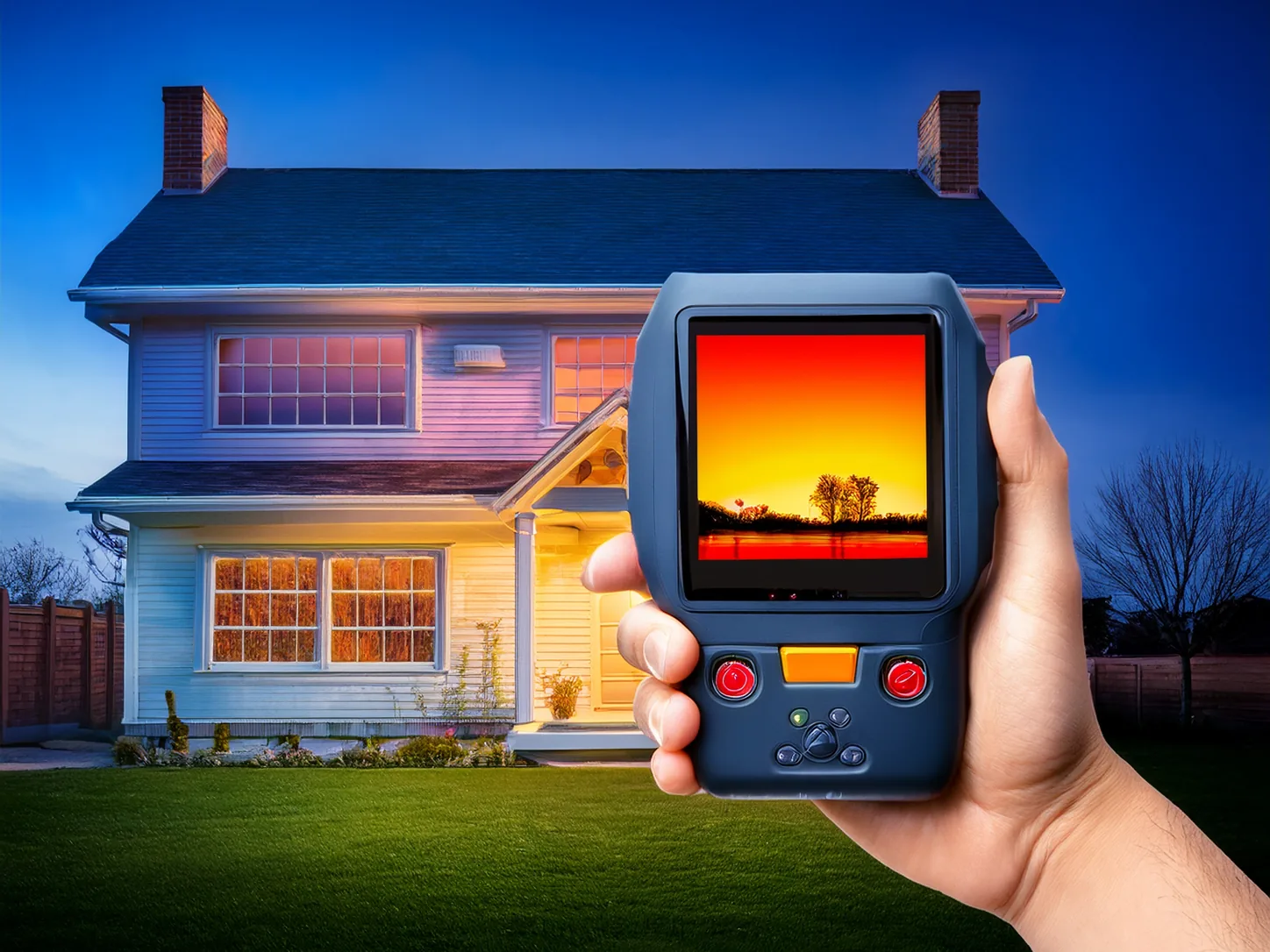
Thermal cameras reveal problems that are otherwise invisible. Building inspectors use them to find missing insulation, air leaks and damp, and in hot climates such as the Gulf, to see where heat is entering a building and overworking the air-conditioning. Electricians scan switchboards for overheating connections before they fail. Firefighters use handheld imagers to see through smoke and find people and hotspots. Search-and-rescue teams fly cameras on helicopters and drones to spot a warm body at night or in rough terrain. Thermal imaging also has roles in veterinary medicine, industrial process control and wildlife surveys, where animals can be counted at night without disturbance.
What they cannot see
Films often show thermal cameras seeing through walls. They cannot; they see only the surface temperature of the wall, although hot pipes or wiring inside may warm the surface enough to show. Glass windows act like mirrors for long-wave infrared, so a camera cannot look through them. Shiny metal reflects heat from its surroundings and can appear misleadingly cold or hot. Every surface emits differently, a property called emissivity, so accurate temperature readings need correct settings. Thermal screening at airports during disease outbreaks showed these limits: skin temperature is affected by sweating, sunlight and recent exertion, so cameras can flag people for checks but cannot diagnose fever reliably.
Cheaper and more common
Thermal imaging began as an expensive military technology, used for night vision and guided weapons. Prices have fallen so far that small thermal cameras now clip onto smartphones, and some cars use them to detect pedestrians in darkness beyond the reach of headlights. Satellites carry thermal sensors to map urban heat islands, measure sea surface temperatures and detect wildfires. Resolution remains far lower than in ordinary cameras, typically tens of thousands of pixels rather than millions, because each microbolometer element is relatively large and costly to make. Even so, the basic insight endures: the world is full of information written in heat, and the right sensor makes it visible.
Sources & further reading
Figures are rounded and widely published; check the linked organisations for the latest editions. These organisations do not endorse this website.