Shouting in the dark
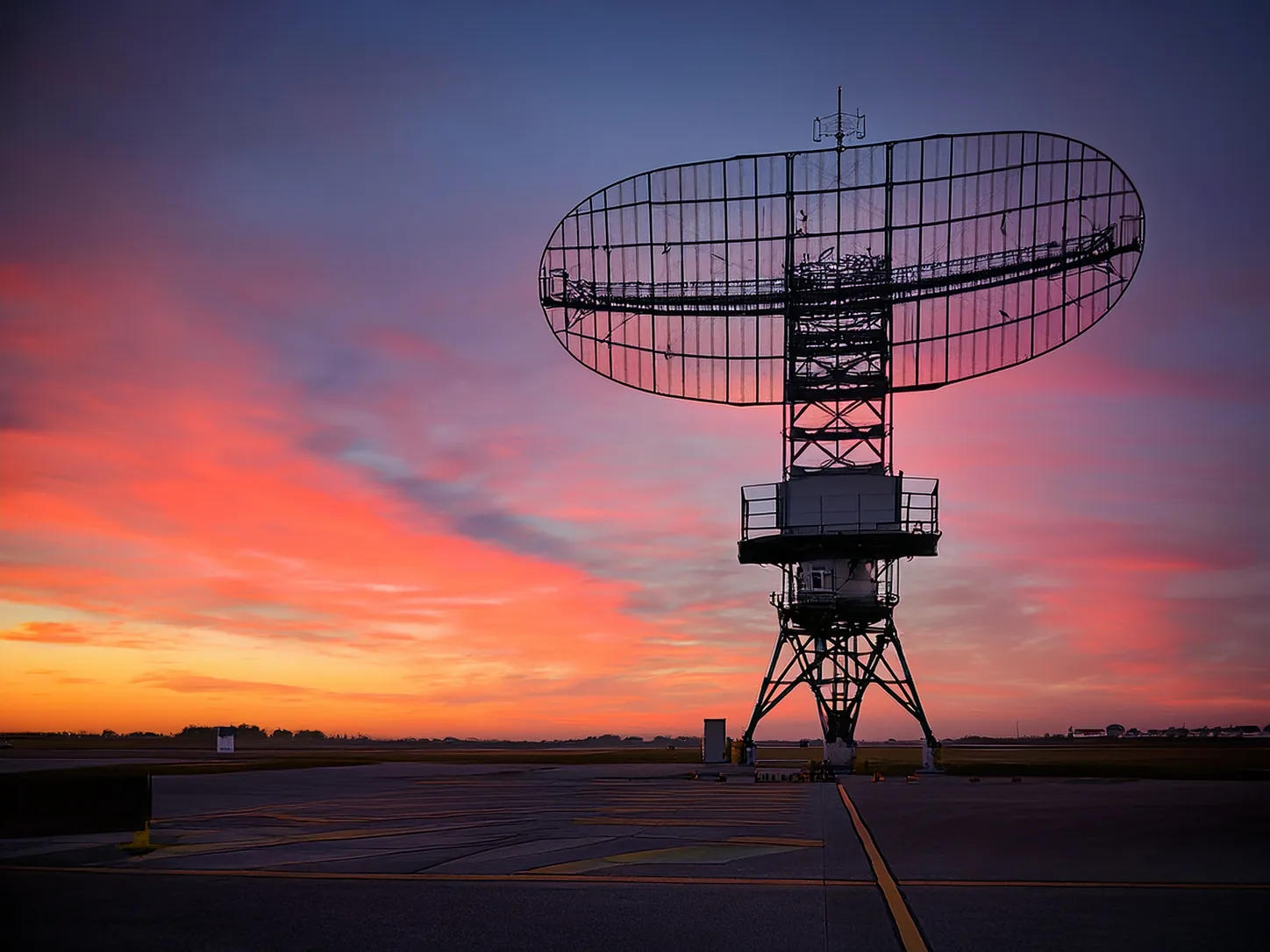
Radar works like shouting across a valley and timing the echo, but with radio waves instead of sound. The name is short for radio detection and ranging. A transmitter sends out a brief, powerful pulse of radio energy. When the pulse strikes an object such as an aircraft, ship or cloud of raindrops, a tiny fraction of the energy bounces back. The same antenna listens for that echo between pulses. Because radio waves travel at the speed of light and pass through darkness, haze, cloud and dust, radar can detect objects far beyond the range of human eyes, by day or night and in almost any weather.
Timing at the speed of light
Distance comes from timing. Radio waves travel about 300,000 kilometres a second, and the echo must go out and back, so each microsecond of delay corresponds to about 150 metres of range. An echo returning one millisecond after the pulse came from something roughly 150 kilometres away. Direction comes from the antenna, which sends a narrow beam and either rotates or steers electronically, so the system knows which way it was pointing when the echo arrived. Combine range and bearing and you have a position. Repeating the measurement every few seconds shows how the object is moving, and the change in echo frequency caused by the Doppler effect reveals its speed directly.
Born in wartime
Several countries explored radio detection in the 1930s, but Britain moved fastest. In 1935 the engineer Robert Watson-Watt and his colleague Arnold Wilkins showed, near Daventry, that a radio signal reflected from an aircraft could be detected. By the start of the Second World War a chain of radar stations, Chain Home, guarded Britain's coast and gave early warning of approaching bombers. In 1940 two Birmingham scientists, John Randall and Harry Boot, built the cavity magnetron, which produced powerful short-wavelength radio waves from a compact device. It allowed radar small enough to fit in aircraft and ships, and the same component later powered the domestic microwave oven.
Guiding modern aviation
After the war, radar transformed civil aviation. Air traffic controllers use primary radar, which detects any reflecting object, alongside secondary radar, which interrogates a transponder on each aircraft that replies with its identity and altitude. Together they let controllers keep aircraft safely separated in busy airspace, such as the crowded skies above Dubai and Doha where several major hubs sit close together. Airliners also carry weather radar in their noses to spot storms ahead. Increasingly, aircraft broadcast satellite-derived positions through a system called ADS-B, but radar remains an essential independent check, because it works even if an aircraft's own equipment fails or is switched off.
Watching the weather
Weather radar applies the same principle to raindrops, hail and snow. The strength of the echo shows how heavy the precipitation is, while Doppler measurements reveal winds swirling inside storms, giving forecasters early warning of damaging gusts and tornadoes. Dual-polarisation radars send waves vibrating both horizontally and vertically, helping distinguish rain from hail, dust or even swarms of insects. In the Gulf, weather radar networks track the occasional intense downpours and dust storms that disrupt traffic and flights. Radar has also spread far beyond the sky: it measures the speed of cars, helps vehicles keep their distance on motorways, maps the ground from satellites and even monitors breathing in sleep studies.
Limits and countermeasures
Radar has blind spots. Because radio waves travel in straight lines while the Earth curves, low-flying aircraft can hide below a ground radar's horizon. Hills and buildings create shadows, and ground clutter, rain and birds can produce false echoes that software must filter out. Stealth aircraft reduce their radar signature with angular shapes that deflect energy away from the receiver and coatings that absorb it, so they return far weaker echoes than their size suggests. A common misconception is that radar shows a picture of an aircraft. It does not; it shows echoes, and turning those echoes into reliable tracks takes careful processing and skilled interpretation.
Sources & further reading
- Britannica · Radar ↗
- US National Weather Service · Doppler radar ↗
- Science Museum Group · Cavity magnetron ↗
Figures are rounded and widely published; check the linked organisations for the latest editions. These organisations do not endorse this website.