A global register of risk
The International Union for Conservation of Nature has maintained its Red List of Threatened Species since 1964. It is the most widely used global source on the extinction risk of animals, fungi and plants. More than 160,000 species have now been assessed, and over 40,000 of them are classified as threatened. The list is used by governments, conservation groups, development banks and researchers to set priorities and track progress. Assessing a species is not a vote or an opinion poll. It is a structured process that tests available evidence against published criteria, so that a frog in Central America and a gazelle in Arabia are judged by the same rules.
The categories
Species are placed in one of several categories. At the extreme are Extinct and Extinct in the Wild, where a species survives only in captivity or cultivation. Three categories are described as threatened: Critically Endangered, Endangered and Vulnerable, in descending order of risk. Near Threatened applies to species close to qualifying for a threatened category, and Least Concern to those at relatively low risk. Data Deficient means there is not enough information to assess the species, which does not imply it is safe. Not Evaluated covers species that have not yet been assessed. Headlines usually focus on movements into or out of the three threatened categories.
Five criteria, with numbers
Each threatened category is defined by thresholds under five criteria. Criterion A looks at population decline over ten years or three generations. Criterion B considers a small or fragmented geographic range combined with decline or extreme fluctuation. Criterion C covers small populations that are also declining. Criterion D applies to very small or very restricted populations, and Criterion E uses quantitative models of extinction probability. Meeting any one criterion is enough. Under Criterion D, for example, a species with fewer than 50 mature individuals qualifies as Critically Endangered, fewer than 250 as Endangered and, under its main test, fewer than 1,000 as Vulnerable. Assessors document which criteria apply.
Who does the assessing
Assessments are carried out largely by networks of volunteer experts in the IUCN Species Survival Commission, organised into specialist groups for particular animals or plants, together with partner institutions. Each assessment includes the data, the reasoning and the criteria met, and is reviewed by other experts before publication. Species are meant to be reassessed regularly, ideally at least every ten years. A change in category is labelled as genuine when it reflects a real change in the species' status, or as non-genuine when it results from new information, better knowledge or corrected earlier mistakes. That distinction matters when the list is used to measure whether conservation is working.
The Arabian oryx
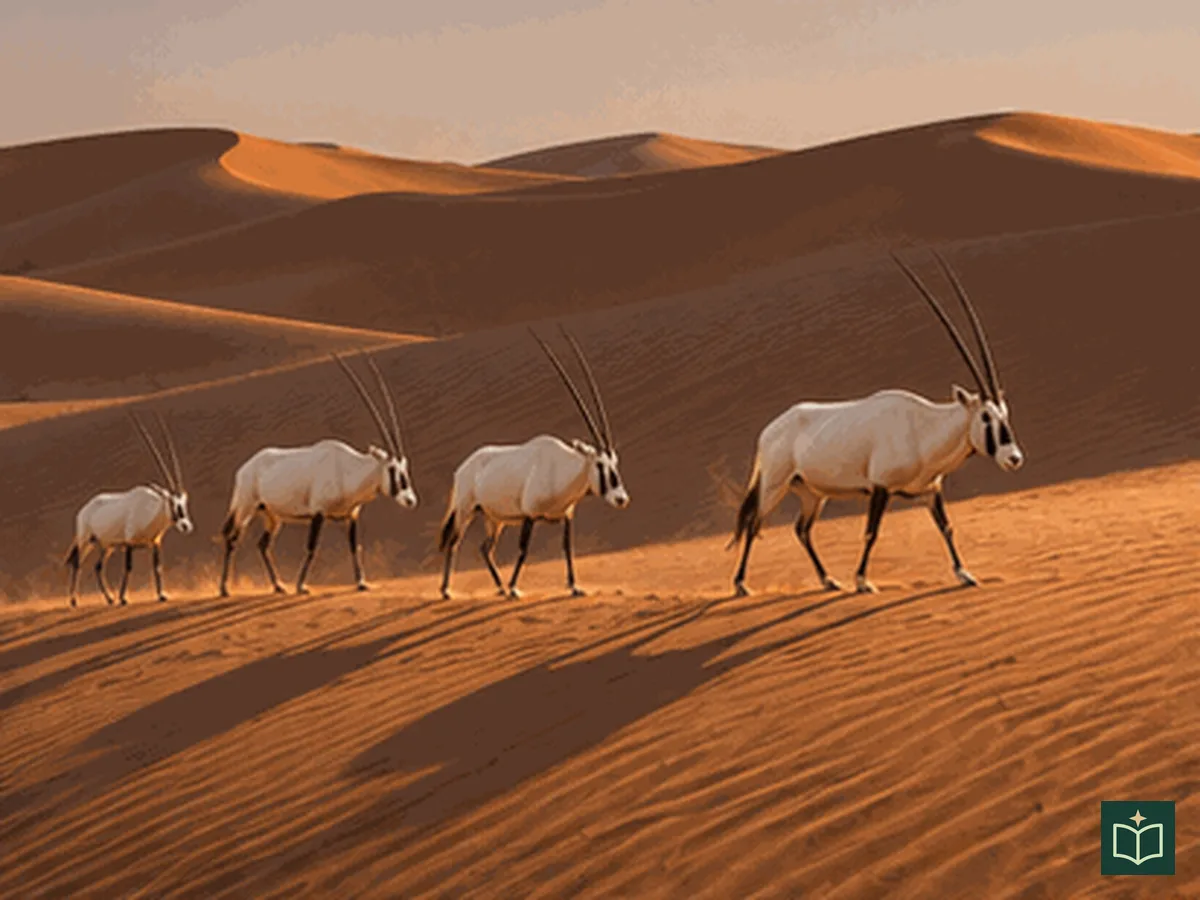
The Arabian oryx shows how far a species can move on the list. Hunting reduced it so severely that the last known wild animals were killed in Oman in the early 1970s, and it was listed as Extinct in the Wild. A captive breeding programme, built from animals held in zoos and private collections, including those in the Gulf, kept the species alive. Reintroductions began in Oman in 1982 and later followed in Saudi Arabia, Israel, the UAE and Jordan. In 2011, the IUCN moved the oryx to Vulnerable, the first time a species had returned to that category after being Extinct in the Wild. The UAE today holds a large share of the world's oryx.
Reading a status change
When a species is reported as moving categories, check the direction and the reason. An uplisting, towards higher risk, may reflect a genuine decline or simply better data. A downlisting may signal successful conservation, as with the oryx, or a revised count. Look at which criteria were used and the population figure behind them. Note that categories describe risk at a global level, so a species can be secure in one country and threatened in another; national red lists exist for that reason. Remember also that Least Concern does not mean that a species' numbers are rising. Some common species are declining steadily while still remaining outside the threatened categories.
Sources & further reading
- IUCN Red List of Threatened Species ↗
- IUCN · International Union for Conservation of Nature ↗
- Environment Agency – Abu Dhabi ↗
Figures are rounded and widely published; check the linked organisations for the latest editions. These organisations do not endorse this website.