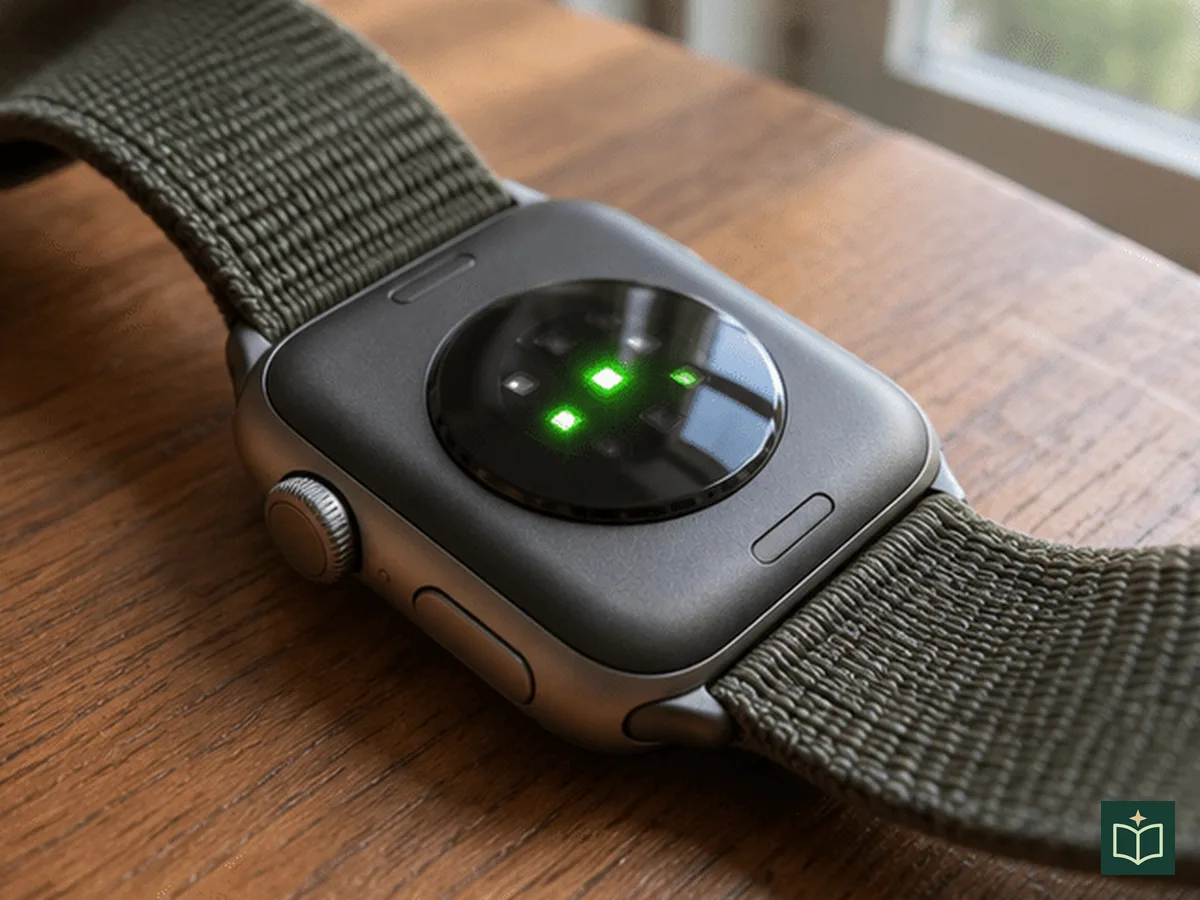
Light under the skin
Turn over most smartwatches or fitness bands and you will see small LEDs and light sensors pressed against the wrist. They use a technique called photoplethysmography, usually shortened to PPG. The idea is simple. Every time your heart beats, it pushes a pulse of blood through your arteries, and the tiny vessels in your skin swell slightly with extra blood. Blood absorbs light, so at the peak of each pulse a little less light is reflected back to the sensor. By measuring the reflected light hundreds of times a second, the watch sees a faint, wave-like signal that rises and falls with your heartbeat. The same principle has been used in medicine since the 1930s.
Why green?
Haemoglobin, the molecule that carries oxygen in red blood cells, absorbs green light strongly. Green also penetrates only a short way into the skin, reaching the dense network of small vessels near the surface while staying less affected by deeper tissue and movement of tendons. That makes it a good choice for tracking pulse during the day. Many devices also carry red and infrared LEDs. Those wavelengths reach deeper and are used to estimate blood oxygen levels, because oxygen-rich and oxygen-poor blood absorb red and infrared light differently. Some watches switch to infrared at night to save power and avoid lighting up a dark bedroom.
From waveform to a number
The raw signal is weak and messy, so software does most of the work. Algorithms filter out slow drifts caused by breathing and pressure changes, then look for the repeating peaks of the pulse. Counting them over time gives a rate. If the watch detects 12 clear peaks in 10 seconds, that corresponds to 72 beats per minute, the figure shown on the screen. In practice the calculation is updated continuously and averaged to smooth out glitches. The same signal can reveal heart rate variability, the small natural changes in time between beats, which many devices use to estimate stress, recovery or sleep stages, though those estimates are less certain.
Movement, fit and skin
Accuracy depends heavily on conditions. Movement is the biggest problem: when you run or lift weights, the watch shifts on your wrist and muscles squeeze vessels, creating signals that can be mistaken for heartbeats. Motion sensors help software subtract this noise, but readings can still lock onto your running cadence instead of your pulse. A loose strap lets in daylight that swamps the sensor. Cold hands, poor circulation and tattoos can weaken the signal. Melanin in darker skin also absorbs green light, and studies have reported mixed results on whether accuracy differs by skin tone. Manufacturers compensate by adjusting LED brightness and sensor sensitivity, but researchers continue to test the question.
Watch versus chest strap
For steady activities such as walking, sitting and sleeping, wrist readings usually match medical equipment closely. During intense or irregular exercise, a chest strap is generally more accurate, because it measures the heart's electrical signal directly, like a simplified electrocardiogram, or ECG. Some smartwatches can also record a single-lead ECG when you touch the crown or bezel with a finger from the other hand, completing an electrical circuit across your body. In some countries such features have been cleared by health regulators to help detect atrial fibrillation, an irregular rhythm. Continuous PPG tracking can also flag unusually high or low resting rates and irregular patterns for a user to follow up.
Useful, not a diagnosis
Wrist-based heart data is valuable for spotting trends, such as a resting rate that falls as fitness improves or rises during illness, poor sleep or a hot Gulf summer. It can encourage people to move more and occasionally prompts a timely check-up. But a smartwatch is not a replacement for medical assessment. Most of its measurements are estimates, alerts can be false alarms, and a normal reading does not rule out heart problems. Anyone with chest pain, fainting, palpitations or breathlessness should seek medical help rather than rely on a device. Used sensibly, with good fit and realistic expectations, the green light on your wrist is a remarkably capable sensor.
Sources & further reading
Figures are rounded and widely published; check the linked organisations for the latest editions. These organisations do not endorse this website.