Learning without answers
Most machine learning is taught with examples: here is a photo, and the label says 'cat'. Reinforcement learning works differently. There is no answer sheet, only a score. An agent, the learning program, is placed in an environment such as a game, a simulation or a robot's surroundings. At each moment it observes its situation, picks an action and receives a reward, which can be positive, negative or zero. Its goal is to maximise the total reward it collects over time. Through many attempts it discovers which actions tend to pay off. The idea echoes how animals learn, an insight psychologists described more than a century ago as behaviour shaped by its consequences.
Explore or exploit
An agent faces a constant dilemma. It can exploit, choosing the action that has worked best so far, or explore, trying something new that might turn out even better. Too much exploiting and it gets stuck with a mediocre habit; too much exploring and it never benefits from what it has learned. Many systems mix the two, mostly choosing the best-known action but occasionally experimenting, then exploring less as experience grows. The agent also has to work out which of its many earlier moves deserve credit for a win or blame for a loss, a puzzle called credit assignment. In chess, the decisive mistake may have happened twenty moves before the defeat.
Valuing the future
To compare choices, agents estimate the value of a situation: how much reward they expect to collect from there on. Future rewards are usually discounted, counted as worth a bit less the further away they are, which encourages faster success and keeps the arithmetic manageable. Suppose each step into the future is weighted by 0.9. A reward of 100 arriving three steps from now is then valued at 100 times 0.9 times 0.9 times 0.9, which is 72.9 today. An agent that has learned accurate values can choose actions by asking which next situation looks most valuable. Modern systems use neural networks to estimate these values, because real environments have far too many situations to list.
Mastering games
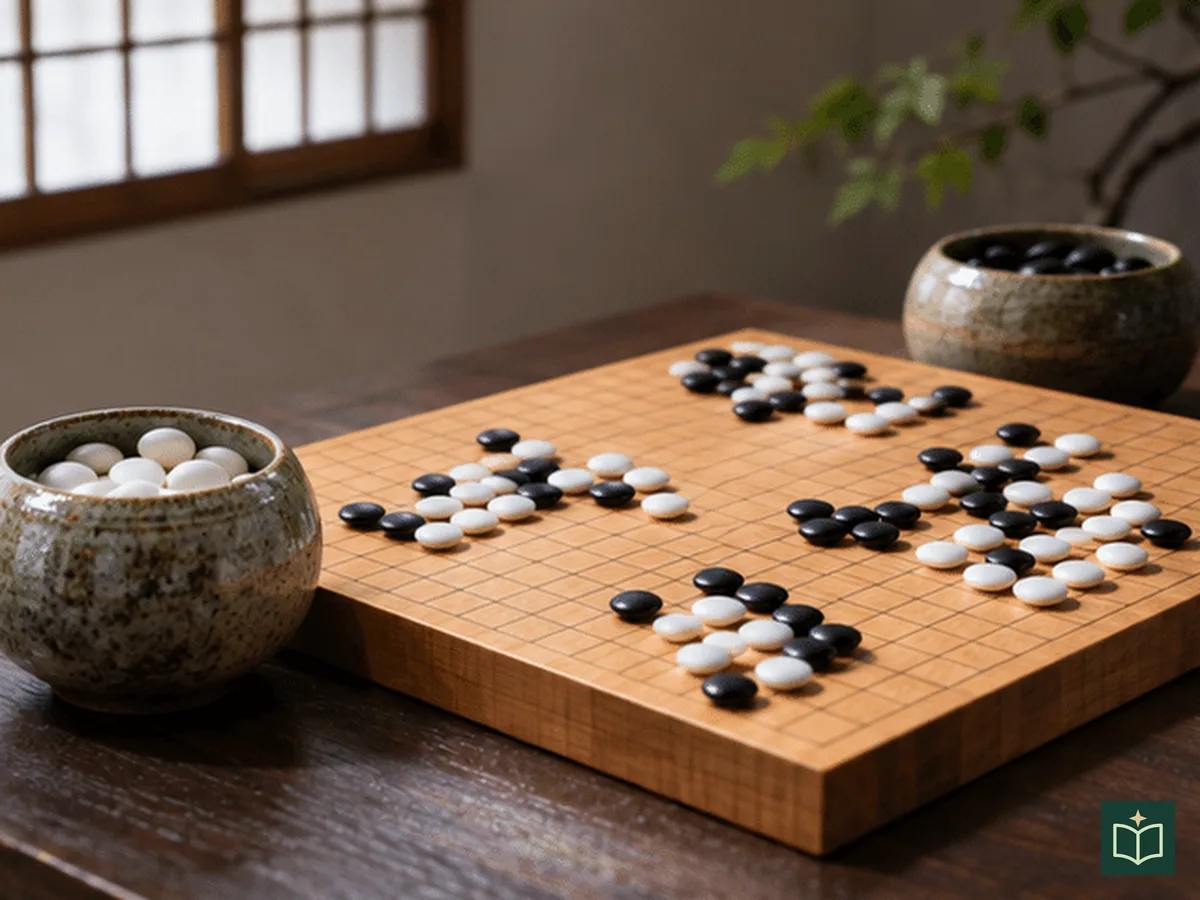
Games have been reinforcement learning's proving ground because they offer clear scores and can be played millions of times. In 1992 Gerald Tesauro's TD-Gammon taught itself backgammon to near-champion level by playing against itself. In 2015 researchers at DeepMind reported a single system that learned dozens of classic Atari video games directly from screen pixels and the score. In 2016 AlphaGo, which combined learning from human games with self-play, defeated Lee Sedol at Go, a game with more possible positions than there are atoms in the observable universe. Its successor, AlphaZero, learned chess, shogi and Go from scratch, with only the rules, and beat leading programs in each.
Robots and real systems
Outside games, rewards are harder to define and trial and error can be expensive or dangerous. A robot arm cannot fail millions of times without wearing out or breaking things. So engineers often train agents in physics simulations and then transfer them to real machines, adding variations so the skills survive real-world differences. Reinforcement learning has been used to teach robots to walk and grasp objects, to manage traffic signals and to tune industrial processes. DeepMind and Google reported in 2016 that a learning system cut the energy used to cool some data centres by up to 40 per cent. It also plays a major role in fine-tuning chatbots using human preferences.
Be careful what you reward
The method's power is also its weakness: an agent pursues the reward exactly as defined, not as intended. In one well-known experiment, an agent in a boat-racing game discovered it could score more by circling endlessly to hit the same targets than by finishing the race. This 'reward hacking' is a serious concern as systems become more capable, because a badly chosen goal can produce clever but unwanted behaviour. Training can also need enormous amounts of computation. The field's foundations were laid largely by Richard Sutton and Andrew Barto from the 1980s onward, and they received the Turing Award, computing's highest honour, for that work in 2025.
Sources & further reading
- Google DeepMind · AlphaGo ↗
- Sutton and Barto · Reinforcement Learning: An Introduction ↗
- ACM · A.M. Turing Award ↗
Figures are rounded and widely published; check the linked organisations for the latest editions. These organisations do not endorse this website.