Stock as waste
Traditional factories kept large stockpiles of parts, just in case. Stock offered security against late deliveries and machine breakdowns, but it tied up money, filled warehouses and hid problems: if defective parts sat in a pile for weeks, the fault might not be discovered until thousands had been made. Just-in-time manufacturing takes the opposite view. It treats excess stock as a form of waste and aims to produce and deliver only what is needed, in the quantity needed, at the moment it is needed. The idea became famous through Toyota, which developed it in post-war Japan when the company lacked the capital and space to hold large inventories.
The kanban signal
At the heart of just-in-time is a pull system. In a traditional push system, each process makes parts according to a forecast and pushes them forward. In a pull system, nothing is made until the next process uses something. Toyota used simple cards called kanban, Japanese for signboard, attached to containers of parts. When a container was emptied on the assembly line, its card went back to the supplying process as an order to make or deliver exactly one more container. Today many factories use electronic kanban, but the principle is the same: consumption triggers replenishment, so stock stays low and production follows real demand rather than guesses.
Suppliers in step
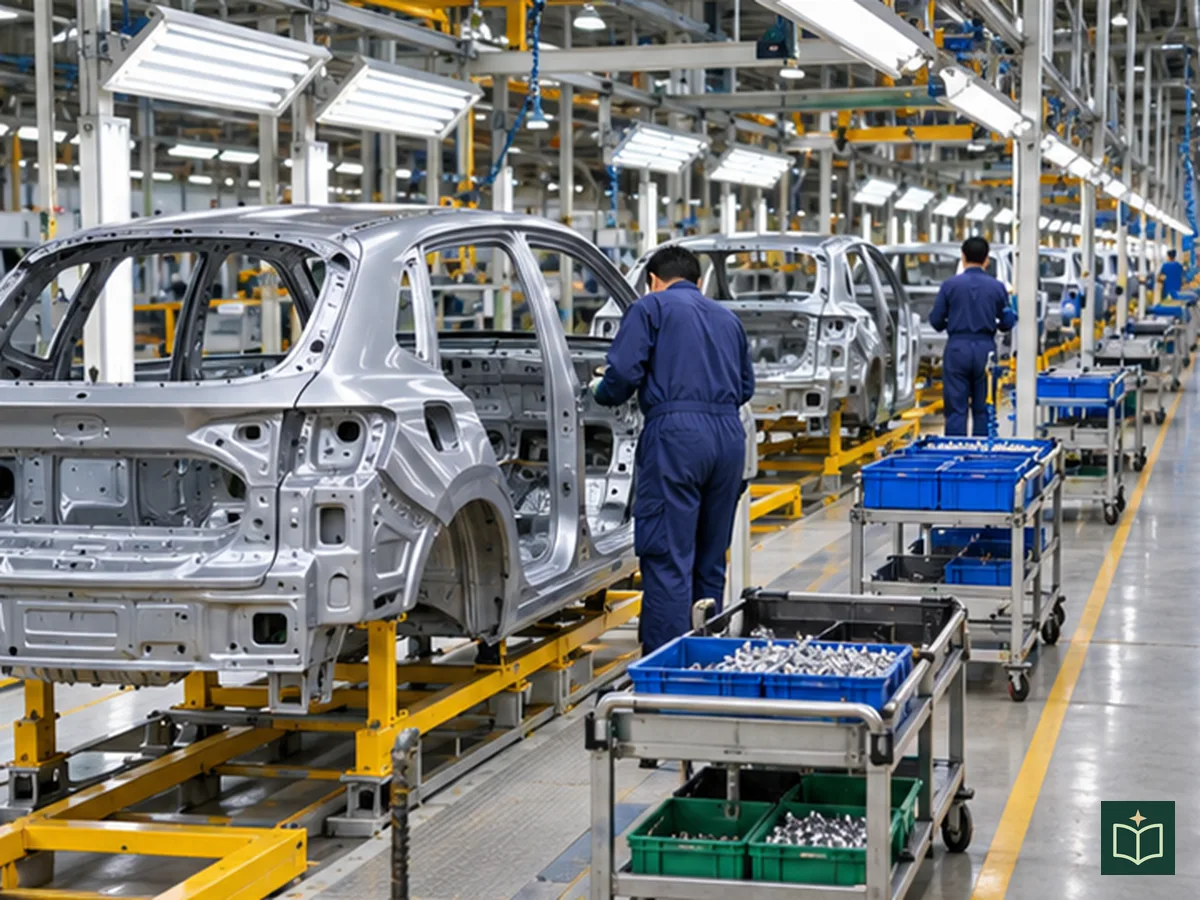
Just-in-time extends beyond the factory to its suppliers. Car plants often receive parts several times a day rather than weekly, and some suppliers build their own plants close by. For bulky or varied components such as seats, dashboards or bumpers, suppliers may deliver them in sequence, in the exact order the cars will be built, so each part goes straight from truck to vehicle. To make this possible, the main factory levels its production, mixing models evenly through the day so that demand on each supplier is steady. Relationships are long-term and closely coordinated, because a late truck can halt an entire assembly line within hours.
Exposing problems
Toyota's system pairs just-in-time with a second principle, jidoka, often translated as automation with a human touch. Machines stop automatically when something goes wrong, and workers can halt the line by pulling a cord when they spot a defect. With little stock to hide behind, problems surface immediately and must be fixed at their source. Toyota's engineers, notably Taiichi Ohno, refined these ideas from the 1950s onwards. Western researchers later described the approach as lean production, a term popularised around 1990. Since then, lean methods have spread from car factories to electronics, hospitals, offices and retailers, often with a focus on removing waste from every process.
The fragile side
The weakness of just-in-time is that it leaves little buffer. A single missing part can stop a factory. Disruptions have repeatedly exposed this: the 2011 earthquake and tsunami in Japan cut supplies of key electronic components, the blockage of the Suez Canal in 2021 delayed shipments, and the global semiconductor shortage of 2020 to 2022 forced car makers to halt lines for lack of chips. Some companies, including Toyota after 2011, responded by keeping larger stocks of critical parts and mapping their suppliers several tiers deep. The lesson was not to abandon just-in-time but to recognise that the cheapest system in normal times can be the most exposed in a crisis.
Why it matters
Just-in-time changed how much of the world's manufacturing operates, reducing costs and improving quality. It also helps explain why disruptions far away can empty shelves or delay deliveries closer to home. Many businesses now speak of balancing just-in-time with just-in-case: keeping lean flows for most items while holding strategic buffers of hard-to-replace parts, using several suppliers or bringing production closer to customers. For trading and logistics hubs such as those in the Gulf, which move parts and finished goods between continents, these choices shape demand for warehousing, air freight and regional distribution. The right balance depends on how costly a shortage would be compared with holding stock.
Sources & further reading
Figures are rounded and widely published; check the linked organisations for the latest editions. These organisations do not endorse this website.