What an aftershock is
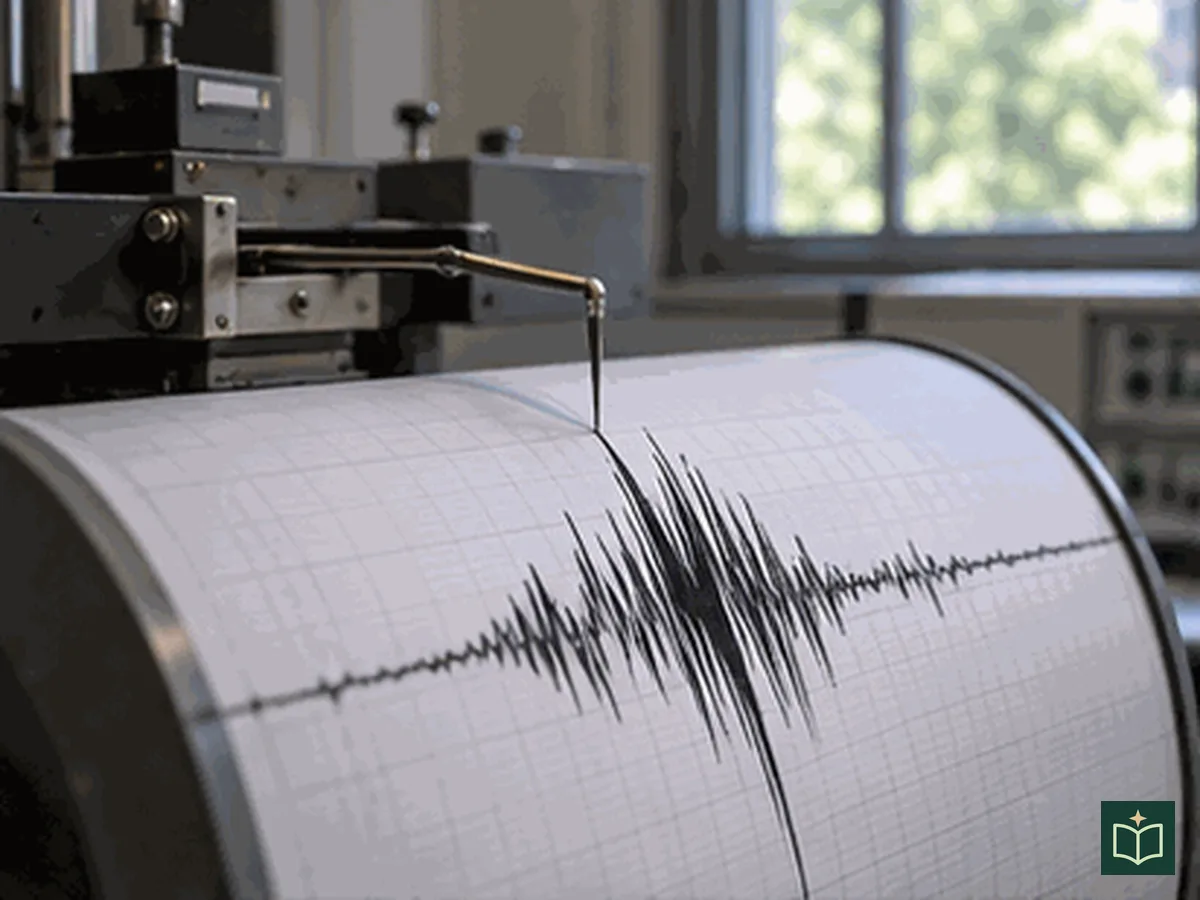
A large earthquake suddenly shifts a fault and changes the stresses in the rock around it. The crust then adjusts through many smaller earthquakes in the same region, known as aftershocks. They can number in the thousands after a major event and continue for months or years, though most are too small to feel. The largest earthquake in a sequence is labelled the main shock, and anything before it is a foreshock. Those labels can only be applied in hindsight. An earthquake that seems to be a main shock today can be reclassified as a foreshock tomorrow if a bigger one follows, which is why forecasters always talk in probabilities.
A decay that repeats
In 1894 the Japanese seismologist Fusakichi Omori noticed that aftershock rates fall off in a regular way, roughly in inverse proportion to time since the main shock. The pattern, now called Omori's law, means that if a region records about 100 noticeable aftershocks on the first day, it might expect about 10 on the tenth day and about one on the hundredth. A second rule, the Gutenberg–Richter relation, says that for each drop of one magnitude unit, about ten times as many earthquakes occur. Båth's law adds that the largest aftershock is typically about 1.2 magnitude units smaller than the main shock. These are averages, and real sequences scatter around them.
Turning patterns into odds
Agencies combine these rules with data from the unfolding sequence to produce forecasts. The United States Geological Survey publishes aftershock forecasts after significant earthquakes, giving the chance of at least one quake above a stated magnitude within the next day, week, month and year, along with a likely range for how many will occur. Early forecasts rely on averages from past sequences in similar tectonic settings. As days pass, the model is tuned to how this particular sequence is behaving, since some regions produce more productive or longer-lasting aftershock sequences than others. Forecasts are updated regularly, and the probabilities shrink as time passes, even though they never drop to zero.
When the second shock is bigger
Most sequences follow the familiar shape, but not all. Seismologists commonly estimate that there is roughly a one-in-twenty chance that any given earthquake will be followed by a larger one nearby, typically within days. In April 2016, a magnitude 6.2 earthquake struck Kumamoto in southern Japan. About 28 hours later, a magnitude 7.0 earthquake hit the same area, and the first event was reclassified as a foreshock. Many people had returned home after the first shock. Japan's Meteorological Agency subsequently changed its public advice, warning that a quake of similar or larger size could follow for about a week after a strong earthquake, rather than describing later shaking only as aftershocks.
Limits of the forecast
Aftershock forecasts describe probabilities across a whole region and time window. They cannot say which day the next strong quake will strike, which building it will hit or exactly how strong it will be. A forecast that gives a 10 per cent chance of a magnitude 6 within a week is also saying there is a 90 per cent chance of none. Forecasts also do not measure shaking at any given address, which depends on distance, depth and local soil. Large aftershocks can be dangerous precisely because buildings already weakened by the main shock may fail under lighter shaking, which is why engineers inspect structures before residents are told to return.
Why it matters
Aftershock forecasts shape decisions after a disaster. Rescue teams use them to judge risks when entering damaged buildings. Authorities use them to decide when to reopen schools, roads and bridges, and when residents can safely go home. Insurers and engineers use them to plan inspections and repairs. For the public, the practical message is consistent: expect further shaking, stay out of visibly damaged buildings, and know how to drop, cover and hold on. The UAE sits away from the most active plate boundaries, but residents travelling to Türkiye, Iran, Japan or other seismic regions may meet these forecasts in local news, and the same reading applies everywhere.
Sources & further reading
Figures are rounded and widely published; check the linked organisations for the latest editions. These organisations do not endorse this website.