Where Europe ends
Europe and Asia share one landmass, so their border is a convention rather than a coastline. In the south-east, most modern geographers draw it along the watershed of the Greater Caucasus, the high ridge running between the Black Sea and the Caspian. An older convention followed the Kuma–Manych Depression, a lowland north of the range, which would leave the whole Caucasus in Asia. Under that rule Mont Blanc would be Europe’s highest mountain. Under the watershed rule, which this ranking uses, Elbrus stands north of the crest and is therefore European, while many other giants sit directly on the Russia–Georgia frontier. The choice of line, in other words, decides which mountain tops the continent.
Elbrus, a sleeping volcano
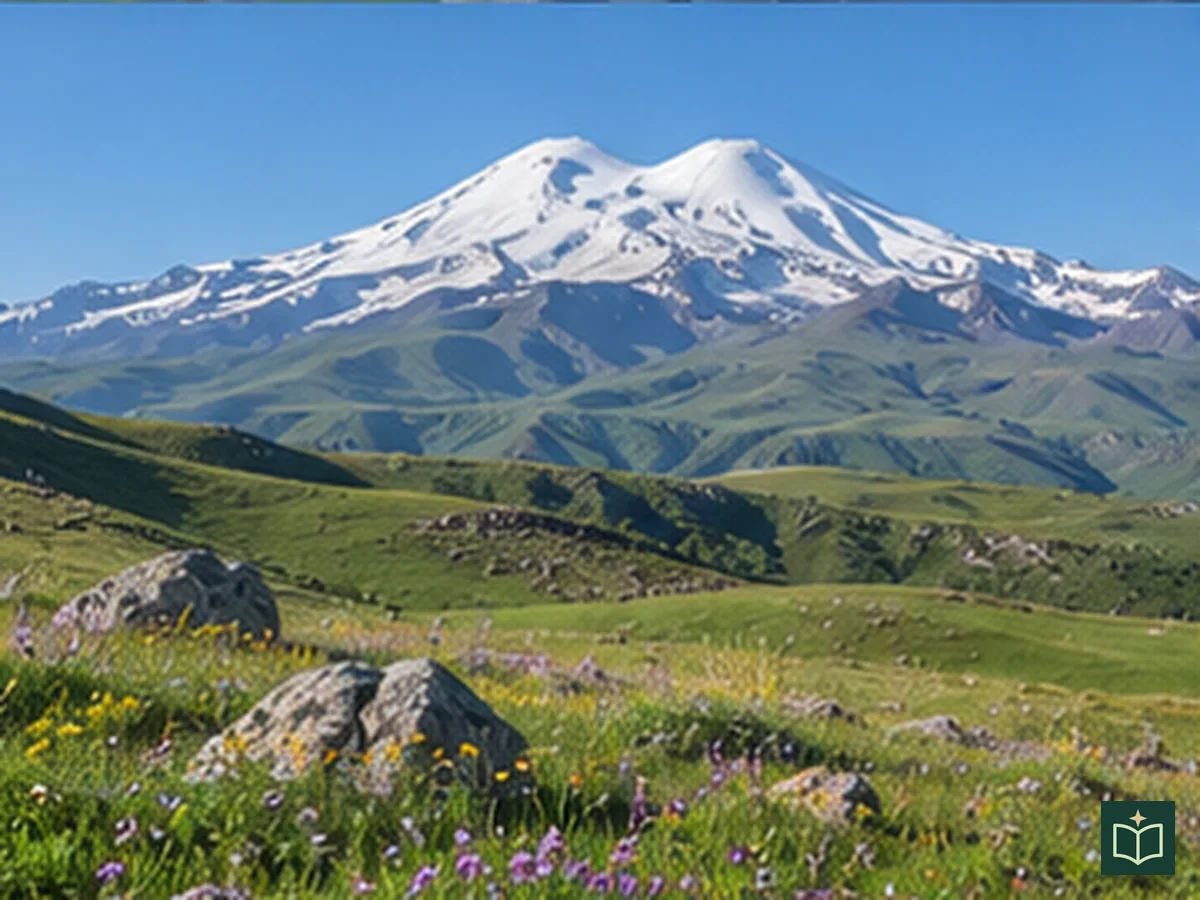
Elbrus is not a folded ridge like most of its neighbours but a dormant volcano with two summits. The western summit reaches about 5,642 metres and the eastern about 5,621 metres. Its last eruption is thought to have occurred roughly two thousand years ago, and it still has fumaroles and a cap of glaciers that feed several rivers. Because it stands slightly apart from the main ridge, its broad snowy slopes are visible from far across the steppe. The eastern summit was first reached in 1829 during a Russian scientific expedition, and the higher western summit in 1874 by a British-led party. Today a cable car carries visitors to around 3,800 metres.
The Caucasus crowd
Behind Elbrus, the next eight summits cluster along a short stretch of the central Caucasus known as the Bezengi area and its neighbours. Dykh-Tau, Shkhara, Koshtan-Tau and Jangi-Tau all exceed 5,000 metres, and Shkhara is the highest point of Georgia. Kazbek, further east, is another extinct volcano and towers above the old Georgian Military Road. The Caucasus formed as the Arabian plate pushed north into Eurasia, the same slow collision that also raised the Zagros mountains of Iran. That link makes the range a distant relative of the folded rocks that shape parts of the Gulf’s northern shore. The pressure continues, so earthquakes remain common across the region.
How Mont Blanc compares
Mont Blanc, on the border of France and Italy, is the highest point of the Alps at about 4,806 metres, a figure that changes slightly with the thickness of its ice cap; a survey in 2021 measured roughly 4,805.6 metres. That is about 836 metres lower than Elbrus. More striking, dozens of Caucasus summits, including all ten in this table, stand higher than Mont Blanc. The Alps remain Europe’s best-known range because they are closer to large populations, crossed by major routes and shaped modern mountaineering. The first ascent of Mont Blanc, in 1786 by Jacques Balmat and Michel-Gabriel Paccard, is often taken as the starting point of the sport.
Why the numbers vary
Lists of Europe’s highest mountains differ for several reasons. Some include subsidiary tops, such as Pushkin Peak on the Dykh-Tau ridge, which some lists give at about 5,100 metres, while others count only summits with enough prominence to be separate mountains. Older Soviet surveys and newer satellite measurements can disagree by tens of metres, especially for Shkhara, Jangi-Tau and Kazbek. The last places in the table are particularly close: Shota Rustaveli Peak, Gestola and Tetnuldi all stand within a few metres of 4,860. For these reasons the values here are rounded and the lower ranks should be read as approximate. The order of the top five, however, is widely agreed.
Why it matters
The Caucasus glaciers supply rivers on both sides of the range, including the Kuban and Terek to the north and tributaries of the Kura to the south. As in the Alps, those glaciers have been shrinking, which affects water supplies, hydropower and the risk of sudden floods from glacial lakes. The range is also a cultural crossroads, home to dozens of languages within a small area. For travellers from the Gulf, the region is increasingly accessible: Tbilisi is roughly a three-hour flight from Dubai, and Kazbek can be seen from the Georgian mountain town of Stepantsminda. Elbrus is one of the Seven Summits, which draws climbers from around the world.
Sources & further reading
Figures are rounded and widely published; check the linked organisations for the latest editions. These organisations do not endorse this website.