Same heat, different numbers
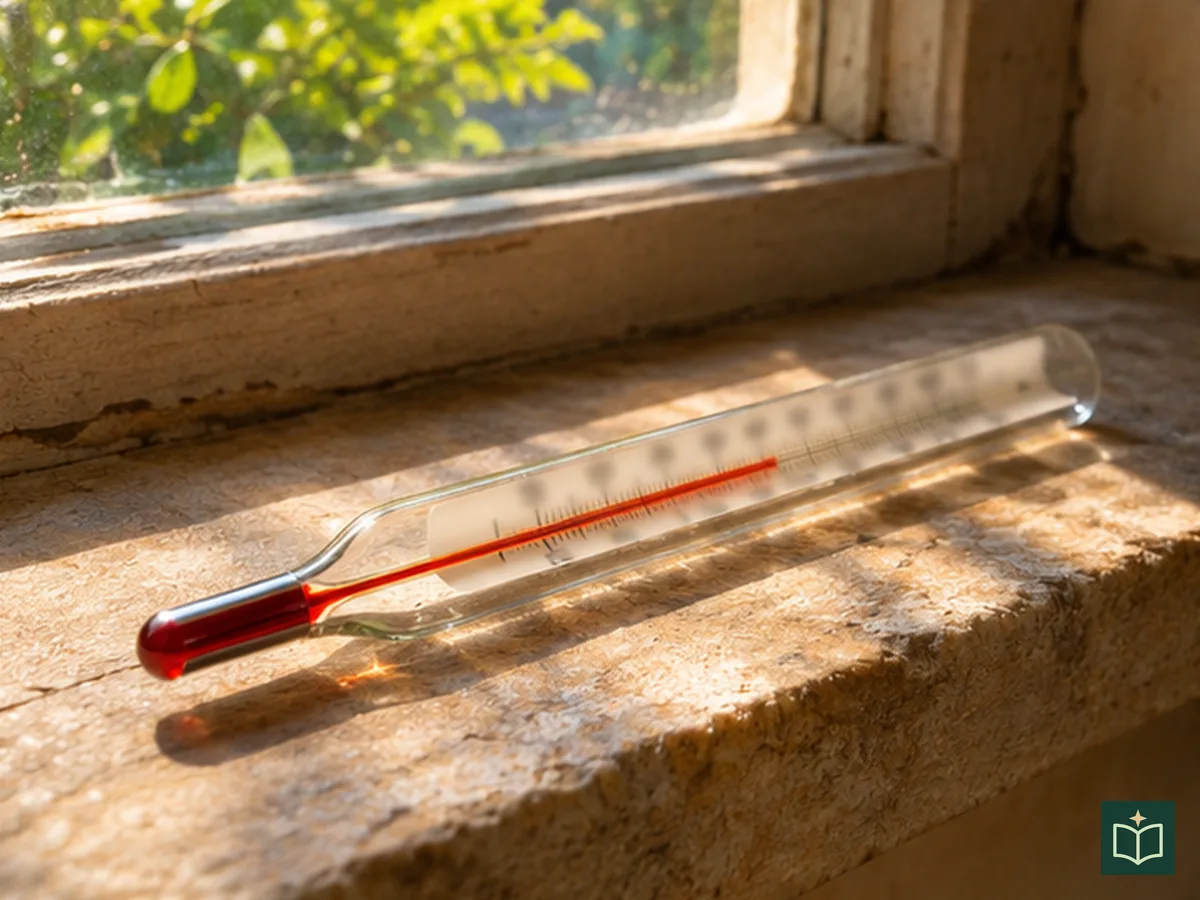
A temperature scale is a ruler for hotness. To build one you need two things: a starting point, the zero, and a step size, the degree. Celsius, Fahrenheit and Kelvin differ on both. On the Celsius scale water freezes at 0 and boils at 100 at sea-level pressure. On the Fahrenheit scale the same points are 32 and 212. Kelvin uses the same step size as Celsius but starts far lower, at absolute zero. None of these is more correct than the others. They are conventions, and each became standard in different places and fields for historical and practical reasons.
Fahrenheit's brine and bodies
Daniel Gabriel Fahrenheit, an instrument maker born in Danzig and working in the Dutch Republic, published his scale in 1724. He was famous for reliable mercury thermometers, and he needed fixed points his customers could reproduce. He set zero at the temperature of a chilled mixture of ice, water and a salt, about the coldest he could reliably produce. He placed freezing water at 32 and healthy body temperature at about 96. Later recalibration put water's boiling point at 212, leaving 180 degrees between freezing and boiling. Normal body temperature now reads about 98.6°F. Fahrenheit's small degrees let people describe weather without decimals, one reason the United States still uses the scale.
Celsius, turned upside down
In 1742 the Swedish astronomer Anders Celsius proposed a scale with 100 degrees between the freezing and boiling points of water. Oddly, he set boiling at 0 and freezing at 100. Shortly after his death in 1744 the scale was flipped into the form used today, with freezing at 0. Long called centigrade, from the Latin for a hundred steps, it was renamed Celsius in 1948. Its decimal logic suited the metric system, and it is now used for weather and daily life in almost every country. In the Gulf, a summer forecast of 45°C is perfectly familiar; the same reading in Fahrenheit is 113°F.
Kelvin and absolute zero
In the nineteenth century physicists realised there is a lowest possible temperature, at which particles have the least possible energy. In 1848 William Thomson, later Lord Kelvin, proposed an absolute scale starting there. Absolute zero is minus 273.15°C, or minus 459.67°F. The kelvin uses Celsius-sized steps, so water freezes at 273.15 K and boils at 373.15 K, and that 45°C Gulf afternoon is 318.15 K. Kelvins are written without a degree sign. Since 2019 the kelvin has been defined by fixing the value of the Boltzmann constant, linking temperature directly to energy, rather than to the properties of water, which had served as its reference for decades.
Converting and the minus 40 trick
Converting between scales takes two steps. From Celsius to Fahrenheit, multiply by 9/5, which is 1.8, then add 32. So 37°C becomes 37 × 1.8 + 32, which is 98.6°F. To go back, subtract 32 and multiply by 5/9: 212°F minus 32 is 180, and 180 × 5/9 is 100°C. Celsius to kelvin is simpler: add 273.15. Because the two everyday scales have different zeros and step sizes, their lines cross at one point. At minus 40, both read the same: minus 40 × 1.8 + 32 equals minus 40. It is a handy check, and a temperature only the coldest places on Earth reach.
Why scientists use kelvin
Kelvin is the base unit of temperature in the International System of Units because it starts from a true physical zero. That matters in equations. Gas laws, for example, say that the pressure of a gas in a fixed volume is proportional to its absolute temperature. Doubling 10°C to 20°C does not double the pressure, but doubling 300 K to 600 K does. Using Celsius or Fahrenheit in such formulas gives wrong answers. Astronomers, chemists and engineers therefore work in kelvin, describing the cosmic microwave background at about 2.7 K. Everyday life sticks with Celsius or Fahrenheit, whose numbers suit human weather far better.
Sources & further reading
- BIPM · The kelvin (SI base unit) ↗
- Britannica · William Thomson, Lord Kelvin ↗
- Britannica · Temperature scale ↗
Figures are rounded and widely published; check the linked organisations for the latest editions. These organisations do not endorse this website.