A desert valley north of Lima
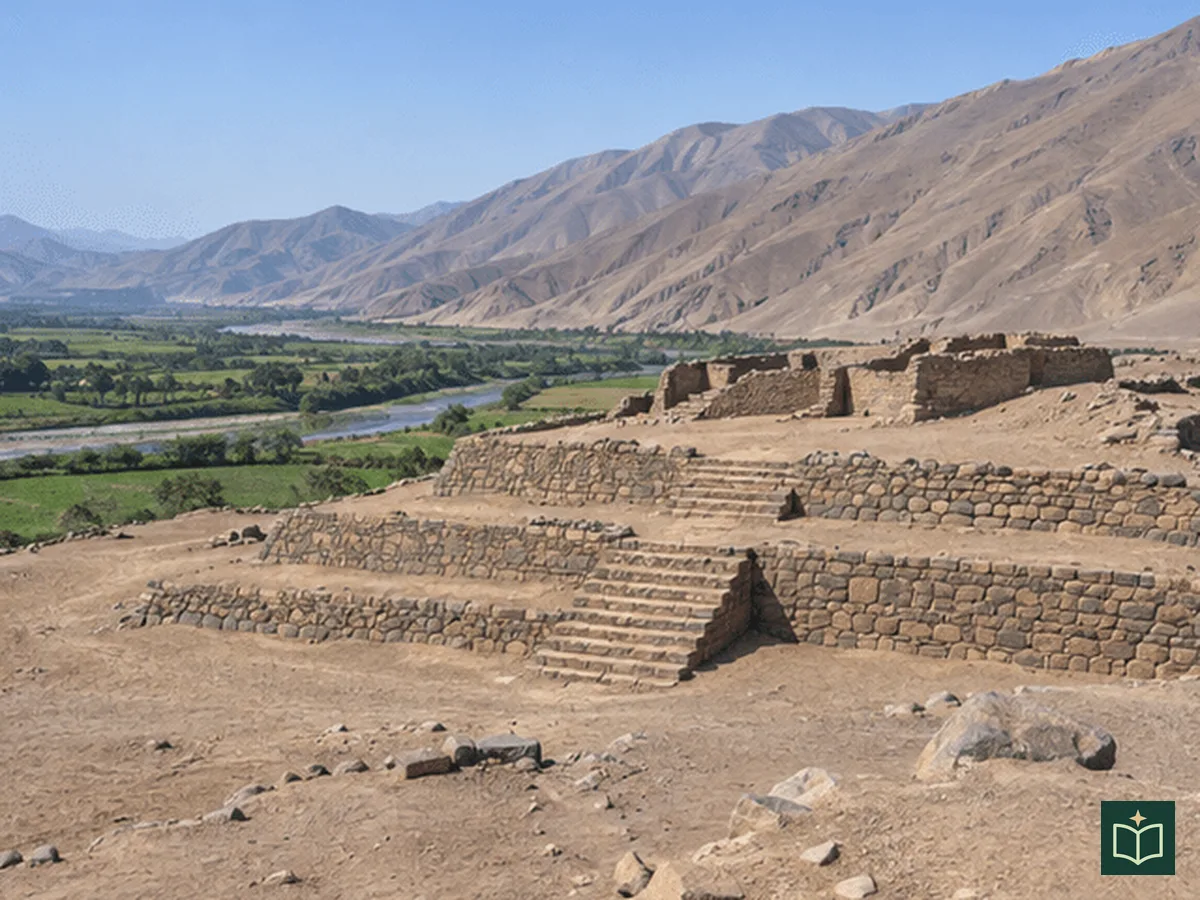
Caral sits on a dry terrace above the Supe River, about 180 kilometres north of Lima and roughly 23 kilometres from the Pacific coast. The site covers more than 600 hectares and includes six large platform mounds, residential areas, plazas and two sunken circular courts. Local people knew there were ruins, and outsiders recorded the site in the twentieth century, but most assumed it was fairly late. That changed in the 1990s, when the Peruvian archaeologist Ruth Shady began systematic excavations. Radiocarbon dates published with colleagues in 2001 showed that Caral’s monuments were being built around 2600 BC, roughly when Egyptians were raising the pyramids of Giza.
What makes it a city
Caral was not a village with a single temple. It had a planned core of monumental buildings and different kinds of housing, from well-built stone compounds near the centre to simpler dwellings further out, which suggests social ranks. The largest structure, the Pirámide Mayor, is a stepped platform roughly 150 by 160 metres at its base and close to 30 metres high, with a staircase leading up to rooms and a fire altar on top. A sunken circular plaza at its foot could hold gatherings. Estimates of the resident population run to a few thousand people, with many more living in related settlements along the valley.
A whole valley of monuments
Caral is the best-studied of some two dozen sites in the Supe, Pativilca and Fortaleza valleys, a region researchers call Norte Chico or Caral-Supe. Several of these sites have their own platform mounds and plazas, and some began even earlier than Caral itself. Together they form one of the world’s small number of places where complex society arose independently, alongside Mesopotamia, Egypt, the Indus Valley, China and Mesoamerica. Among the unusual finds at Caral are 32 flutes carved from pelican and condor bones, and a knotted cord that some researchers suggest may be an early ancestor of the khipu, the record-keeping cords used much later by the Inca.
Built without pottery
One striking feature of Caral is what it lacked. Its builders made no fired pottery, used no metal tools and left no evidence of writing. Archaeologists call this period the Late Archaic, or the preceramic. Food was cooked by other means, such as in gourds or by roasting. The builders filled the platforms with shicras, mesh bags woven from plant fibre and packed with stones. Each bag could be carried by one worker and dropped into place, making construction easy to organise. Some engineers think the loosely packed bags also helped the structures absorb shaking in earthquakes, which are common on this coast, though that idea is still debated.
Fish, cotton and trade
Caral’s economy linked the sea and the valley. The cold Humboldt Current makes Peru’s coast one of the richest fisheries on Earth, and anchovies, sardines and shellfish turn up in large quantities in Caral’s rubbish, even though it lies inland. In return, valley farmers grew cotton, which coastal fishers needed for nets and lines. They also irrigated squash, beans, chilli peppers and guava. Áspero, a related site on the coast, shows this partnership from the other side. Researchers have found no defensive walls, no weapons and no mutilated bodies at Caral, which has led some to argue that trade, ritual and shared feasting held this society together rather than force.
Why it matters
Caral challenged two common assumptions: that civilisation in the Americas came much later than in the Old World, and that cities needed pottery, grain agriculture or writing first. It also shows that monumental building can grow out of coastal fishing combined with farming. The site was gradually abandoned after about 1800 BC, possibly linked to changes in climate and to the rise of other centres. UNESCO listed the Sacred City of Caral-Supe as a World Heritage Site in 2009. Like many Peruvian archaeological sites, it faces pressure from looting, farmland expansion and land disputes. Much of the surrounding valley remains unexcavated, so its story is still being written.
Sources & further reading
Figures are rounded and widely published; check the linked organisations for the latest editions. These organisations do not endorse this website.