Printing circuits with light
Chips are made using a process called photolithography. A silicon wafer is coated with a light-sensitive material, and light is shone through a pattern, called a mask, to project the design of a circuit onto it, much like a photographic slide projector shrinking an image. The exposed areas are then etched or treated, and the process is repeated dozens of times to build up layers. The finer the features to be printed, the shorter the wavelength of light required.
A company from Veldhoven
ASML was founded in 1984 as a joint venture between the Dutch electronics company Philips and chip equipment maker ASM International, starting in a leaky shed next to a Philips office. Based in Veldhoven in the southern Netherlands, it grew into the world's leading supplier of lithography machines. It relies on a network of specialised partners, most notably the German optics company Zeiss, which makes the mirrors and lenses inside its machines.
Extreme ultraviolet
For decades, the most advanced lithography used deep ultraviolet light with a wavelength of 193 nanometres. To print ever smaller features, the industry needed light with a much shorter wavelength. Extreme ultraviolet light, at 13.5 nanometres, was the answer, but producing and controlling it proved extraordinarily difficult. ASML and its partners spent more than two decades and billions of euros developing EUV machines, with the first used in high-volume chip production around 2019.
How the machine works
Inside an EUV machine, a powerful laser hits tiny droplets of molten tin, about 50,000 times per second, turning each into a plasma that emits extreme ultraviolet light. Because EUV light is absorbed by almost everything, including air, the machine operates in a vacuum and uses mirrors instead of lenses. The mirrors are among the smoothest surfaces ever made. The light is bounced off a patterned mask and onto the wafer, with positioning accurate to fractions of a nanometre.
A machine like no other
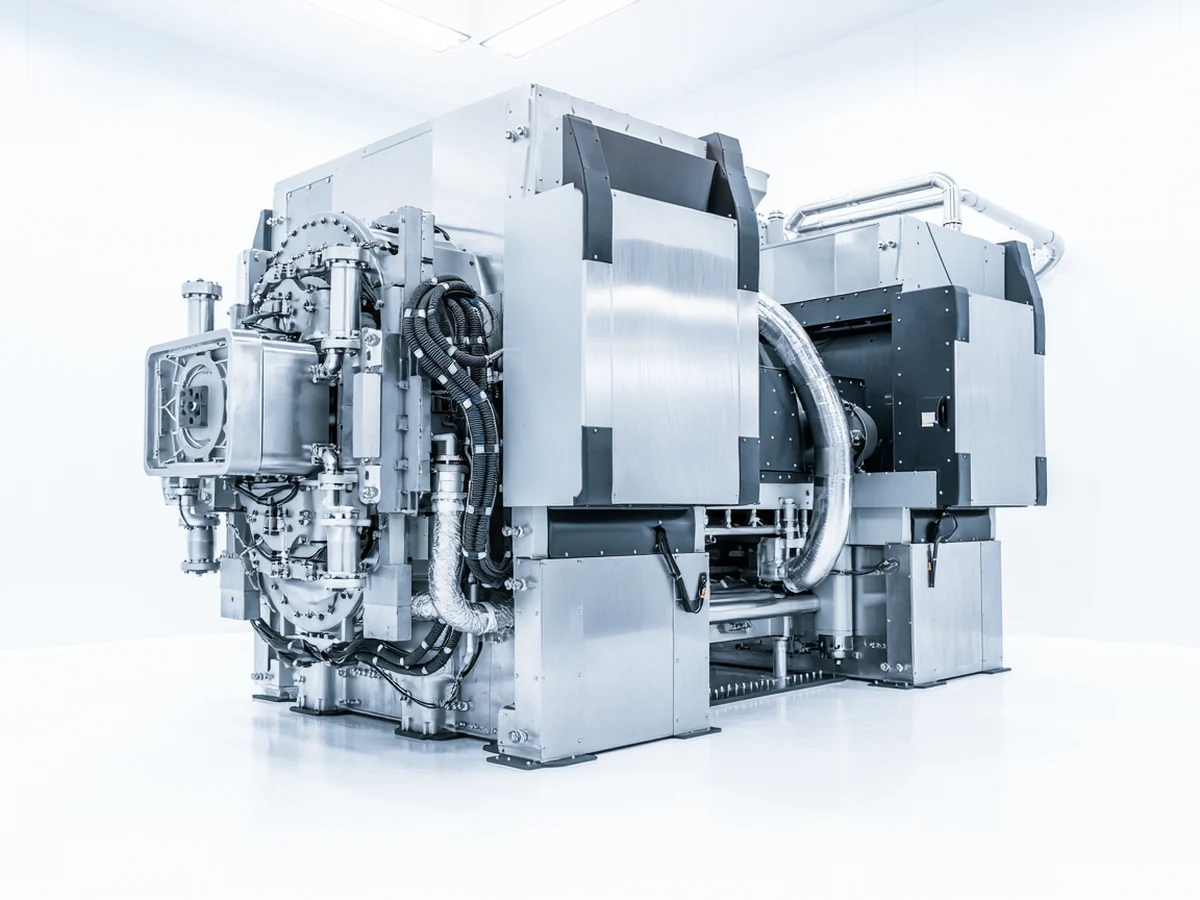
An EUV system is about the size of a bus and contains hundreds of thousands of components. ASML has said that shipping one requires dozens of freight containers and several cargo planes, with installation taking months. Standard EUV machines cost well over 100 million euros, and the newest high numerical aperture versions, which can print even finer features, cost several hundred million euros each. Only a handful of chipmakers can afford them.
A monopoly by necessity
ASML is the only company in the world that makes EUV machines, and its customers include TSMC, Samsung and Intel. Without them, manufacturing the most advanced chips, including those used for AI, smartphones and data centres, would not be possible at current scales. This position has made ASML one of Europe's most valuable technology companies. Its dominance stems not from blocking competitors but from the enormous difficulty of the technology.
Export controls
Because EUV machines are essential for advanced chips, they have become a tool of geopolitics. At the urging of the United States, the Dutch government has never allowed ASML to export EUV machines to China, and since 2023 it has also restricted exports of some of ASML's advanced deep ultraviolet machines. China has been one of ASML's largest markets for older equipment, and Chinese companies are trying to develop their own lithography technology.
Keeping Moore's law alive
In 1965, Intel co-founder Gordon Moore observed that the number of transistors on a chip roughly doubled at regular intervals, a trend known as Moore's law. Progress has slowed, but EUV lithography has allowed the industry to keep shrinking transistors. ASML's roadmap includes machines that will print features for chips through the 2030s. Combined with new transistor designs and advanced packaging, this continued progress supports the growing computing power needed for AI.
Europe's role
While the United States leads in chip design and Asia dominates manufacturing, ASML shows Europe's important place in the semiconductor supply chain. The European Union's Chips Act aims to strengthen the region's industry, and ASML's presence makes the Netherlands central to global technology. The company has expressed concerns about access to skilled workers and has invested heavily in its home region to support growth.
Why it matters
AI depends on computing power, which depends on advanced chips, which depend on ASML's machines. This chain illustrates how the AI revolution rests on a small number of highly specialised companies and how vulnerable global technology can be to disruptions at any single point. ASML's story is also a testament to long-term engineering ambition: a technology many experts once considered impractical now underpins the digital world.
Sources & further reading
Prices are approximate public estimates. Photograph: original AI-generated illustration (Adobe Firefly). Reference organisations do not endorse this website.