Methane is the principal component of natural gas, but the fuel travelling through an energy system is usually a mixture. It may also contain ethane, other hydrocarbons and non-hydrocarbon gases. Processing changes that composition before delivery. The formula CH₄ describes one methane molecule: a carbon atom bonded to four hydrogen atoms. It does not mean a gas field contains pure methane. This distinction connects chemistry to commerce, because composition affects heating value, treatment requirements and the specifications that pipelines and customers expect a supplier to meet.
The molecular formula describes methane, not the exact composition of every natural gas stream.
Natural gas has more than one origin. Thermogenic gas forms when buried organic material changes under heat over geological time. Biogenic methane is produced by microorganisms under suitable conditions. Both routes can contribute to natural accumulations, and some reservoirs contain a mixture. The distinction describes formation, rather than the commercial category of the final fuel. Methane produced long ago and trapped underground is not automatically renewable because microbes were involved. Geologists use evidence such as gas composition and isotopes to investigate how an accumulation formed and evolved.
Gas reservoirs can contain mixtures of origins; biogenic does not automatically mean renewable.
Associated gas occurs with crude oil. It may be dissolved in the oil or present as a separate gas accumulation above it. Non-associated gas occurs in reservoirs that are not associated with crude oil. The distinction helps explain why some gas supply responds to oil-field activity rather than only to the gas price. In either case, a commercial outlet requires infrastructure. A productive reservoir can be far from processing plants and customers. Reservoir setting therefore tells only part of the story of whether gas can become dependable market supply.
These categories describe reservoir association, not whether gas is clean, cheap or easy to produce.
Conventional accumulations usually concentrate hydrocarbons in reservoir rock beneath a trapping seal. Shale gas is held within very low-permeability shale, so its movement towards a well is much more restricted. This geological difference changes how a field is developed. Horizontal wells and hydraulic fracturing are commonly combined to increase access to gas-bearing rock, although they are distinct techniques. Unconventional is not a synonym for shale: tight sandstone and coal seam gas are other examples. In every setting, volume underground and the ability to deliver sustained production are separate questions.
Shale is one unconventional resource; tight sandstone and coal seam gas are other examples.
Resource estimates and proved reserves answer different questions. Technically recoverable resources concern what available technology could recover, without making every volume commercially viable today. Proved reserves are quantities estimated with reasonable certainty to be recoverable under existing economic and operating conditions. Prices, costs, development decisions and new information can therefore change a reserves estimate without changing the amount of rock underground. Neither figure should be read as a fixed countdown to exhaustion. Comparisons also need a consistent definition, reporting date and geographic boundary before their numbers become meaningful.
Categories overlap; this is a decision framework, not a universal proportional diagram.
Wet natural gas may contain methane together with recoverable heavier hydrocarbons, commonly called natural gas liquids or NGLs. Processing can separate those components into valuable product streams. Dry gas is predominantly methane after most recoverable liquids and unwanted components have been removed. The words can be confusing because water is also present in many raw gas streams. Dehydration removes water vapour, while liquids recovery targets hydrocarbons. These are different jobs. A field’s composition therefore affects both the processing equipment it needs and the mix of products it can sell.
“Wet” can refer to liquid-rich composition; water removal is a separate treatment requirement.
Natural gas and liquefied petroleum gas are related through production, but they are not interchangeable names. Natural gas is predominantly methane. LNG is natural gas changed into a liquid by deep cooling. LPG is a product group dominated by propane and butanes, obtainable from gas processing and oil refining. These different molecules have different storage and handling characteristics. A cylinder of LPG is therefore not a small LNG tank. Distinguishing composition from physical state makes product labels clearer and prevents misleading comparisons between gas networks, portable cylinders and ocean-going LNG cargoes.
LPG proportions vary by product and market; LNG is not another name for propane.
Natural gas is colourless and naturally odourless. Many distribution systems add an odorant so that a possible leak is more noticeable. This is a deliberate safety measure, not a natural characteristic of methane. At ordinary ambient conditions, methane-rich natural gas is lighter than air, but that statement needs care around cryogenic LNG: very cold vapour can initially remain denser until it warms. Odorants are not relied upon in the same way throughout every part of the supply chain. LNG facilities and vehicles use specialised detection and monitoring systems.
Odour is not a universal detection method: LNG systems use specialised monitoring.
Gas can be measured by physical volume or by energy content. A cubic metre describes space occupied under specified reference conditions; a kilowatt-hour or British thermal unit describes energy. Converting between them requires the gas’s heat content per unit volume. That factor varies with composition, so a universal one-number shortcut can mislead. Temperature and pressure bases also matter because gas volume changes with conditions. For a sound comparison, align the volume basis and the heating-value convention before applying the multiplication. A clearly labelled unit is part of the information, not decoration.
Always match pressure, temperature and gross/net heating-value conventions before converting.
Combustion of a hydrogen-containing fuel produces water. Higher heating value, also called gross heat content, includes the heat available if that water condenses. Lower heating value, or net heat content, excludes that contribution. The fuel has not changed: the accounting convention has. This matters when comparing energy statistics, equipment efficiencies and fuel costs. An efficiency quoted on a lower-heating-value basis cannot be compared directly with one on a higher-heating-value basis. Read the footnotes before ranking systems, and keep the convention consistent throughout a calculation or infographic.
HHV and LHV describe accounting conventions, not two grades of natural gas.
Exploration begins with an interpretation of the subsurface, not a picture of a guaranteed gas field. Geologists investigate whether a basin has the ingredients needed to generate, hold and preserve hydrocarbons. Geophysical surveys can help identify a prospect worth testing, but an anomaly is not the same as commercial gas. An exploration well supplies direct evidence, followed by further evaluation if the results are promising. The process is therefore a sequence of hypotheses and tests. Each stage can reduce uncertainty, reveal a problem or change the view of the next investment decision.
A promising map does not establish a commercial discovery or prove recoverable reserves.
Seismic surveying uses waves to investigate rock beneath the surface. Energy travels through the ground and some reflects from boundaries where physical properties change. Receivers record the returning signals, which are processed and interpreted to build a view of subsurface geometry. The result can help identify structures, faults and possible reservoirs. It is not a literal photograph, and a striking feature does not automatically prove a commercial gas accumulation. Interpreters combine seismic information with geological knowledge and well data, using each to test the assumptions and limitations of the others.
Seismic images are interpreted physical measurements, not photographs of gas underground.
A gas well is more than a hole leading to a reservoir. It is an engineered system intended to provide access while keeping fluids contained and formations separated. Steel casing and cement are important parts of that system, alongside other well components and controls. Their effectiveness depends on design, installation quality and verification rather than simply on their presence in a diagram. Conditions vary between wells, so a single cutaway cannot represent every construction. The central idea is that productive access and reliable isolation have to be designed together throughout the well’s life.
Conceptual illustration only. Barrier design depends on the well, geology and applicable requirements.
Horizontal drilling changes the direction of the well so that it can remain within a target layer for a longer distance. Hydraulic fracturing changes flow pathways in the surrounding rock. The two techniques are often used together in shale development, but they are not synonyms. A horizontal well does not automatically imply fracturing, and fracturing is not limited to horizontal wells. Their usefulness depends on geology and economics. Evaluating a development also requires attention to well integrity, water management, surface activity and other local impacts beyond the production diagram itself.
Overview only. Water use, well integrity, wastewater and local impacts require separate assessment.
A producing well can bring gas, liquid hydrocarbons and water to the surface together. Separation equipment divides this mixture into streams that can be treated and handled appropriately. This first split should not be confused with producing fully marketable gas. Water vapour, acid gases and heavier hydrocarbons may still remain in the gas outlet and require additional treatment. The exact sequence depends on the fluid arriving from the reservoir. Some operations take place near the well, while others are concentrated at larger plants serving several fields through a gathering network.
Separation is not complete purification; dissolved components and vapours can remain.
Liquid water separation does not remove all water from a gas stream. Water vapour can remain and later create problems as pressure and temperature change. Dehydration reduces that moisture before the gas continues into the network or subsequent processing. It helps manage corrosion and the formation of hydrates, ice-like solids that can obstruct equipment and pipelines. Different technologies suit different gas streams and delivery specifications. The important visual distinction is between removing liquid droplets and reducing water vapour: the absence of visible liquid does not mean the gas is sufficiently dry.
Hydrates are ice-like solids involving water and gas; they are not simply frozen pure water.
Gas sweetening means removing certain unwanted components, especially carbon dioxide and hydrogen sulphide, from a natural gas stream. The term has nothing to do with adding a flavour. These acid gases can affect equipment, processing and product specifications, and hydrogen sulphide is highly toxic. Treatment separates them from saleable gas using a process appropriate to the feed stream. Separation alone does not tell us what happens next: the removed material still needs management. A diagram that ends at clean gas therefore misses part of the plant’s material and environmental balance.
“Sweetening” is industry terminology. Gas treatment does not make the entire value chain emissions-free.
Natural gas liquids can initially leave gas processing as a mixture. Fractionation separates that mixture into individual components or product groups, using differences in boiling behaviour. Ethane, propane, butanes and heavier liquids do not all have the same applications, storage characteristics or market values. The separation creates more specific commercial products from the original stream. It is distinct from merely drying natural gas or removing acid gases. Plant configuration varies with the incoming mixture and the products customers require, so the infographic shows the principle rather than a universal equipment sequence.
Simplified process map. Product slate and equipment vary; not every plant separates every component.
Gas does not travel indefinitely through a pipeline without help. Pressure differences drive flow, while resistance along the route reduces the available pressure. Compressor stations add energy to the gas so that the network can continue transporting it towards delivery points. The equipment may use gas-driven machinery or electric motors, depending on the installation. Compression is therefore both a physical necessity and part of the system’s energy use. A long-distance pipeline is better understood as connected pipes, stations and controls than as one passive tube between a field and a city.
Conceptual pressure story; actual profiles depend on flow, terrain, equipment and network conditions.
Natural gas delivery uses networks with different jobs. Gathering systems collect production and bring it towards treatment. Transmission pipelines transport bulk gas over longer distances between producing regions, storage facilities and demand centres. Distribution systems take gas through local mains and service lines to many individual customers. The route is not identical for every user: a large industrial facility or power station may connect directly to transmission. Understanding these layers helps explain why a country can have abundant gas production yet still face local delivery constraints when a particular network segment lacks capacity.
Large industrial users and power stations may connect directly to transmission systems.
Liquefied natural gas is natural gas cooled into liquid form, typically around minus 162 degrees Celsius near atmospheric pressure. Before this deep cooling, the feed stream must be prepared so that unwanted components do not interfere with the process or product specification. Refrigeration removes heat through specialised equipment, producing a compact cryogenic liquid. LNG is not a different energy source from the gas used to make it. It is a different physical form that makes long-distance shipment practical where a pipeline connection is absent or unsuitable for the route.
Approximate temperature near atmospheric pressure; composition and pressure affect phase behaviour.
Natural gas occupies roughly six hundred times less volume as LNG than in its gaseous form at ordinary reference conditions. This is why a ship can carry a commercially useful quantity across an ocean. The ratio describes volume, not an increase in fuel energy. Liquefaction itself requires energy, and the complete journey includes additional processing and transport. Actual expansion ratios depend on composition and the reference conditions used for the gas. A fair illustration therefore keeps the amount of material constant and clearly labels both the gaseous and liquid states.
A volume comparison, not an energy gain. The exact ratio depends on composition and reference conditions.
LNG and compressed natural gas are two ways to carry natural gas more compactly. LNG relies on cooling until the gas becomes a liquid. CNG remains gaseous but is held under elevated pressure. The distinction changes the storage vessel, supporting equipment and energy required for preparation. It also affects which transport distances and applications make sense. Neither label identifies a completely different fuel molecule. Both describe a physical storage approach. Comparing the options requires an entire system view, including preparation, transport, storage and delivery, rather than choosing solely by how small the fuel becomes.
Neither option creates energy; both require equipment and energy to prepare and handle the fuel.
In the LNG industry, a train is a connected production unit that turns prepared gas into LNG. It is not a railway carrying the finished product. The unit combines equipment such as refrigeration compressors and heat exchangers, with the exact arrangement depending on the technology. A site may operate several trains that share storage, utilities or marine facilities. This matters when reading project announcements: a new train adds processing capacity, while a new tank adds inventory space. Those investments serve different purposes even when they are part of the same expansion.
A train is process equipment, not a railway. Plants can have several trains and shared infrastructure.
LNG storage has to address a large temperature difference between the cargo and its surroundings. Specialised containment holds the cryogenic liquid, while insulation reduces heat entering the tank. It cannot eliminate that heat transfer completely, so vapour management is part of storage rather than an optional extra. Monitoring and protective systems support the overall design. Tanks differ across terminals, ships and smaller installations, making a single cutaway only a conceptual example. The useful idea is that inventory, heat flow and vapour handling are linked: storing LNG means managing all three together.
Conceptual functions, not a construction specification. Storage designs differ by site and scale.
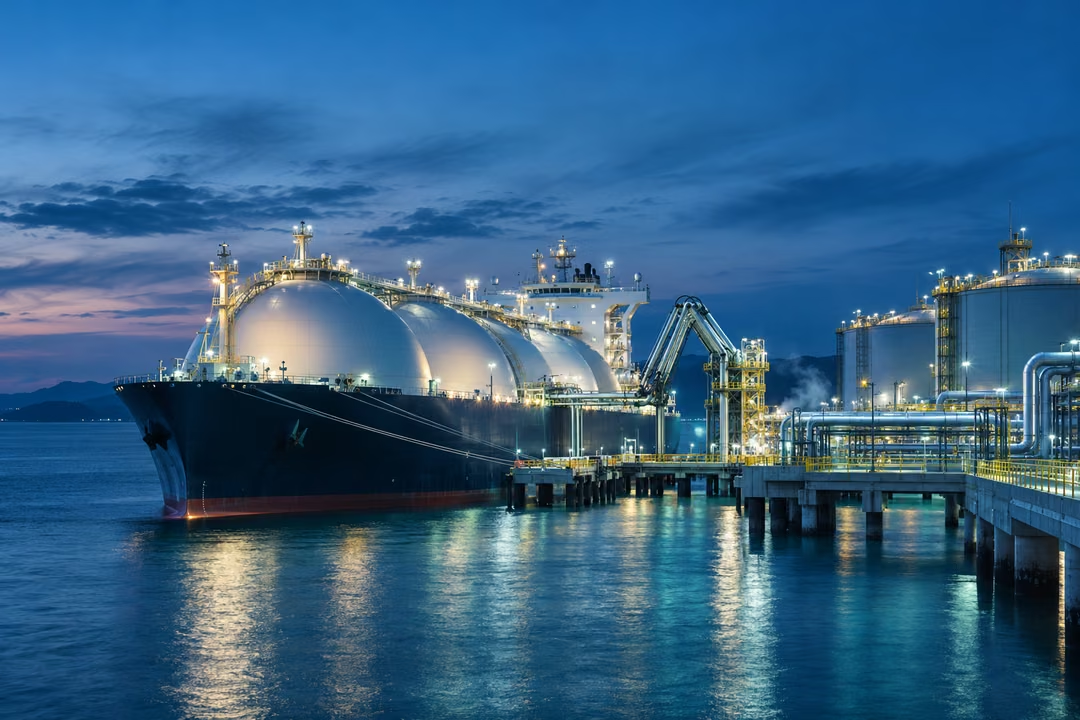
An LNG carrier combines a seagoing vessel with a sophisticated cryogenic cargo system. Its tanks and insulation manage the cold liquid, while gas-handling equipment deals with vapour generated during the voyage. Containment technologies vary, including membrane systems and independent tank designs. The cargo system also has to work with the terminals at both ends of the route. A ship’s usefulness therefore depends on more than its size: loading compatibility, route constraints and onboard equipment matter too. The visible hull is only the outer layer of the engineering that makes LNG shipping possible.
Containment designs include membrane and independent tanks; vessel equipment and capabilities vary.
Insulation slows heat entering LNG but does not stop it entirely. Some liquid consequently evaporates, producing boil-off gas. Ships and terminals have systems to manage this vapour; depending on their design, it may be used as fuel, recovered or re-liquefied. Boil-off should therefore not be equated automatically with methane being vented to the atmosphere. The changing mixture can also alter cargo composition because components do not evaporate equally. This is one reason LNG quality and quantity are measured carefully at transfer points rather than assumed unchanged throughout the voyage.
Boil-off rates and handling options vary. Boil-off does not automatically mean direct methane venting.
Regasification reverses liquefaction by adding heat to LNG until it becomes gas again. Receiving terminals combine this process with cargo transfer, storage, measurement and connection to a delivery network. Heat-exchanger designs and heat sources vary between projects. The gas must also satisfy the requirements of the receiving system. A terminal’s rated regasification capacity is therefore only one part of its practical value: ships must arrive, storage must be available and downstream pipelines must be able to take the output. The chain ends at usable delivery, not at the jetty.
Regasification equipment and heat sources differ; delivery depends on downstream network capacity.
An FSRU is a floating storage and regasification unit: a vessel that can receive LNG, hold it and convert it back into gas for delivery. Some are purpose-built, while others result from conversion of LNG carriers. The approach can offer flexibility, but the vessel is not an entire import system on its own. Mooring arrangements, transfer facilities, pipeline connections and environmental requirements still matter. Its practical output also depends on available cargoes and the receiving network. The defining feature is integration of storage and regasification on a floating platform.
FSRUs still need a suitable location, connections and approvals; floating does not mean infrastructure-free.
An LNG cargo depends on a sequence of connected assets and schedules. Gas production and liquefaction have to make a cargo available; storage and a loading berth have to be ready when the ship arrives. The voyage then meets constraints such as weather, route availability and the receiving terminal’s timetable. Finally, regasification and a delivery network turn the cargo into usable supply. This explains why nameplate capacity at one stage cannot guarantee output from the entire chain. The limiting step can move as maintenance, demand and shipping conditions change.
Schematic logistics sequence. Delays or constraints at one stage can affect the value of the whole cargo.
The United States, Russia, Iran and China head this historical EIA ranking of dry natural gas production. Dry gas is the consumer-grade gas remaining after processing and removal of relevant liquids and impurities. Rankings change when the definition changes: gross withdrawals, marketed production, dry gas, exports and reserves answer different questions. A large producer can consume most of its output at home, while a smaller producer can export a greater share. Read this as a dated production snapshot, not a forecast or a ranking of national energy security.
Historical snapshot: EIA 2023 dry natural gas production ranking; not reserves or LNG exports.
Proved reserves describe gas that geological and engineering analysis indicates can be recovered with reasonable certainty under existing economic and operating conditions. Production describes what flowed out during a period. Dividing reserves by annual output gives a reserves-to-production ratio, but not a reliable date when the gas will run out. Prices, technology, discoveries, development, revisions and changing production all move the numerator or denominator. Keep both units and dates visible: a stock measured at year-end cannot be treated as the same quantity as an annual flow.
Proved reserves depend on economic and operating conditions and can be revised.
The United States led global LNG exports in 2024, averaging 11.9 billion cubic feet per day. EIA identifies Australia and Qatar as the other two leading exporters and Russia as fourth, at 4.4 billion cubic feet per day. These are gas-equivalent volumes of LNG exports, not tonnes of LNG or the countries’ entire natural gas production. Liquefaction capacity, maintenance, access to ships and domestic demand all influence export flows. This dated snapshot deliberately avoids treating export-terminal capacity as if it were gas actually shipped during the year.
Historical EIA 2024 snapshot. Australia and Qatar are not ordered here; this is LNG, not total gas exports.
Pipeline trade moves gaseous fuel through a fixed connection between markets. LNG trade adds a different chain: cooling gas to a liquid, loading specialised vessels, crossing the sea, then regasifying it. Both routes need functioning infrastructure at each end. Shipping introduces destination options but also terminal constraints, vessel availability and maritime exposure. Pipelines can offer continuous flows but remain tied to their physical corridors. There is no universal winner on cost: distance, utilisation, financing, energy consumption and the receiving network all shape the comparison for a particular project.
Route comparison is conceptual; cost depends on distance, utilisation and project-specific conditions.
Natural gas markets are connected, but their prices are not identical. Moving fuel between them requires pipeline access or a complete LNG chain, with transport costs, fuel use, terminal fees and time. A higher destination price does not automatically mean a cargo can reach that market profitably or promptly. Local demand, storage and bottlenecks still matter. More flexible LNG trade can link regional markets more closely, yet it does not erase geography. Always compare the delivery point, period, currency and energy unit before interpreting an apparent price gap.
This is a price-formation framework, not a live quotation or a guaranteed arbitrage opportunity.
Underground storage uses geology rather than giant buried metal tanks. Depleted reservoirs and suitable aquifers hold gas in pore spaces within rock; salt caverns provide engineered cavities. Each type has different costs, operating characteristics and rates of injection or withdrawal. Base gas supports the pressure and operation of the facility, while working gas is the portion available for routine cycling. A large inventory alone does not guarantee adequate supply on the coldest day. Operators must also consider deliverability, which can change as pressure and the quantity of stored gas fall.
Storage performance is site-specific; total gas in place is not all withdrawable working gas.
In the United States, working gas storage commonly builds during April through October and declines during November through March. The seasonal pattern helps bridge the difference between relatively steady production and weather-sensitive demand. It is not a promise that every summer week adds gas or every winter week withdraws it. Hot weather can increase gas use for electricity, and unusual temperatures, maintenance or supply interruptions can alter the balance. Compare inventories with relevant seasonal history and expected demand, while remembering that storage volume and withdrawal speed measure different aspects of readiness.
Typical US pattern, not a rule for every country or every week.
A market may have enough gas over a whole year and still struggle during a short demand surge. Severe cold raises heating requirements, while heatwaves can lift gas-fired electricity generation for cooling. Production, pipelines, storage withdrawal and local distribution must respond at the same time. Short-term alternatives may be limited, allowing prices to move sharply. Resilience therefore depends on more than annual supply totals. The useful question is whether sufficient fuel can reach the required place at the required rate, alongside measures that can safely reduce or shift demand.
Illustrative system logic; the timing and severity of a peak differ by region.
An interconnector joins neighbouring gas systems and can give a market access to additional sources, storage or import terminals. Its value depends on practical details: available capacity, pressure, operating rules and whether physical reverse flow is possible. A line on a map cannot demonstrate that gas can move freely in either direction. Connections also do not create fuel during a shortage shared by every neighbour. Evaluate interconnectors as part of a wider system that includes upstream supply, contractual access, downstream bottlenecks and demand flexibility during stressed conditions.
A connection is not unlimited supply; reverse flow requires appropriate technical arrangements.
Supply diversification has several dimensions. Buying from more companies helps little if they depend on the same plant, pipeline or maritime passage. A resilient portfolio considers production origins, transport routes, contract structures and the buffers available when something fails. Storage and demand flexibility can complement imports, but their capacity and operating limits remain important. Diversification also involves costs and trade-offs rather than a free guarantee of security. Look for genuinely independent options and workable substitution during stress, then test whether the receiving network can deliver those options to consumers.
Conceptual resilience framework; diversity reduces some exposures but cannot remove every risk.
Henry Hub refers to a physical natural gas hub in Louisiana and underpins the standard NYMEX futures contract. TTF is the Dutch virtual trading point, with ICE futures quoted in euros per megawatt-hour. Platts JKM assesses the spot value of delivered LNG cargoes into Japan, South Korea, China and Taiwan. These benchmarks therefore describe different locations, delivery arrangements and market instruments. A numerical comparison without unit conversion and timing alignment is misleading. Even after conversion, a spread can reflect transport, market conditions and contract differences rather than an instantly available profit.
Benchmark descriptions, not live prices. Futures, physical spot trades and assessments are distinct.
A megawatt-hour and a million British thermal units both measure energy. Using the conventional rounded conversion, one MWh equals about 3.412 MMBtu. A hypothetical gas quotation of three dollars per MMBtu therefore corresponds to roughly 10.24 dollars per MWh of gas energy. This is a unit conversion, not the cost of producing a MWh of electricity. A power station needs more fuel energy than the electricity it delivers. Comparing with a euro-denominated benchmark also requires an exchange rate, matching delivery periods and consistent price conventions.
Hypothetical price; energy-unit conversion only. No exchange rate, transport cost or generation efficiency included.
A spot transaction addresses a relatively near-term cargo requirement, while a long-term agreement allocates deliveries and obligations over an extended period. That difference in duration does not, by itself, tell you how the gas is priced. Term contracts can reference oil prices, gas hubs or a combination of indices. They may also contain different volume tolerances and destination restrictions. Read duration, pricing, quantity and flexibility separately. The structure distributes risk between buyer and seller, but neither a spot purchase nor a multi-year commitment can eliminate all uncertainty about future conditions.
Contract structures vary. Long-term does not automatically mean fixed-price or destination-flexible.
Some LNG contracts link the gas price to a specified oil benchmark through an agreed formula. A multiplier, constant and sometimes additional provisions translate the oil reference into the gas price. Averaging periods and lags mean that a change in oil prices need not appear immediately in a delivered gas invoice. Other contracts use gas-hub indices or hybrid structures instead. The exact wording matters: there is no single universal oil-to-gas conversion factor. Understand the pricing mechanism before attributing a movement in a contract price solely to local gas supply or demand.
Schematic formula only. Coefficients, lags, floors and ceilings vary between contracts.
The standard NYMEX Henry Hub Natural Gas futures contract represents 10,000 MMBtu. Its minimum price increment is 0.001 dollars per MMBtu, so one tick changes the contract value by ten dollars. A movement of one dollar per MMBtu changes it by 10,000 dollars before costs. These specifications describe the standard NG contract; smaller products have different quantities. Futures involve leverage, variation margin and expiry arrangements, including physical delivery for this contract. The collateral posted is not a cap on potential loss. This arithmetic explains exposure rather than recommending a trade.
CME standard Henry Hub NG specifications. Margin is collateral, not maximum loss; education only.
Heating degree days summarise how far outdoor temperatures fall below a chosen reference. With the common US base of 65 degrees Fahrenheit, a day averaging 45 degrees has 20 heating degree days. Daily values can be summed across a month or winter. The index helps compare weather-related heating needs, but it does not directly measure gas consumption. Building insulation, equipment, behaviour, population and alternative heating fuels also matter. Other applications can use different base temperatures, so a degree-day comparison needs a consistent definition as well as the same geographical coverage.
US 65°F base example. Degree days are a weather index, not measured fuel consumption.
A storage announcement is more useful when placed in context. The level of working gas shows available inventory, while the season helps explain whether that level is unusual. Weather expectations affect how quickly supplies may be required, and deliverability governs how much can actually leave storage in a day. Production, imports and pipeline constraints also shape the outlook. Markets can respond to a surprise relative to expectations rather than to the inventory number alone. Avoid turning a simple increase or decrease into a mechanical price prediction without examining the wider balance.
Storage is one influence on prices. A larger inventory does not guarantee a falling market.
Power markets often rank supply offers from lower to higher prices to meet demand while respecting system limits. Gas-fired generators incorporate fuel costs and the amount of fuel required for each unit of electricity, alongside other operating costs. When a gas unit is needed at the margin, changes in gas costs can influence the wholesale power price. This does not mean every electricity unit burns gas or every market follows identical rules. Congestion, plant availability, start-up requirements and reliability can alter dispatch, while retail bills include components beyond wholesale generation.
Simplified wholesale-market logic. Rules, congestion and reliability requirements vary by power system.
A business exposed to a local gas price may use a contract linked to a different benchmark. The difference between those prices is called basis, and it can change over time. A pipeline restriction or local demand surge can widen the gap even if the benchmark moves little. Hedging the broad market price therefore does not necessarily eliminate the actual purchase or sales exposure. Timing and quantity mismatches create further complications. Basis instruments can address some differences, but their availability and fit must be assessed rather than assuming that any gas contract is an exact substitute.
Conceptual education. Basis depends on location, timing and product; a hedge can remain imperfect.
A hedge aims to offset a defined exposure, but it introduces practical requirements of its own. Quantity, location and timing must match sufficiently for the offset to work as intended. Futures positions can also require cash when prices move, even if the underlying business later benefits from that movement. This creates a distinction between the economics of the overall position and the liquidity needed to maintain it. Counterparty obligations, operational changes and transaction costs add further considerations. A sensible evaluation starts with the exposure being managed, rather than treating a financial contract as protection against every possible outcome.
Educational framework, not a trading strategy. Futures losses can exceed initial margin.
A combined-cycle gas plant connects two thermodynamic cycles. Burning gas produces hot gases that drive a combustion turbine. Instead of discarding all the exhaust heat, a heat recovery steam generator uses it to raise steam for another turbine. The additional electricity improves fuel conversion compared with using the combustion turbine alone. Real configurations differ, and some plants burn supplementary fuel in duct burners. Efficiency also changes with operating conditions. The useful idea is recovery of otherwise wasted heat, not the creation of energy without fuel or the elimination of combustion emissions.
Simplified combined-cycle arrangement. Some plants add supplementary fuel; efficiency varies by design and operation.
Annual fuel utilisation efficiency, or AFUE, compares annual useful heat output with annual fuel input for a heating appliance. In a simplified 90 per cent example, 100 units of fuel energy yield 90 units of useful appliance heat. This ratio does not describe every loss between the fuel supply and a warm room. Ducts or pipework, controls, building insulation and operating conditions affect the wider result. For gas and oil equipment, the AFUE definition also excludes electrical energy. Keep the boundary clear when comparing appliance ratings or estimating whole-building energy needs.
Hypothetical 90% AFUE example. Actual performance and whole-building losses depend on equipment and installation.
Electricity supply and demand must remain balanced as consumption, weather and equipment availability change. Gas plants can provide adjustable generation, but flexibility is broader than one fuel. Storage, demand response, interconnection and other controllable resources can also help. Different resources respond at different speeds and for different durations. A gas unit still needs a reliable fuel supply and has operating limits, start-up requirements and emissions. Evaluate the service the system needs, then compare available ways of providing it. Installed capacity alone does not establish that a resource can perform every balancing task.
Capabilities vary by technology and installation. Gas flexibility depends on fuel delivery and plant availability.
Natural gas can supply both energy and raw material in conventional ammonia manufacture. Reforming methane produces hydrogen, which is combined with nitrogen obtained from air to make ammonia. Some gas is also consumed to provide process energy. This distinction matters: a feedstock contributes atoms to chemical production, rather than simply being burned for heat. Ammonia supports nitrogen fertiliser manufacture and other industrial uses, but alternative hydrogen routes and feedstocks exist. Comparing production technologies requires attention to energy requirements, process emissions and the origin of the hydrogen, rather than treating all ammonia as identical.
Simplified conventional route. Ammonia can also be produced through other feedstocks and technologies.
Steam methane reforming uses high-temperature steam to produce hydrogen from a methane-containing feedstock. Reforming creates a mixture including hydrogen and carbon monoxide; a subsequent water-gas shift reaction produces additional hydrogen and carbon dioxide. Separation then purifies the hydrogen. The process needs energy and generates carbon emissions, even though using hydrogen itself may produce no carbon dioxide at the point of use. Any carbon capture must be evaluated by its actual coverage and performance, alongside upstream methane emissions. Assess the full production pathway rather than inferring climate performance from the hydrogen molecule alone.
Process overview, not a balanced reaction diagram. Climate impact depends on upstream emissions, energy and any carbon capture.
EIA lists a natural gas combustion factor of 52.91 kilograms of carbon dioxide per MMBtu of fuel energy. It is a useful accounting coefficient, but it answers a narrow question: emissions from burning the gas. It is not a lifecycle footprint and does not include upstream methane or all energy used in processing and transport. Nor is it a figure per MWh of electricity, which depends on conversion efficiency. Climate comparisons need consistent system boundaries, energy outputs and greenhouse-gas metrics, so a single chimney measurement should never be presented as the complete chain.
EIA combustion coefficient, not lifecycle CO₂-equivalent or emissions per MWh of electricity.
Methane can escape through equipment leaks, deliberate venting or incomplete combustion. These emissions affect the climate performance of gas and represent product that fails to deliver its intended service. Different monitoring tools reveal different parts of the problem: satellites can identify large sources, while on-site surveys can locate smaller component leaks. Detection alone is not equivalent to elimination. Operators need to quantify relevant releases, repair or replace equipment where appropriate and verify the result. Measurements also need time context, because a brief observation does not automatically establish a facility’s annual emissions.
Methane emissions can be intentional, accidental or caused by incomplete combustion. Detection methods have different limits.
Venting releases gas directly, whereas flaring burns it. Because natural gas is mainly methane, the distinction matters for greenhouse-gas emissions. A working flare converts much of the methane into carbon dioxide, but incomplete combustion can still release methane and other pollutants. Neither practice should be described as emission-free. Where technically and safely possible, capturing gas, using it or avoiding the release can reduce waste and emissions. The relevant assessment considers equipment performance, operating circumstances and available alternatives, rather than assuming that the presence or absence of a flame proves a complete climate outcome.
Flaring is not zero-emission. Operational safety requirements and practical recovery options must be assessed.
Biogas from anaerobic digestion contains methane mixed with carbon dioxide and other components. Upgrading removes carbon dioxide, water and unwanted contaminants to produce biomethane suitable for particular uses. Injection into a gas network requires the relevant quality and connection conditions, not merely a claim that the fuel is renewable. Pressure, energy content and contaminants matter for safe, reliable operation. Climate performance also depends on feedstock handling, processing energy and methane losses. Biomethane can use parts of existing infrastructure, but its renewable origin does not remove the need for measurement, maintenance and careful lifecycle accounting.
Grid specifications vary. Biomethane remains methane and requires careful control of leakage.
A gas headline can sound precise while mixing different concepts. Start by identifying whether it describes production, exports, reserves or infrastructure capacity. Then check the period and whether the figure is measured, estimated or forecast. Units matter: a daily flow is not an annual total, and a gas volume needs an energy-content assumption before conversion to energy. Finally, examine the route and delivery timing. A new resource or terminal does not instantly become usable supply everywhere. Following these questions turns a dramatic headline into a more disciplined reading of the underlying evidence.
An interpretation checklist, not a price forecast. Follow the original dataset and its definitions.