
When the payment
chain slows.
The US banking disruption exposed a distinction that matters: a problem at one institution can interrupt a payment without bringing every bank’s systems down.

A disruption.
Several different experiences.
Customers reported trouble with US banking services on Monday, 16 November. Gulf News captured the initial uncertainty, including problems with access and transactions. Subsequent reporting supplied a narrower explanation and a recovery update. [9]
Chase attributed its problem to a software bug in internally hosted hardware systems and said there was no evidence of a cyber cause. It said spillovers involved transactions to which it was a party. That is the bank’s account of the cause and scope, rather than an independent forensic finding. [1]
| Institution / network | Reported position | What it means |
|---|---|---|
| JPMorgan Chase | Confirmed technical disruption | Identified a software bug; later reported normal transaction posting. [2] |
| Bank of America | Normal systems reported | Told CBS its systems were operating normally despite customer reports. [3] |
| U.S. Bank | Counterparty delays | Said its own systems were not directly affected; some cross-bank Zelle payments could be delayed. [2] |
| Zelle | Network operational | Said the network was working; problems at a participating institution could delay payments. [2] |
| Capital One & Truist | Normal operations reported | Both reported normal operations in statements carried by NBC. [2] |
This is a comparison of statements, not a ranking of reliability or a complete inventory of affected services. Customer experiences can differ by channel and transaction.
A Chase disruption and payment spillovers.
The recovery update narrows the present-tense headline. It does not document the outcome of every individual payment.
A single failure at every named bank.
The reviewed coverage does not provide a complete affected-account count, quantified losses, or a public engineering postmortem. It also does not establish a shared cause with the recent Microsoft or aviation disruptions. [2]
See the connections.
Open an image to read it at full size, or download its individual PNG. The diagrams simplify mechanisms; they are not a reconstruction of Chase’s internal systems.
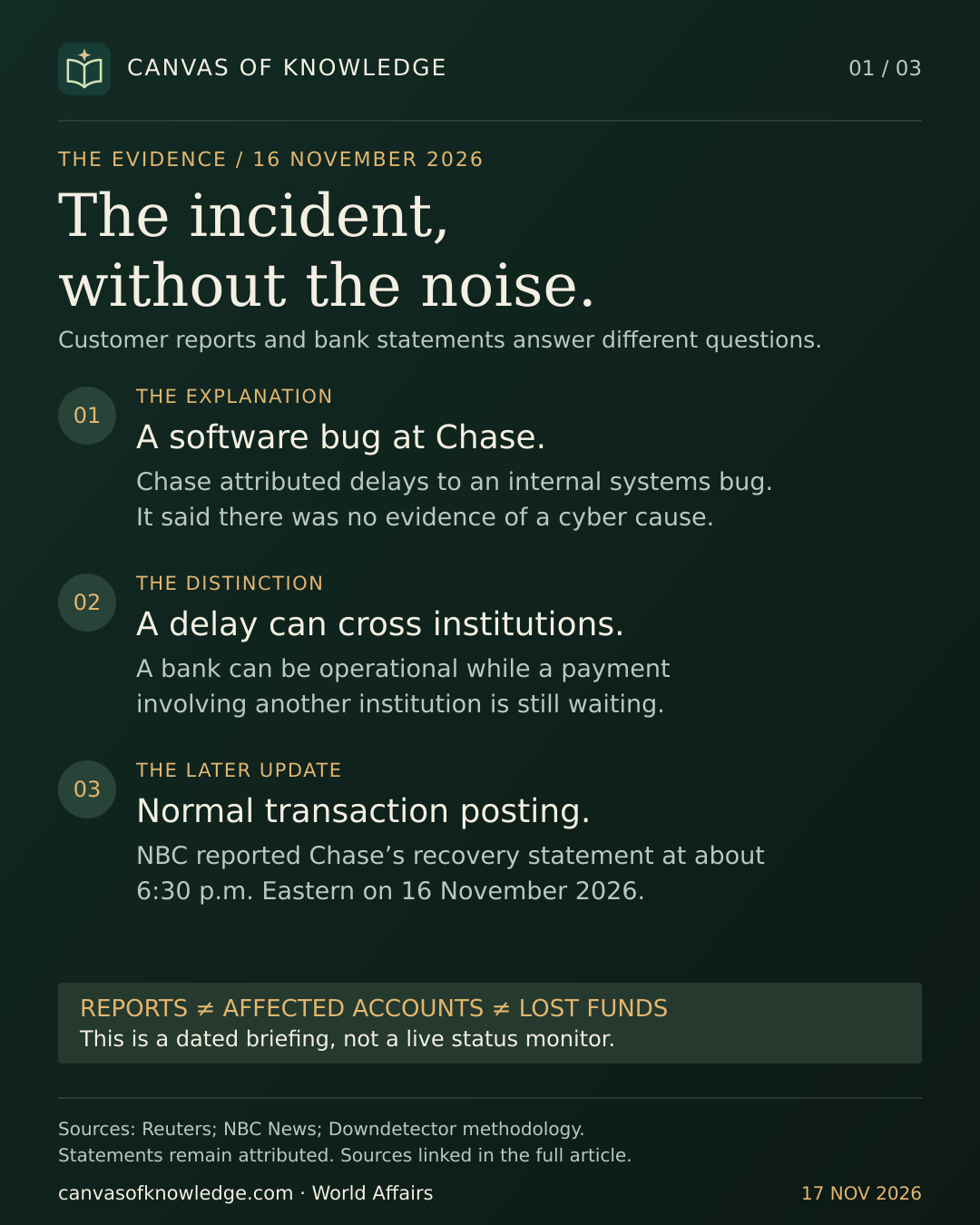
The incident, without the noise
Separate reported disruption, the bank’s explanation and the later recovery update.
Download PNG ↓SVG ↓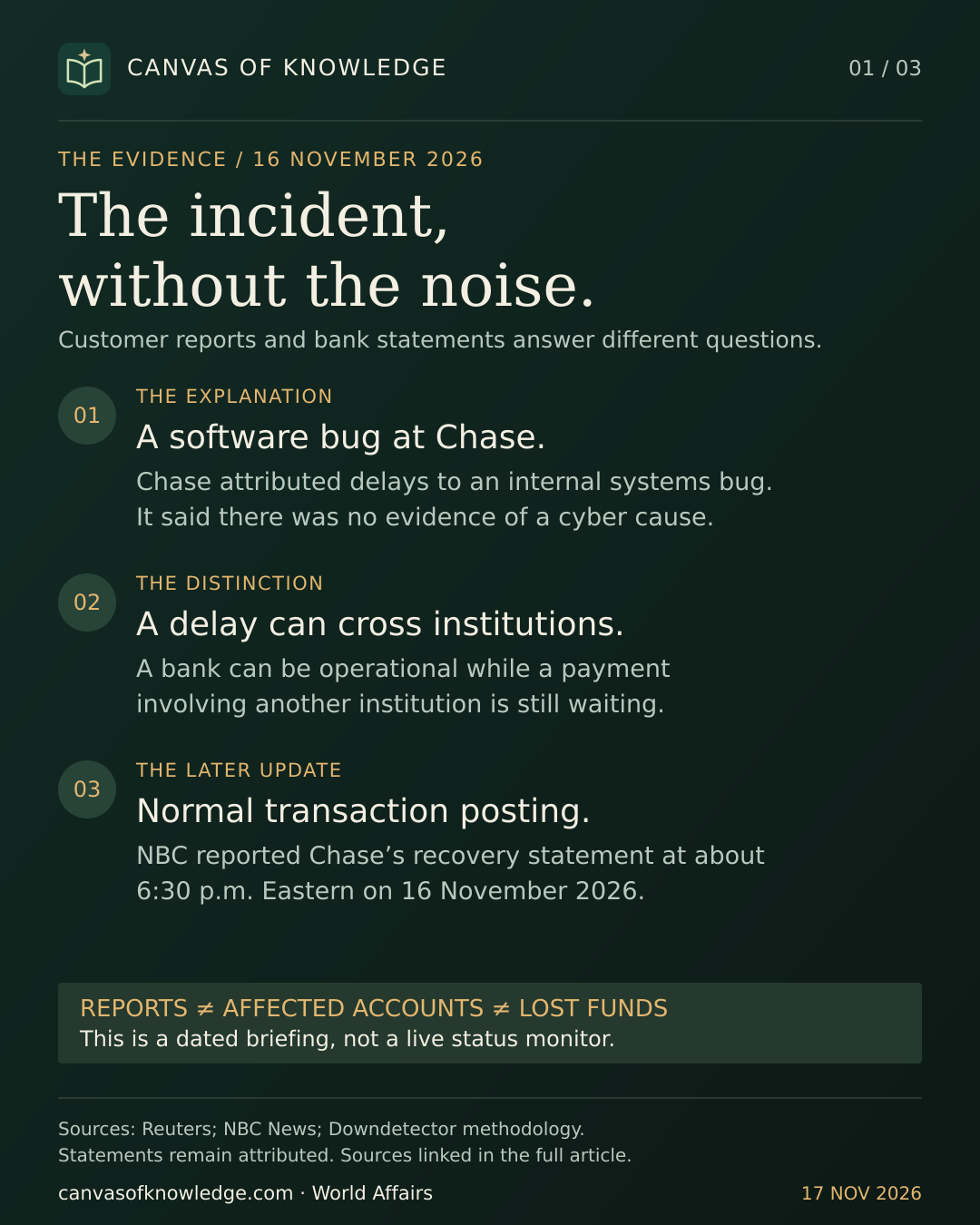
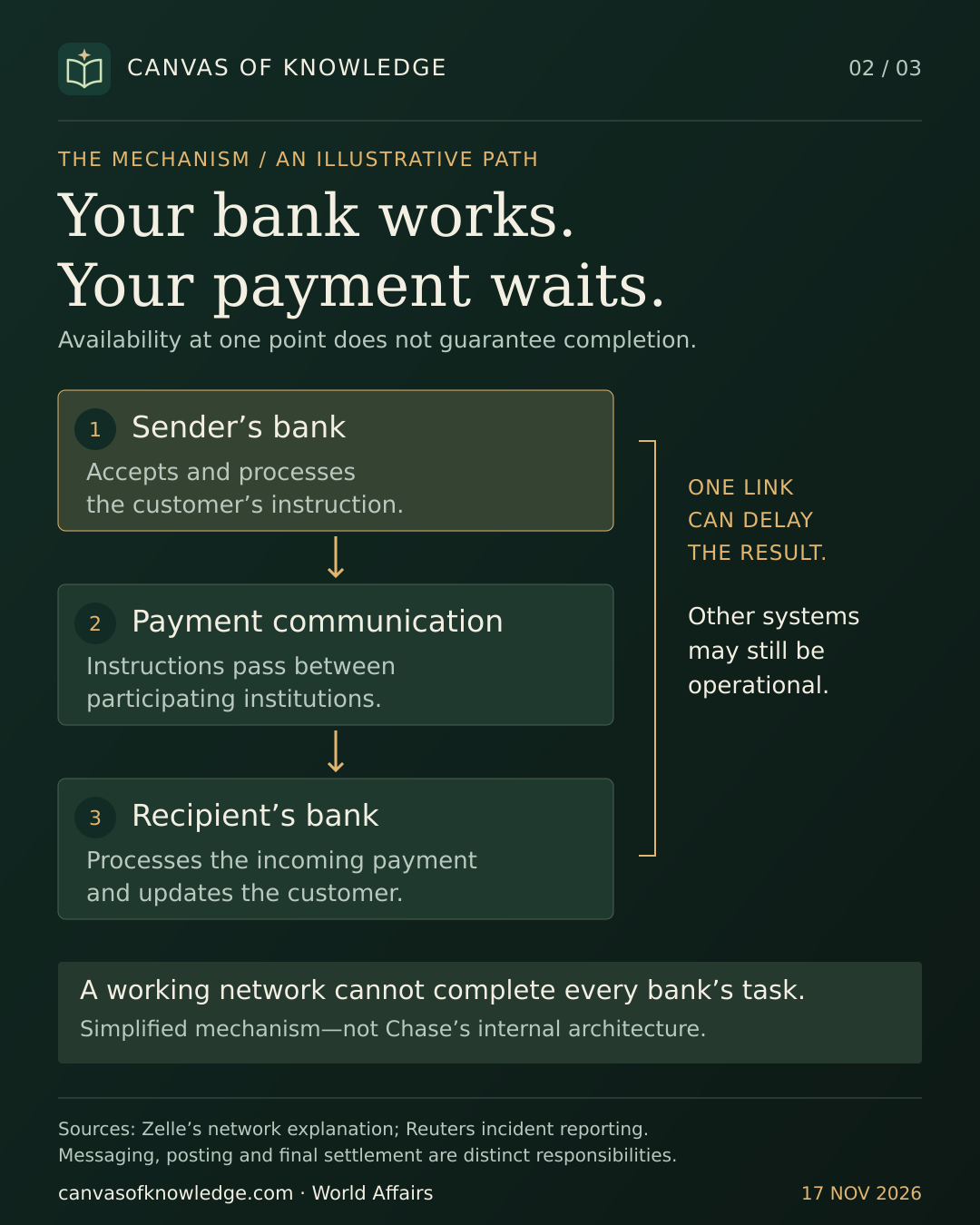
How a delay travels
A simplified payment path shows why a working bank can still have a delayed transaction.
Download PNG ↓SVG ↓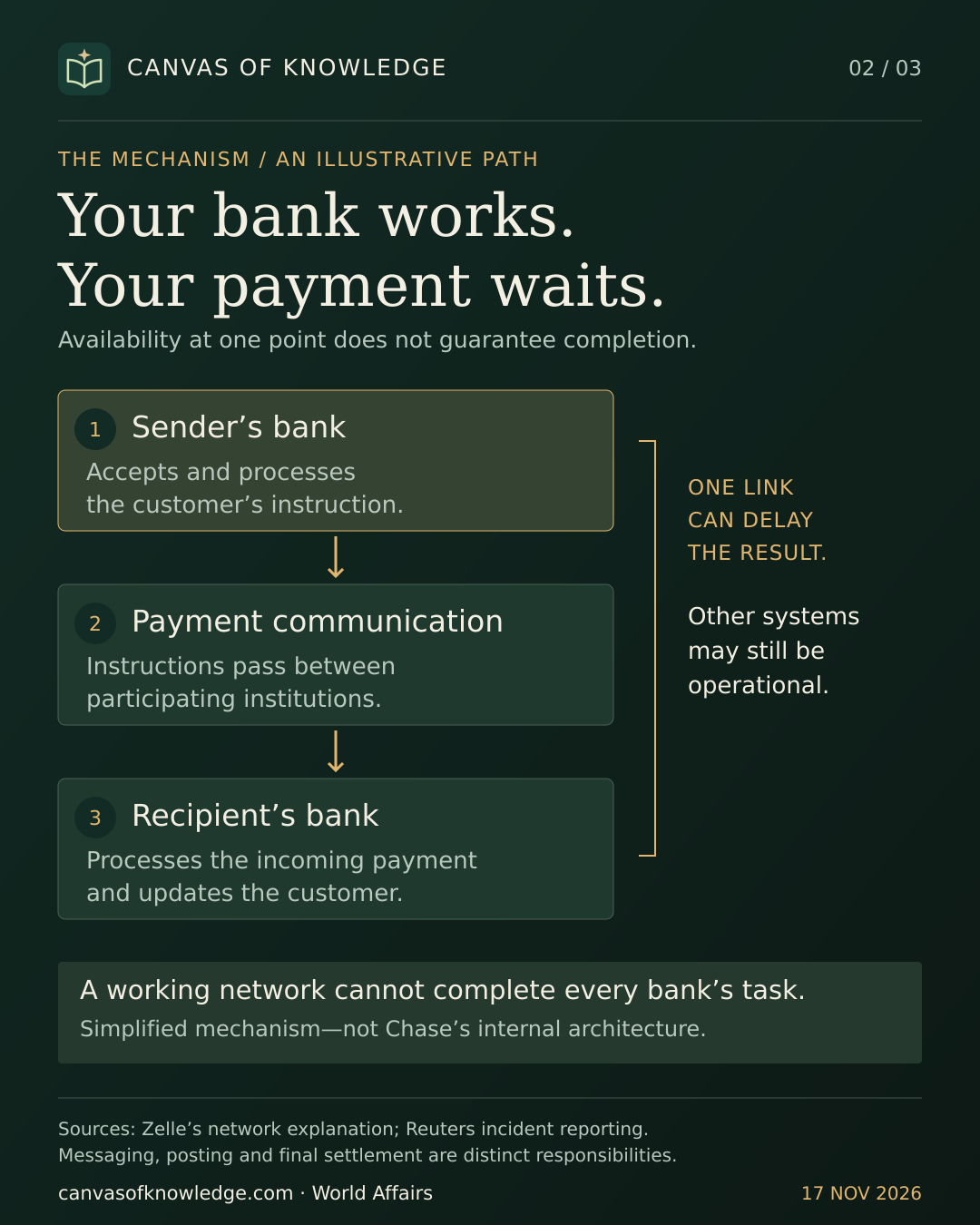
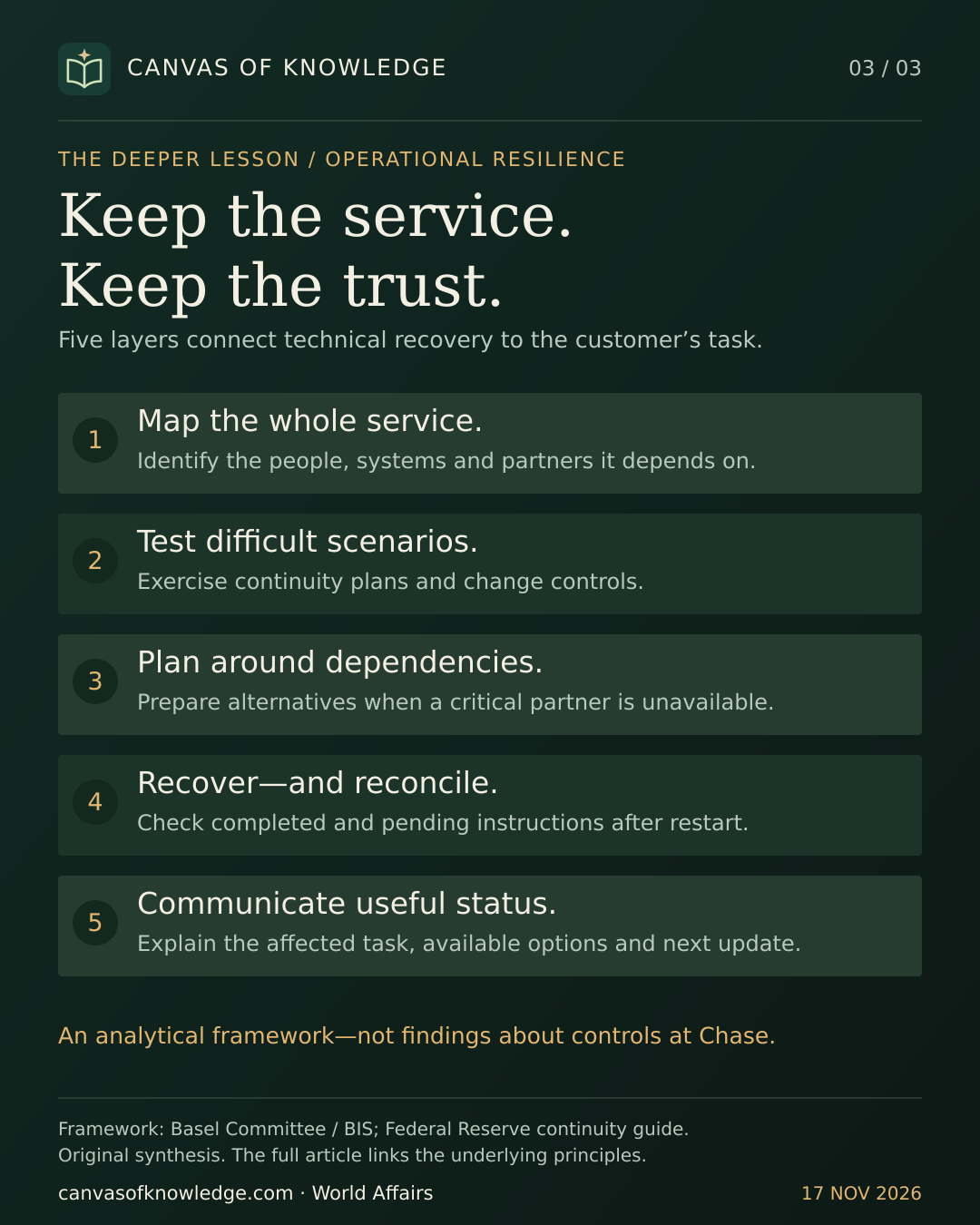
What resilience requires
Five practical layers connect continuity planning to the customer’s experience.
Download PNG ↓SVG ↓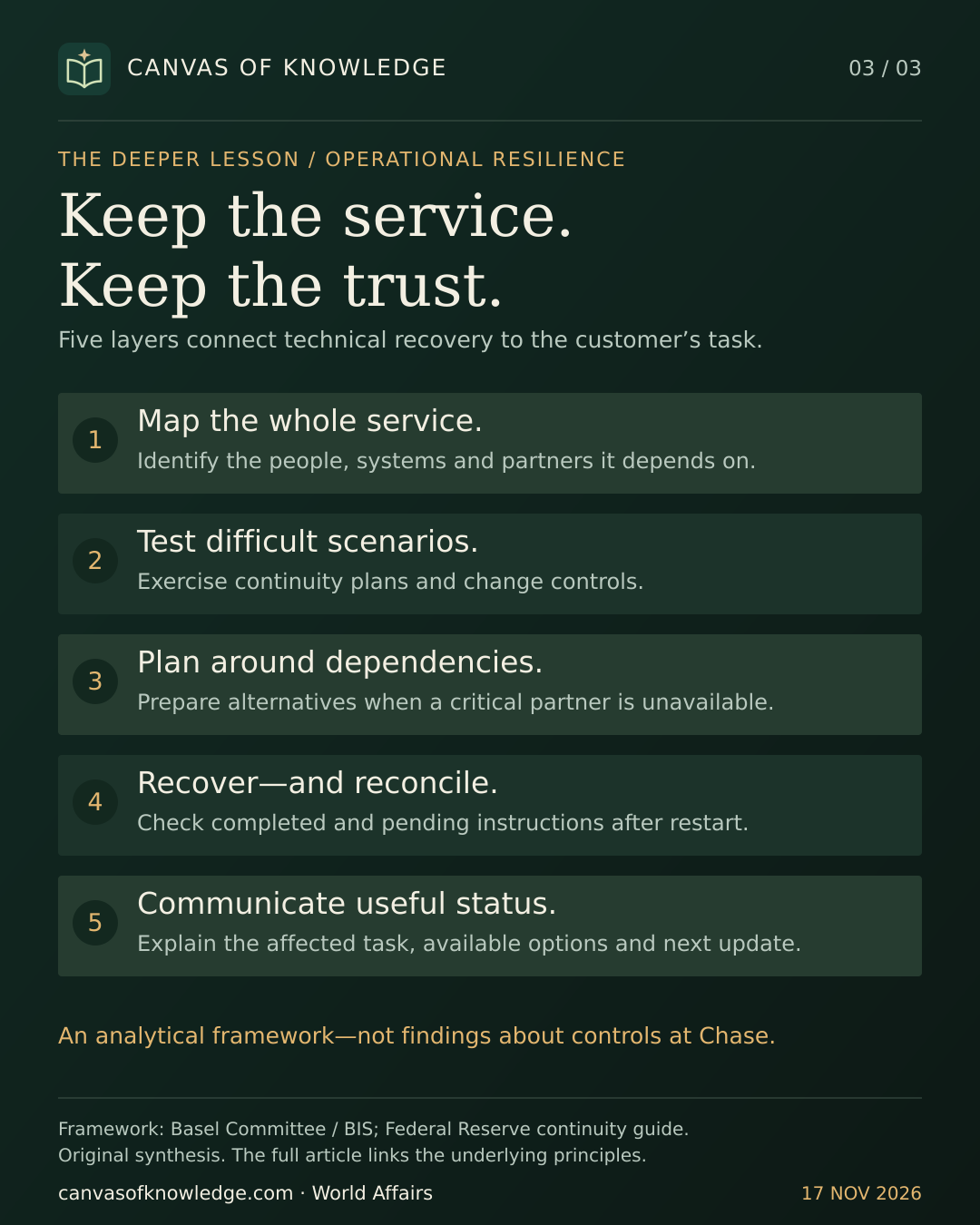
Your bank can be working.
Your payment can still be waiting.
Zelle’s own explanation helps untangle the story. Customers use it through participating banks and credit unions; the network facilitates payment instructions between institutions. It does not hold a separate balance of customer money. A network can therefore be available while a participant has trouble completing its part of a payment. [5]
Think of the transaction as a set of coordinated responsibilities: the sender’s institution accepts an instruction; systems communicate; the recipient’s institution handles the incoming payment and updates the customer. A delay at one participant can become visible to people dealing with another. This is a simplified mechanism, not a claim about the exact software component that failed.
Posting, messaging and settlement are different jobs.
The interface tells a customer what appears to have happened. Interbank messaging communicates instructions. Settlement changes obligations or balances between institutions. These steps need not be visible in the same way or at the same instant.
Fedwire provides a useful comparison: the Federal Reserve describes checks on an incoming message, movements between participants’ reserve accounts, and acknowledgements to the parties. Processed payments are final and irrevocable. That is background on one payment system; the cited coverage does not establish a Fedwire outage or show that every delayed retail payment used Fedwire. [7]
Why an outage chart cannot count the damage.
Downdetector compares submitted reports with a service’s typical reporting levels and limits how repeated submissions affect public totals. That makes it useful for spotting unusual symptoms. It does not turn the chart into a census of affected accounts, a measure of missing money, or proof of a common technical cause. [4]
Our inference: adding together complaints about a sender’s bank, a recipient’s bank and a payment service could describe overlapping experiences. Without transaction-level evidence, a combined total would give a misleading impression of precision.
Reliability is a promise
made across a chain.
Our analysis is that the useful question extends beyond whether an app is reachable. Can a customer complete a critical task, understand a delay and verify the eventual result? A functioning front end offers limited reassurance when a required participant cannot finish its work.
The Basel Committee’s resilience principles start from the assumption that disruption will occur. Banks are expected to identify critical operations, map dependencies, test continuity arrangements and improve response after incidents. These are general supervisory principles; they are not a finding that Chase breached a rule. [6]
The Financial Stability Institute explains disruption tolerance as a boundary for the impact an institution is prepared to accept under severe but plausible scenarios. The practical challenge is to test the complete service—including people, processes and external dependencies—rather than treating each component’s availability as the final result. [10]
The Federal Reserve’s continuity guide provides a concrete example of recovery practice: backup facilities, regular contingency testing and reconciliation procedures. Reconciliation matters because a restarted service still has to establish which instructions completed and which require attention. [7]
- ScopeWhich services and transactions were delayed, and for how long?
- ContainmentWhich dependency carried the effect beyond the originating institution?
- RecoveryWhen did normal processing resume, and when were pending items reconciled?
- PreventionWhat changes will reduce recurrence, and how will their effectiveness be tested?
These are our analytical questions. They should not be read as allegations about controls that failed.
Verify the channel.
Then verify the transaction.
A generic error message does not explain the fate of a particular payment. Check its status through your bank’s official channels before deciding what to do next. Keep the transaction reference, time and any error message so the bank can investigate the specific instruction.
Be cautious about unsolicited offers to “restore access” or “protect your money.” The FTC advises contacting the institution through its official app, website or the number on a card or statement. Keep verification codes private and do not give an unexpected caller remote access to your device. [8]
Original analysis.
Traceable evidence.
We began with the linked Gulf News report, checked later reporting, and added primary documentation on payment networks, settlement, resilience and consumer protection. No article text or news photograph has been reproduced.
Incident statements remain attributed. Conceptual diagrams and our analysis are identified. The information is a snapshot reviewed on 17 November 2026; it is not a real-time outage tracker.
- Reuters · JPMorgan says software bug slows its transactions 16 November 2026
Bank statement, stated cause and scope; reporting, not a technical post-incident audit.
- NBC News · Chase says transactions back to normal 16–17 November 2026
Later recovery statement and responses from participating institutions.
- CBS MoneyWatch · Bank service disruption reporting 16 November 2026; updated 8:09 p.m. EST
Customer reports and the Bank of America response.
- Downdetector · How its reporting methodology works Checked 17 November 2026
Primary methodology; report volumes and normal baselines, not affected-account totals.
- Zelle · What the network does 17 August 2026
Primary description of bank-to-bank instructions and where funds are held.
- Basel Committee / BIS · Operational resilience Consolidated chapter published 1 January 2026
Primary supervisory principles; general context, not findings about this incident.
- Federal Reserve Financial Services · Fedwire continuity guide Checked 17 November 2026
Primary explanation of settlement, backup arrangements and reconciliation practice.
- FTC · Verify unexpected warnings about your money January 2026
Primary consumer guidance on bank impersonation and trusted contact channels.
- Gulf News · Initial report that prompted this feature 16 November 2026; updated 23:11
Starting coverage. This feature uses independent reporting, primary references and original analysis.
- BIS / Financial Stability Institute · Operational resilience summary 29 September 2022
Background on disruption tolerance, dependency mapping and continuity exercises.