
Intelligence,
on your desk.
AMD Ryzen AI Halo. NVIDIA DGX Spark.
Two compact approaches to running large AI models locally.

A large model no longer always requires a remote server. These desktop systems place substantial memory beside capable processors, so developers can experiment with inference, tools and selected fine-tuning workflows locally. Their similar footprint hides meaningful differences in architecture and software.
A small footprint.
A substantial difference inside.
Explore the reference systems, then compare the complete specifications below. Manufacturer figures describe the hardware; they are not our benchmark results.
 Tap to enlarge ↗
Same capacity, different paths
Both reference systems specify 128 GB of unified memory. That means a shared system resource, not a separate 128 GB allocation for every processor. AMD’s graphics-memory settings and the chosen runtime affect how that capacity can be used. [2] [4]
Capacity is not a speed score
Memory bandwidth describes a transfer rate; compute throughput describes arithmetic. A real workload may wait on either, or on software, storage and synchronisation. A faster headline number alone cannot predict the complete experience.
200 billion parameters.
Read the memory budget.
AMD and NVIDIA advertise support for models up to 200B parameters on these 128 GB configurations. AMD separately advertises up to 300B on its 192 GB Halo. These are vendor capacity claims, not promises of equal speed, accuracy or compatibility for every model. [1] [3]
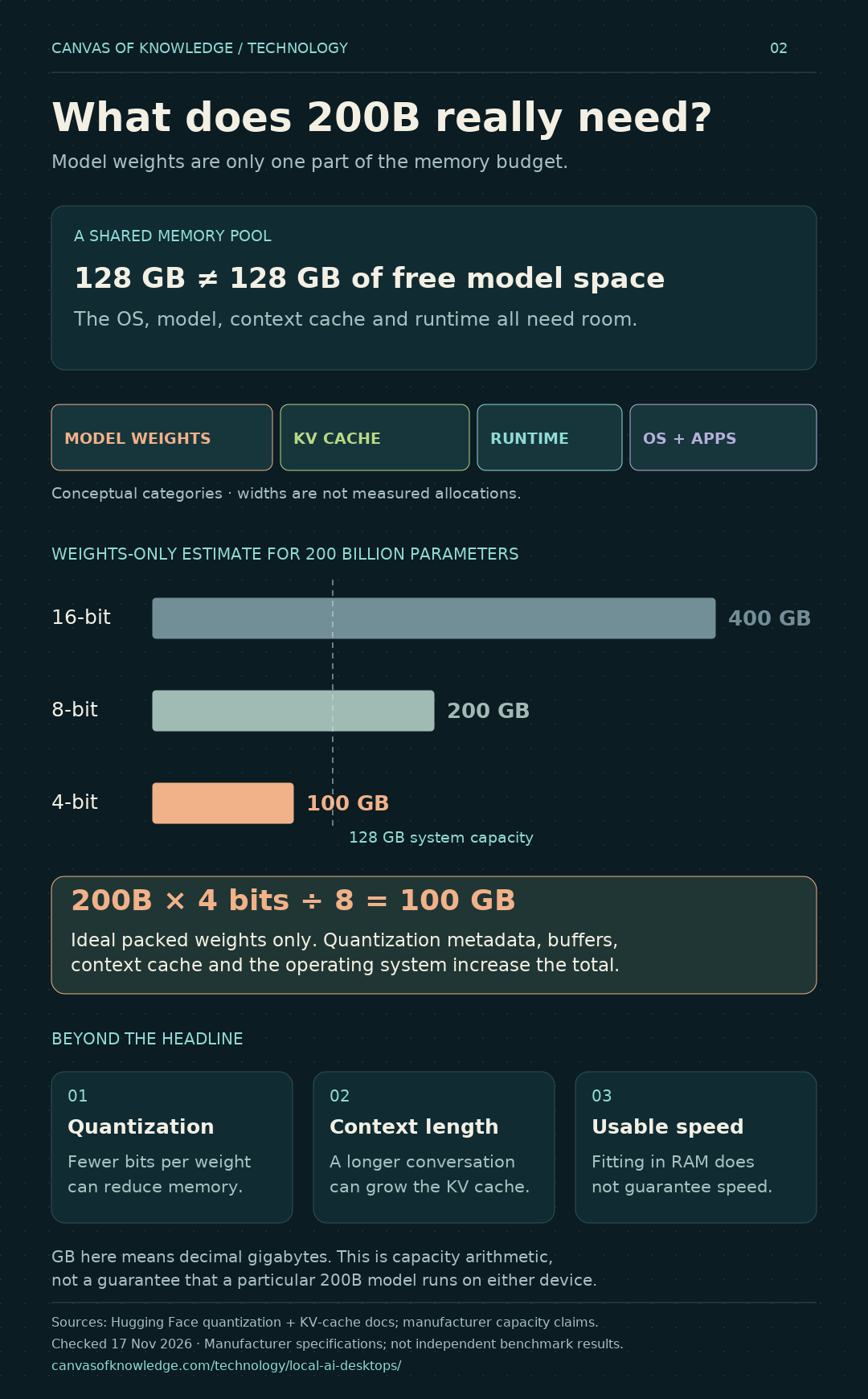 Tap to enlarge ↗
Why fewer bits help
A parameter is a learned numerical value. Quantization represents values with fewer bits, reducing the space required for weights. Its effects on quality and speed depend on the method, model and supported kernels. [5]
Our simplified calculation is parameters × bits per weight ÷ 8. For 200 billion parameters, ideal 4-bit storage is 100 decimal GB, compared with 400 GB at 16 bits. Real formats also store scales and other metadata.
The rest of the system still needs memory
The key-value cache retains information used when generating subsequent tokens. It can grow with context, subject to model-specific attention limits. Buffers, activations, applications and the operating system also consume memory. [6]
Inference uses an existing model. Fine-tuning changes selected or all weights and brings additional memory requirements. A model-size inference claim is not a claim that the same model can be fully trained on the device.
How much room do the weights take?
This estimates packed weights only, using decimal GB. It does not estimate speed or certify that a model will run.
Three kinds of numbers.
Different kinds of work.
The Halo’s NPU TOPS, its GPU FP16 TFLOPS and Spark’s FP4 tensor claim describe different engines and numerical conditions. Treating them as one league table would be misleading. [1] [4]
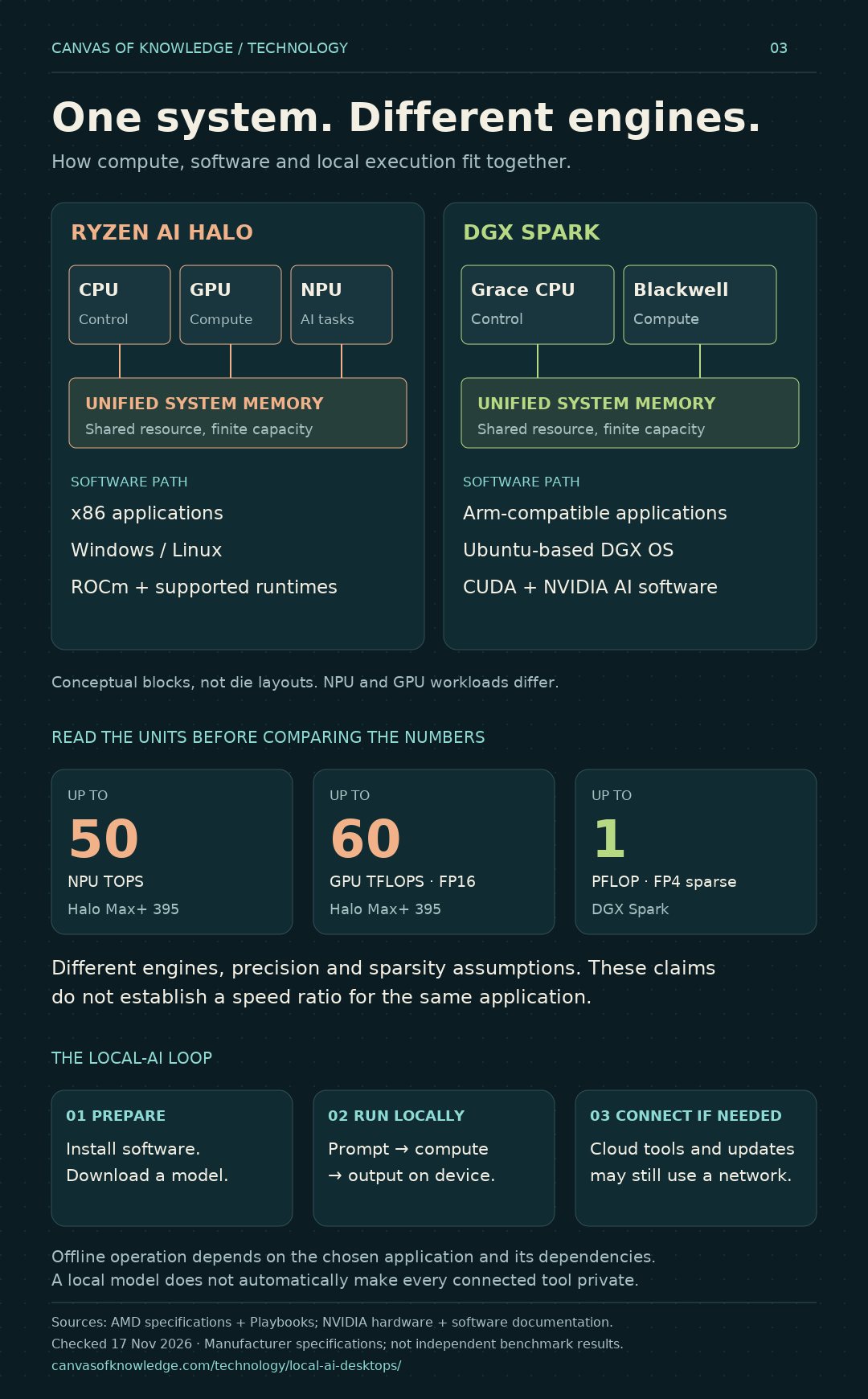 Tap to enlarge ↗
Choose software that fits the processor
Halo provides an x86 platform with Windows and Linux options and AMD’s supported ROCm ecosystem. AMD’s Playbooks cover tools such as local LLM servers and image-generation workflows; support varies by device, operating system and application. [1] [7]
Spark combines an Arm CPU with NVIDIA’s GPU ecosystem. Its Ubuntu-based DGX OS, CUDA tools and containers support AI development. Check Arm-compatible dependencies when moving an existing x86 project. [8] [9]
Local can mean offline—with preparation
Once the model and required software are installed, a suitable application can perform inference without a cloud model endpoint. Downloading models, installing updates, retrieving live information or calling remote tools still requires connectivity. AMD’s local Playbooks also allow optional cloud integrations. [7]
As a practical implication, local execution can keep prompts and documents on the machine, but only if the full application is configured that way. A local model connected to a remote service is still a connected workflow.
Memory decides what can fit. Architecture and software shape what runs well. Your workload decides what matters.
Three configurations.
Every detail in context.
Manufacturer-listed specifications checked 17 November 2026. Model-capacity and compute claims depend on precision, workload and software.
Halo · 128 GB
- Processor
- Ryzen AI Max+ 395
- CPU
- 16 Zen 5 cores / 32 threads
- GPU
- Radeon 8060S · 40 compute units
- Unified memory
- 128 GB LPDDR5x
- Memory bandwidth
- 256 GB/s
- NPU / tensor claim
- Up to 50 NPU TOPS
- GPU FP16 claim
- Up to 60 TFLOPS
- Storage
- 2 TB M.2 SSD
- Chip TDP
- 120 W
- Dimensions · L × W × H
- 150 × 150 × 45.4 mm
- Networking
- 10 GbE · Wi-Fi 7 · Bluetooth 5.4
- Connections
- 3 USB-C + USB-C power · HDMI 2.1b
- Operating systems
- Windows 11 / Linux
Halo · 192 GB
- Processor
- Ryzen AI Max+ PRO 495
- CPU
- 16 Zen 5 cores / 32 threads
- GPU
- Radeon 8065S · 40 compute units
- Unified memory
- 192 GB LPDDR5x
- Memory bandwidth
- 273 GB/s
- NPU / tensor claim
- Up to 55 NPU TOPS
- GPU FP16 claim
- Up to 61 TFLOPS
- Storage
- 2 TB M.2 SSD
- Chip TDP
- 120 W
- Dimensions · L × W × H
- 150 × 150 × 45.4 mm
- Networking
- 10 GbE · Wi-Fi 7 · Bluetooth 5.4
- Connections
- 3 USB-C + USB-C power · HDMI 2.1b
- Operating systems
- Windows 11 / Linux
DGX Spark · 128 GB
- Processor
- GB10 Grace Blackwell
- CPU
- 20 Arm cores: 10 Cortex-X925 + 10 Cortex-A725
- GPU
- Blackwell · 5th-generation Tensor Cores
- Unified memory
- 128 GB LPDDR5x
- Memory bandwidth
- 273 GB/s
- NPU / tensor claim
- Up to 1 PFLOP FP4, with sparsity
- GPU FP16 claim
- Not compared on this page
- Storage
- Up to 4 TB NVMe M.2
- Chip TDP
- 140 W · 240 W system power supply
- Dimensions · L × W × H
- 150 × 150 × 50.5 mm
- Networking
- 10 GbE · Wi-Fi 7 · Bluetooth 5.4 · ConnectX-7
- Connections
- 4 USB-C including power · HDMI 2.1a · 2 QSFP network ports
- Operating systems
- Ubuntu-based DGX OS
CUs are GPU compute units; an NPU is a neural processing unit. TOPS and FLOPS are peak arithmetic rates, not tokens per second. Chip TDP is a thermal design specification; a power-supply rating is its capacity, not a measurement of everyday electricity use. No price or purchasing recommendation is implied.
Sources & methodology
This is an original editorial explanation based on primary documentation. Product images are supplied by AMD and NVIDIA; architecture diagrams are conceptual. The memory chart and calculator use stated arithmetic, not measured benchmarks. Product names identify the systems and do not imply endorsement.
- AMD · Ryzen AI Halo ↗
Processor configurations, advertised compute and model-capacity claims.
- AMD · Halo User Guide ↗
RAH-001 / RAH-002 specifications and graphics-memory allocation.
- NVIDIA · DGX Spark ↗
128 GB model-capacity claims and product configurations.
- NVIDIA · Hardware Overview ↗
GB10 architecture, memory, power, dimensions and connectivity.
- Hugging Face · Quantization concepts ↗
Why lower-precision weights can reduce memory requirements.
- Hugging Face · Cache strategies ↗
KV-cache growth and memory / performance trade-offs.
- AMD · AI Playbooks ↗
Local workflows, supported tools and operating systems.
- NVIDIA · DGX Spark software ↗
CUDA, containers, development tools and system software.
- NVIDIA · Spark software requirements ↗
Ubuntu-based software environment and operating modes.