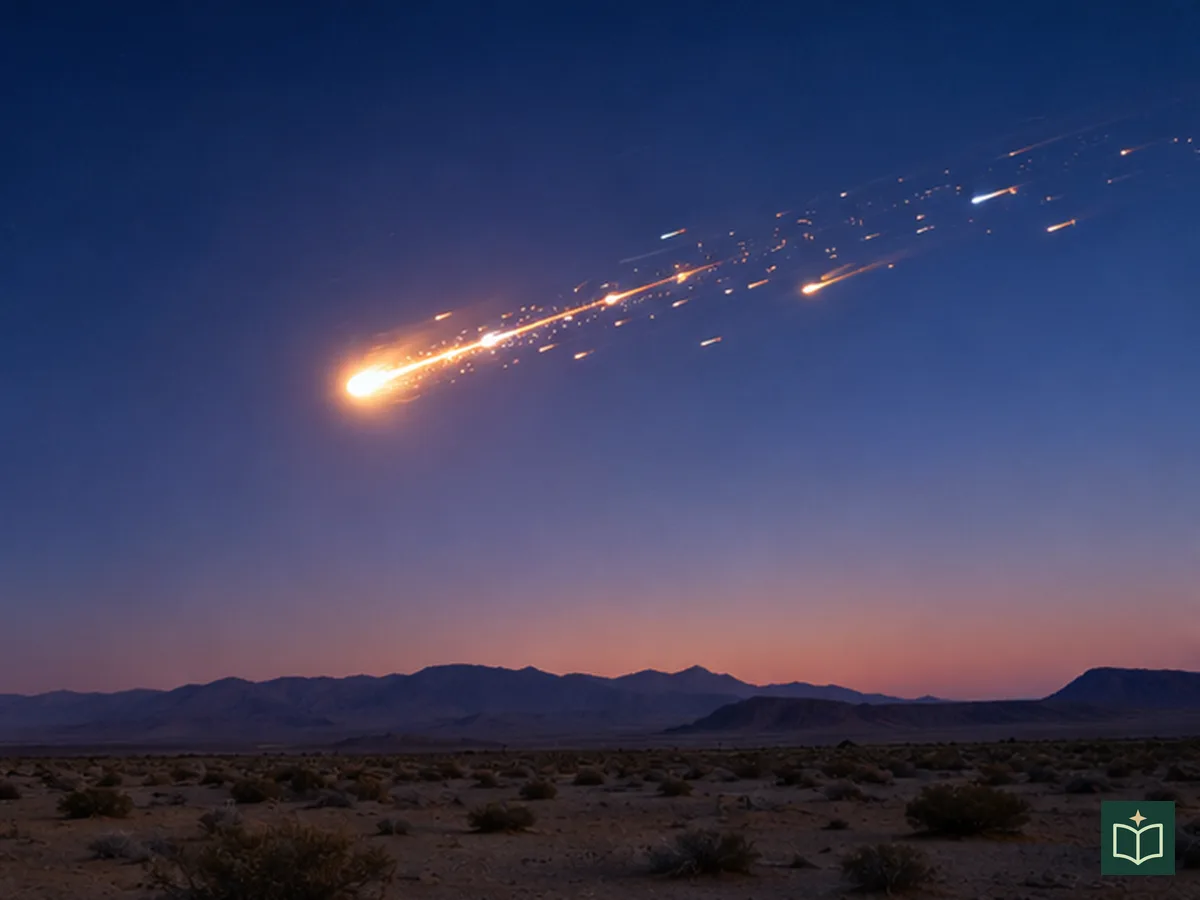
Why things fall back
Objects in low Earth orbit are not in a perfect vacuum. A thin trace of atmosphere still reaches hundreds of kilometres up, and each pass through it creates a little drag. Over months or years this lowers the orbit, and as the object descends into denser air, drag grows and the descent accelerates. Eventually it re-enters the atmosphere. Many satellites and spent rocket stages are steered into a controlled re-entry, using their engines to aim at remote ocean, often a region of the South Pacific far from land. An uncontrolled re-entry happens when an object has no working propulsion, or was never designed to deorbit itself, so its fall is left to physics.
Why the window is so wide
Predicting exactly when an object will re-enter is difficult. The density of the upper atmosphere changes with solar activity, which can heat and expand it, and the object's orientation as it tumbles alters the drag. A common rule of thumb is that forecasts carry an uncertainty of around 10 to 20% of the time remaining. A week out, that means a day or more either way. Because the object circles the Earth roughly every 90 minutes at about 7.8 kilometres a second, even a one-minute error moves the impact point by around 470 kilometres. A window of a few hours spans several orbits and much of the globe.
Who does the tracking
Military and civilian networks track larger objects with radar and telescopes and publish predictions that are refined as the final day approaches. The US Space Force's tracking network, the European Space Agency's Space Debris Office and other national centres all issue forecasts, and independent bodies such as the Aerospace Corporation publish their own. As re-entry nears, windows shrink from days to hours and then to minutes. Even so, the final location is often confirmed only afterwards, from sightings of fireballs, sensor data or recovered debris. Forecast maps showing a long band across several continents describe where the object might fall, not where it is expected to.
What survives the fall
Most material burns up. Re-entry speeds generate intense heat, and objects break apart at altitudes of roughly 70 to 80 kilometres. Light structures melt, while dense, heat-resistant parts such as titanium tanks or steel engine components can reach the ground. Estimates suggest that, for a large object, something like 10 to 40% of the mass may survive, scattered along a footprint hundreds of kilometres long. Famous cases include the US Skylab space station, which fell partly over Western Australia in 1979, and China's Tiangong-1, which came down over the South Pacific in 2018. Large Long March 5B core stages have also re-entered uncontrolled in recent years.
How small the risk is
Most of Earth's surface is ocean or sparsely populated land, so the odds of debris hitting anyone are low. No death from re-entering space debris has been confirmed. Agencies assess risk by casualty expectation, the chance that anyone at all is harmed by a given re-entry. A widely used standard, applied by NASA and others, is that an uncontrolled re-entry should carry no more than about a 1 in 10,000 chance of injuring anyone. The chance that a particular individual is struck is far smaller, many trillions to one. Larger objects that exceed the standard are expected to be brought down in a controlled way.
Reading the alerts
When a headline warns that a rocket stage is falling to Earth, look for the source of the forecast, the time window and how it is changing. A window of several days means the location is still essentially unknown; a window of minutes means the track is becoming clear. Do not read a band on a map as a target. If debris does land and is found, do not touch it: some fragments may carry residual fuel or sharp edges, so report them to local authorities. The growing number of satellites means re-entries will be more frequent, which is why agencies are tightening rules on disposing of spacecraft at the end of their lives.
Sources & further reading
- European Space Agency · Space debris ↗
- NASA Orbital Debris Program Office ↗
- The Aerospace Corporation · Reentries ↗
Figures are rounded and widely published; check the linked organisations for the latest editions. These organisations do not endorse this website.