What the claim says
A claim of quantum advantage, sometimes called quantum supremacy, means that a quantum computer has completed a specific calculation that no classical computer could match in a practical amount of time. The physicist John Preskill coined the term supremacy in 2012 to describe that threshold. The key word is specific. The tasks used in these demonstrations are chosen because they suit quantum hardware and are believed to be extremely hard for ordinary computers to simulate. They are not chosen because anyone needs the answer. An advantage claim is therefore a scientific milestone showing that quantum machines can do something beyond classical reach, not a sign that they are ready for everyday work.
The 2019 milestone
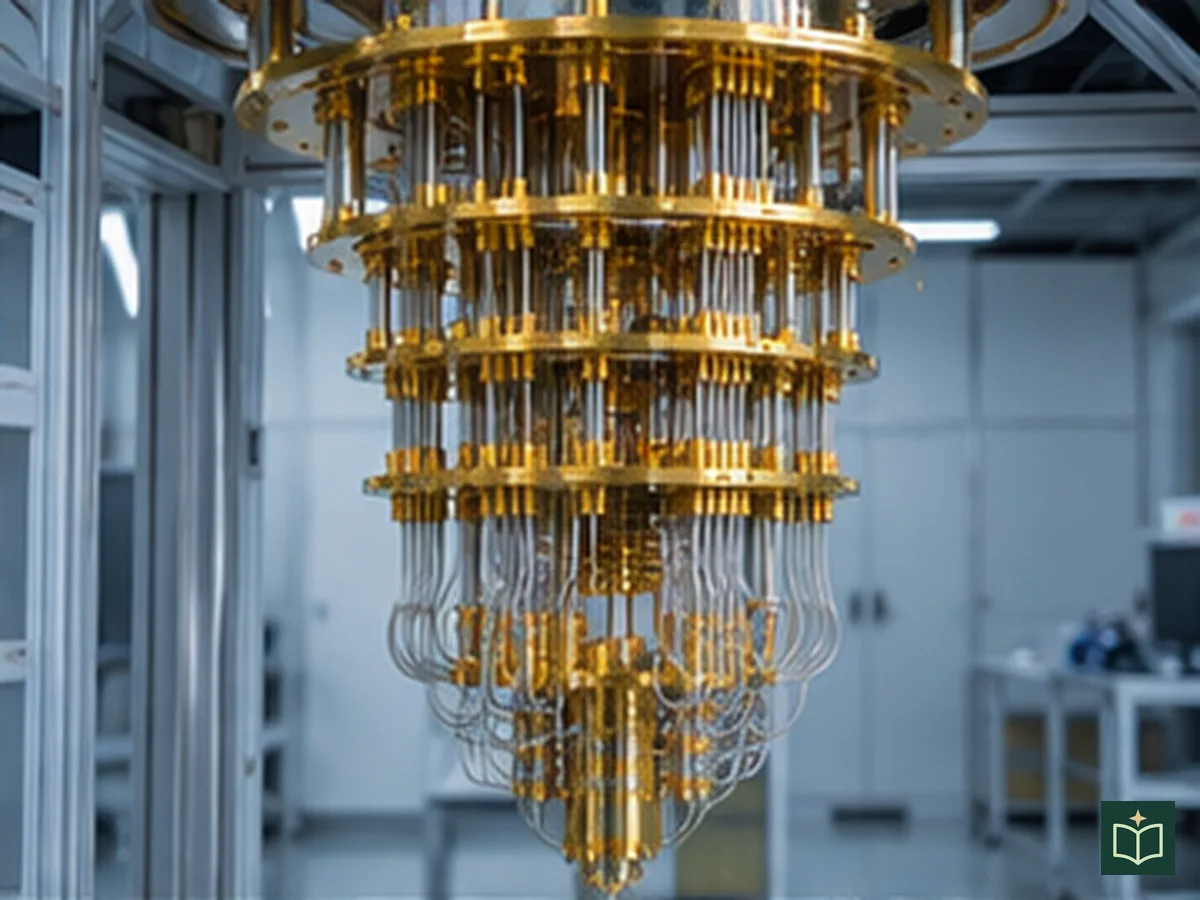
The best-known claim came from Google in 2019. Its Sycamore processor, with 53 working qubits, ran a task called random circuit sampling: applying a random sequence of operations to the qubits and recording the output many times. Google reported that the chip finished in about 200 seconds and estimated that a leading supercomputer would need around 10,000 years. IBM quickly argued that, with better use of disk storage, a supercomputer could do it in days. In later years, other researchers used improved classical algorithms to simulate the task far faster than Google had estimated, narrowing the gap considerably, though quantum hardware has also grown in the meantime.
Other demonstrations
Other groups have made similar claims with different technology. In 2020, a team at the University of Science and Technology of China reported quantum advantage with Jiuzhang, a device that uses particles of light rather than superconducting circuits, on a task called boson sampling. Later experiments by several companies and laboratories have pushed the size and complexity of such demonstrations further. A pattern has emerged: a quantum team announces an advantage, classical researchers find cleverer simulation methods, and the boundary shifts. This contest is healthy science, but it means any single claim should be read as provisional until it has been tested by sceptical experts.
Why noise is the obstacle
Today's quantum computers are noisy. Qubits are fragile and lose their delicate quantum states, a process called decoherence, after tiny fractions of a second. Every operation introduces small errors that accumulate quickly. The demonstrations so far tolerate this because the tasks are short and the results are judged statistically. Useful calculations, such as simulating complex molecules or breaking widely used encryption, require long sequences of operations with very few errors. The solution is quantum error correction, which combines many physical qubits into a more reliable logical qubit. In late 2024, Google reported that adding qubits to its Willow chip reduced errors, an important step, but large-scale error correction remains ahead.
Useful advantage
Researchers increasingly distinguish between a demonstration of advantage and a useful advantage, meaning a quantum computer solving a problem that matters, more cheaply or quickly than any classical alternative. Promising areas include chemistry and materials science, where quantum effects are hard to model, and certain optimisation problems. Breaking today's public-key encryption with Shor's algorithm would require machines with very large numbers of high-quality qubits, far beyond current devices, though governments are already moving to new post-quantum encryption standards as a precaution. Claims of practical advantage are harder to judge than speed records, because classical methods for real problems are mature and continually improving.
Reading the headline
When a company announces a quantum breakthrough, ask what task was performed and whether anyone needs its answer. Check how the classical comparison was made and whether independent experts accept it. Look at the number of qubits, but also at their error rates, which matter more than the raw count. Distinguish physical qubits from error-corrected logical ones. Note whether the result is peer reviewed or only described in a press release. Quantum computing is advancing quickly and the long-term promise is real, but most announcements describe progress along a long road rather than its destination. Hype tends to run several years ahead of the hardware.
Sources & further reading
Figures are rounded and widely published; check the linked organisations for the latest editions. These organisations do not endorse this website.