What Moore actually said
In 1965 Gordon Moore, an engineer who later co-founded a major chipmaker, wrote a short magazine article about the future of integrated circuits. He observed that the number of components that could be placed economically on a chip had been doubling about every year, and he projected the trend would continue for at least a decade. In 1975 he revised the rate to roughly every two years. The observation was about economics as much as physics: it concerned the number of components at the lowest cost per component. It was not a statement about clock speed, and it was never a law in the scientific sense.
A self-fulfilling roadmap
Moore's prediction became a planning tool. Chip designers, equipment makers and material suppliers coordinated around it, with industry roadmaps setting targets for each new generation. Because everyone expected the doubling, companies invested to deliver it, and customers planned software that would need it. The result was remarkable consistency over decades. A single chip in the early 1970s held a few thousand transistors; today's largest processors hold tens of billions. That growth, roughly a millionfold over fifty years, is what turned room-sized computers into phones and made today's internet services, digital photography and artificial intelligence affordable. Few industrial forecasts have held so well.
How shrinking worked
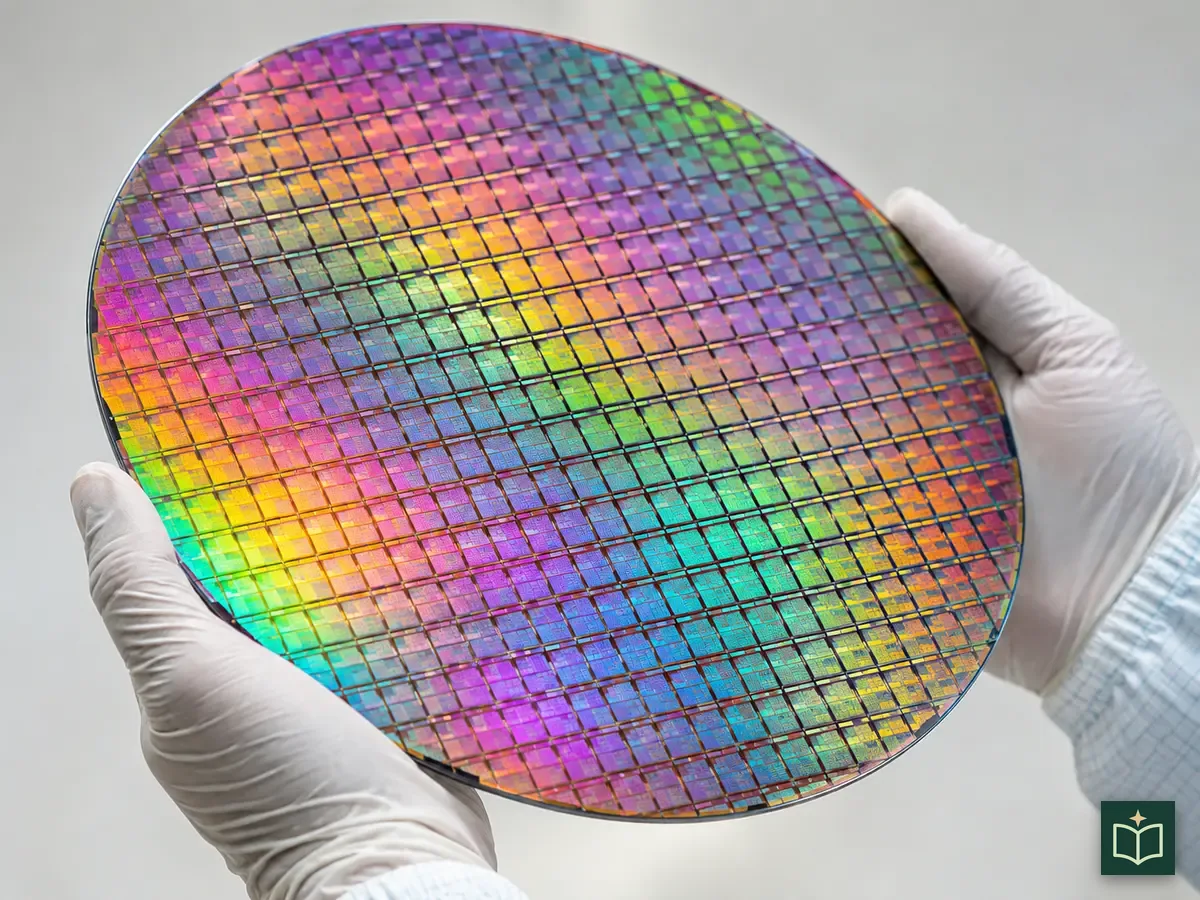
For much of the period, progress came from making transistors smaller using ever finer lithography, the process of printing circuit patterns onto silicon with light. Smaller transistors were not only more numerous but, for a time, also faster and less power-hungry, a happy coincidence engineers called Dennard scaling. That bonus faded around the mid-2000s, when leakage currents and heat stopped clock speeds rising. Shrinking continued, but each step required more complex tools, including extreme ultraviolet light, and three-dimensional transistor shapes that wrap the gate around the channel to keep control of current at tiny dimensions. Those tools are among the most complex machines ever built.
Names no longer measure size
Chip generations are labelled with names such as '5 nanometre' or '3 nanometre'. These once referred to a physical feature, but today they are largely marketing labels for successive generations rather than the size of any particular part of the transistor. This causes understandable confusion. A useful way to compare is transistor density, the number of transistors per square millimetre, though even that varies by the type of circuit. Atoms of silicon are about a fifth of a nanometre apart, so there are physical limits ahead, but engineers have repeatedly found routes around predicted dead ends. Predictions of the end have often proved premature.
Beyond simple shrinking
Progress now comes from several directions at once. Memory chips stack hundreds of layers vertically. Processors are increasingly assembled from several smaller 'chiplets' joined inside one package, which improves manufacturing yields and lets different parts be made on the most suitable process. Designers add specialised blocks for graphics, AI or video so that common tasks use less energy. Advanced packaging places memory right beside the processor. Some describe this as the end of Moore's law; others see it as the law continuing by other means. Either way, the steady, simple doubling of the past has become harder, slower and much more expensive.
Why it matters
Moore's law shaped expectations far beyond engineering. Consumers came to expect a better phone every year at similar prices, and software makers assumed tomorrow's hardware would absorb today's inefficiencies. As cost per transistor stops falling so quickly, that assumption weakens, and efficient software and specialised hardware matter more. The cost of cutting-edge chip factories, many billions of dollars each, has concentrated advanced manufacturing among very few companies and places, turning chips into a question of economic strategy for governments worldwide, including in the Gulf. The history of Moore's law is ultimately a story of coordination, investment and persistent engineering. It remains a useful lens.
Sources & further reading
Figures are rounded and widely published; check the linked organisations for the latest editions. These organisations do not endorse this website.