What is inside a grain
A wheat kernel has three main parts. The endosperm, about four-fifths of its weight, is a store of starch and protein and is the source of white flour. The bran is the layered outer skin, rich in fibre and minerals. The germ is the tiny embryo that would sprout into a new plant, and it contains oils, vitamins and protein. White flour is made almost entirely from endosperm, while wholemeal flour puts all three parts back together. The miller's job is therefore one of separation. The difficulty is that the parts are tightly bonded, and grinding the whole grain at once would smear bran into the flour.
Cleaning and conditioning
Wheat arrives at the mill by ship, train or truck and is tested for moisture, protein and contamination. It then passes through a series of cleaning machines that remove stones, straw, metal, dust and other seeds using sieves, air currents, magnets and optical sorters. Next comes tempering. Water is added and the grain rests for several hours, often overnight, so the moisture can soak in. This toughens the bran, making it peel off in large flakes instead of shattering, and it softens the endosperm so it breaks more easily. Millers also blend wheat varieties at this stage, because different grains give flour with different strengths and baking qualities.
Rollers and sieves
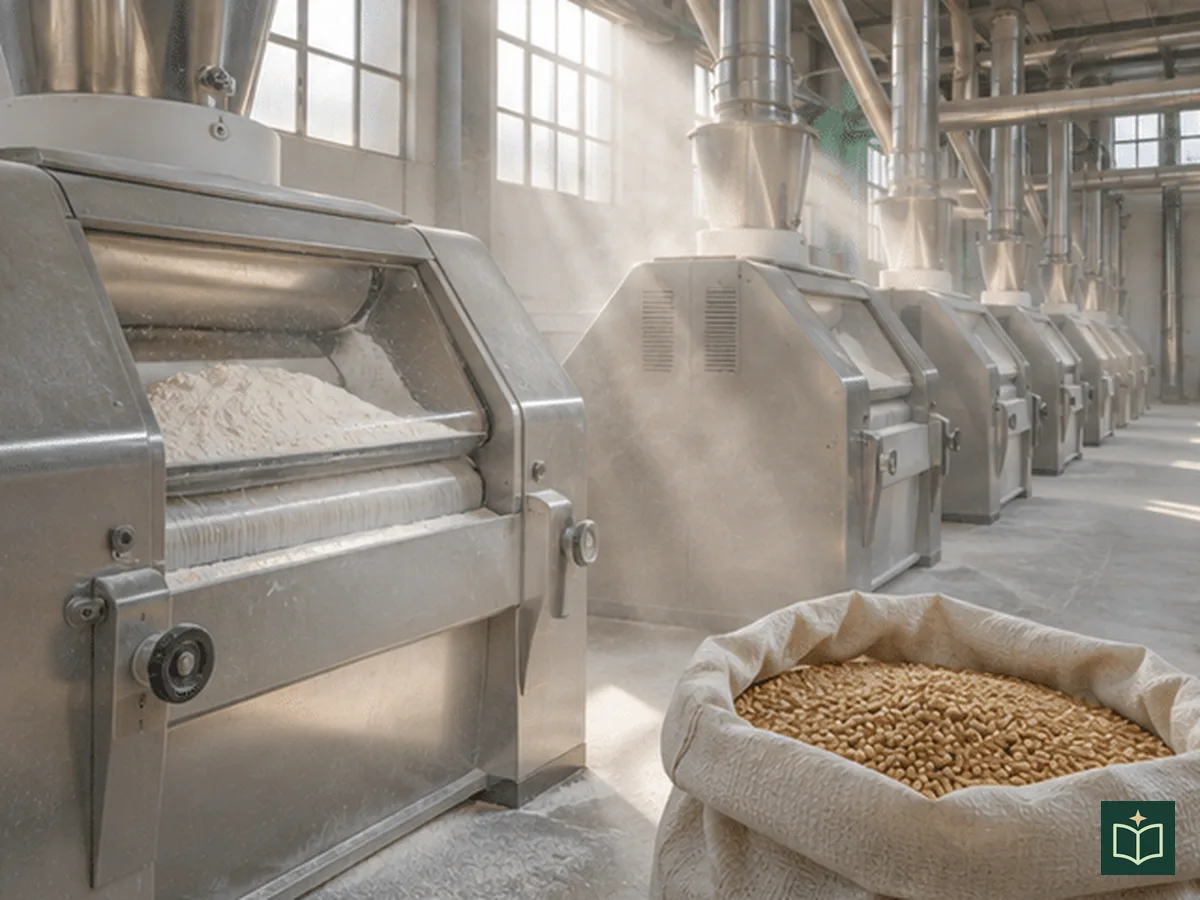
The heart of a modern mill is the roller mill. In the first break stage, pairs of corrugated steel rollers spinning at different speeds shear the grain open rather than crush it. The broken material goes to a plansifter, a large box of stacked sieves that shakes in a circular motion and sorts particles by size. Bran flakes go one way, coarse endosperm pieces another, and a little flour falls through. The process repeats through several break stages. Smooth reduction rollers then grind the clean endosperm pieces into fine flour, with more sifting after each pass. A single bag of white flour may have passed through dozens of these steps.
Numbers from the mill floor
Suppose a mill receives 1,000 kilograms of wheat at 11% moisture and wants to temper it to 16%. Because the dry matter stays the same, it must add about 1,000 × (16 − 11) ÷ (100 − 16), or roughly 60 litres of water. After milling, an extraction rate of about 75% means around 750 kilograms of white flour, with the remainder leaving as bran, germ and fine by-products that usually become animal feed. Large mills in the Gulf, which import most of their wheat, run around the clock and process hundreds of tonnes a day. The same approach scales from a small plant to the largest milling complexes in the world.
From millstones to rollers
For thousands of years, grain was ground between stones, first by hand, then by animals, water and wind. Stone milling crushed the whole kernel, so white flour required laborious sifting through cloth and was a luxury. In the nineteenth century, mills in Hungary and later the United States adopted porcelain and then steel roller mills combined with mechanical sieving. This gradual reduction method produced whiter flour cheaply and in huge volumes, reshaping bread around the world. It also had a cost: removing the bran and germ took away fibre, vitamins and minerals. That is why many countries now require or encourage fortifying white flour with iron, folic acid and B vitamins.
Myths and what to watch
Stone-ground flour is sometimes assumed to be more nutritious simply because of the method. In fact, nutrition depends mostly on how much of the grain stays in the flour, not on the type of mill. A roller mill can make excellent wholemeal flour, and stone-ground flour can be sifted white. Another misconception is that all flour is the same apart from colour. Protein content, which depends on the wheat variety, decides whether flour suits crusty bread, cakes or flatbreads. For import-dependent countries, flour mills are also strategic assets. Gulf governments treat milling capacity and wheat storage as part of national food security planning.
Sources & further reading
Figures are rounded and widely published; check the linked organisations for the latest editions. These organisations do not endorse this website.