What the Assembly is
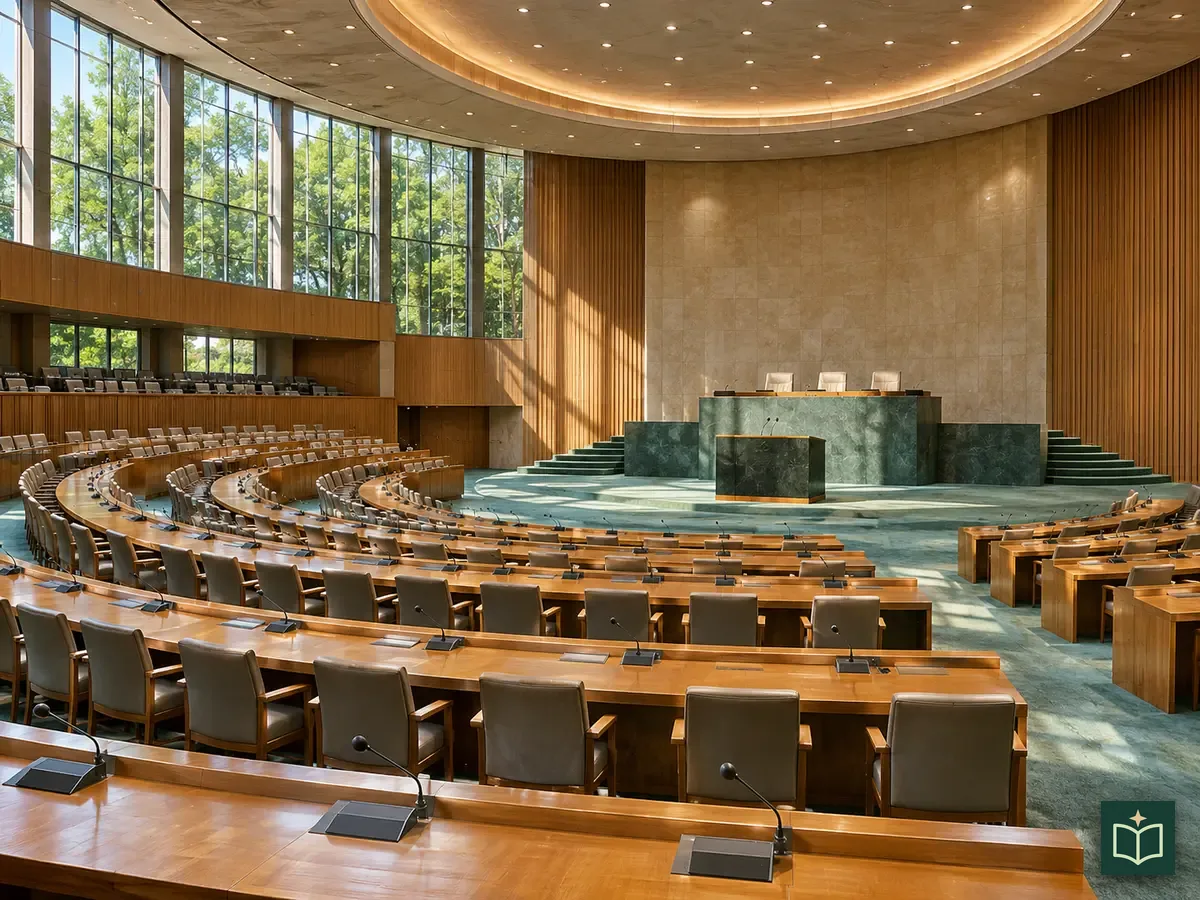
The General Assembly is the main deliberative body of the United Nations, created by the UN Charter in 1945. It is the only UN organ in which every member state is represented, and each has exactly one vote, whatever its population, wealth or military power. A country of a few hundred thousand people carries the same formal weight as one of more than a billion. The Assembly meets in New York, with its main annual session opening each September, when heads of state and government gather for the high-level General Debate. Much of the detailed work, however, happens later in six main committees covering issues such as disarmament, economics, human rights and law.
How a resolution passes
Most decisions need a simple majority of members present and voting. Matters the Charter calls important questions, including peace and security recommendations, admitting new members and budgetary questions, need a two-thirds majority. In practice, a large share of resolutions are adopted by consensus, meaning they pass without a formal vote because no delegation insists on one. Abstentions do not count as votes cast, so a resolution can pass with fewer than half of all members voting in favour. States also form negotiating groups, such as the Group of 77 developing countries or the regional groups, which coordinate positions so that drafts arrive with broad support already secured.
What it can actually decide
Assembly resolutions on world affairs are generally recommendations: they express the view of the international community but do not legally bind states. The Assembly does, however, have real decision-making power over the UN’s own machinery. It approves the organisation’s budget and sets how much each member pays. It elects the non-permanent members of the Security Council, the members of the Economic and Social Council and, together with the Security Council, the judges of the International Court of Justice. It also formally appoints the Secretary-General on the Council’s recommendation. Those internal powers explain why votes inside the Assembly can be fiercely contested even when the outcome is non-binding.
An example from the Gulf
The United Arab Emirates was admitted as a UN member in December 1971, days after the federation was formed, and its admission was approved by the General Assembly on the Security Council’s recommendation. Since then, the UAE has taken part in annual Assembly debates and competed in regional group elections, including its successful campaign for a non-permanent seat on the Security Council for 2022 and 2023. Elections like this show how the Assembly’s secret ballots work: candidates need two-thirds of the votes of members present and voting, and campaigns can run for years. Small and medium-sized states often use Assembly diplomacy to build influence well beyond their size.
Common misconceptions
A frequent assumption is that the Assembly is a world government. It is not: it has no army, no police and no power to tax citizens. Another is that its resolutions are meaningless. Although most are not binding, they can shape international norms over time, and some declarations, such as the Universal Declaration of Human Rights of 1948, became reference points for later binding treaties and national constitutions. A third misconception concerns voting patterns. Large majorities for a text do not always mean deep agreement, because states may vote in favour while explaining reservations, and some delegations prefer to abstain rather than oppose a text outright.
Why it matters
The Assembly matters because it is where legitimacy is measured. Governments watch voting records to understand alliances, test whether new ideas have support and signal positions to domestic and foreign audiences. It is also where reform debates take place, including long-running discussions about the size and composition of the Security Council. Researchers use Assembly votes as a dataset to track how countries align over decades. For readers following world news, a useful habit is to look past the headline result and examine the numbers in favour, against and abstaining, and which groups explained their votes, because that detail often reveals more about diplomacy than the outcome itself.
Sources & further reading
Figures are rounded and widely published; check the linked organisations for the latest editions. These organisations do not endorse this website.