How they form
Stars more than about eight times the Sun's mass end in a supernova. The core collapses; electrons and protons are squeezed into neutrons. If the remaining core is not too heavy, neutron pressure halts the collapse and a neutron star is born.
Neutron stars
Neutron stars spin rapidly, some hundreds of times a second, and many have intense magnetic fields. Those that sweep beams of radio waves past Earth are seen as pulsars.
Black holes
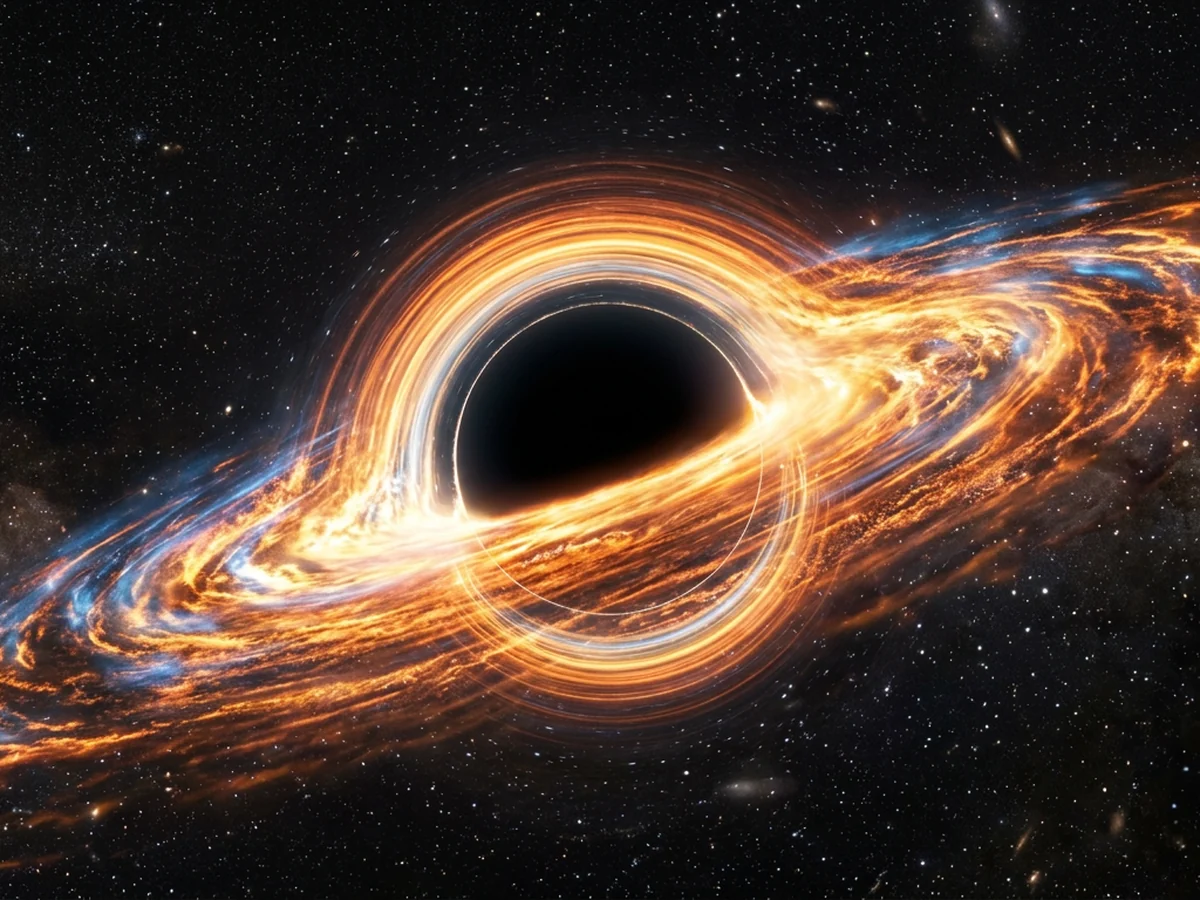
If the core is heavier than roughly two to three solar masses, gravity overwhelms all resistance and it collapses into a black hole. Its boundary, the event horizon, marks where escape becomes impossible.
Seeing the invisible
Black holes can be detected through their effect on nearby stars and gas, gravitational waves from mergers, and images such as the Event Horizon Telescope's 2019 picture of the black hole in galaxy M87.
Sources & further reading
Mass thresholds are approximate. Photograph: original AI-generated illustration (Adobe Firefly). Reference organisations do not endorse this website.